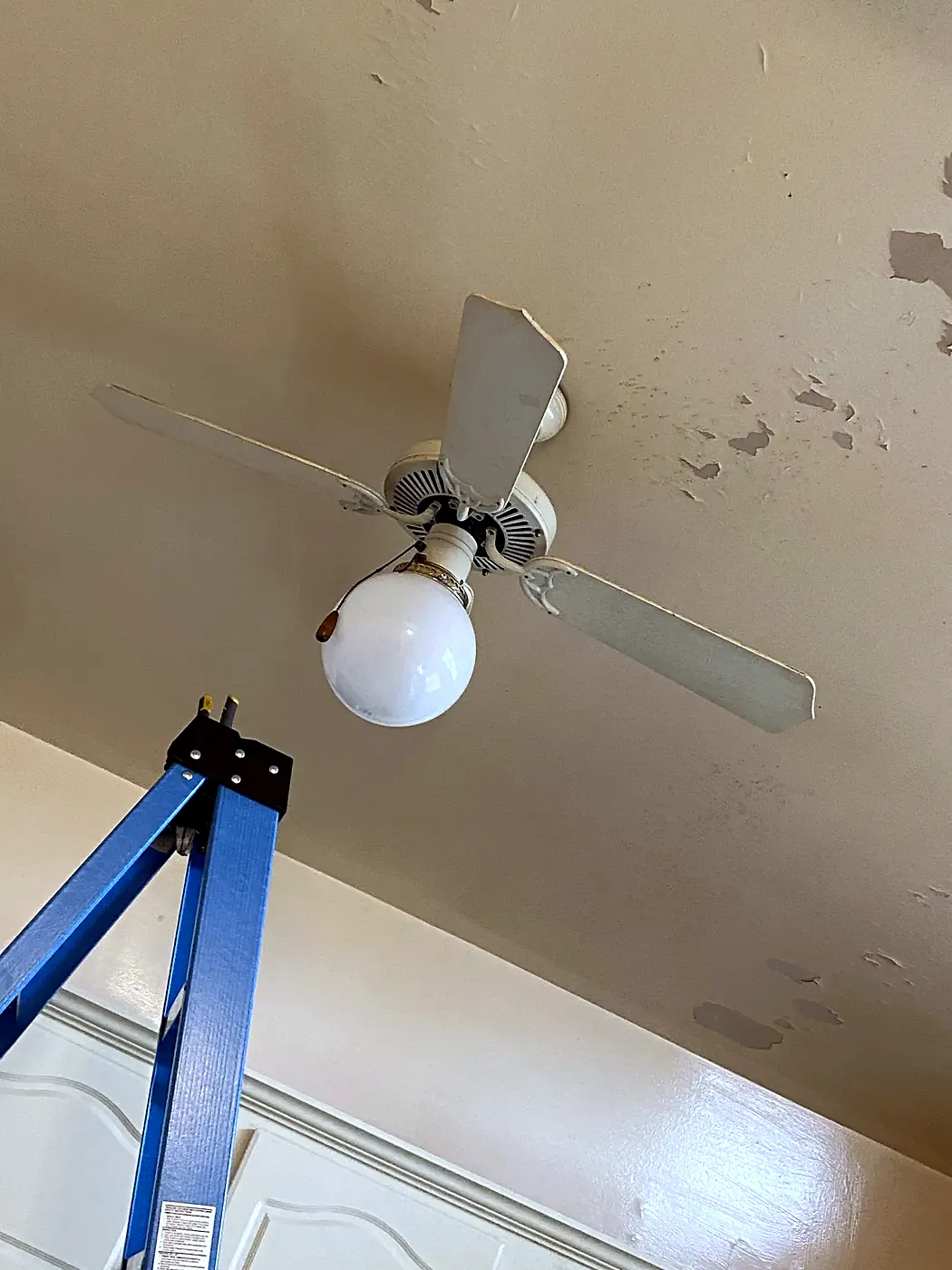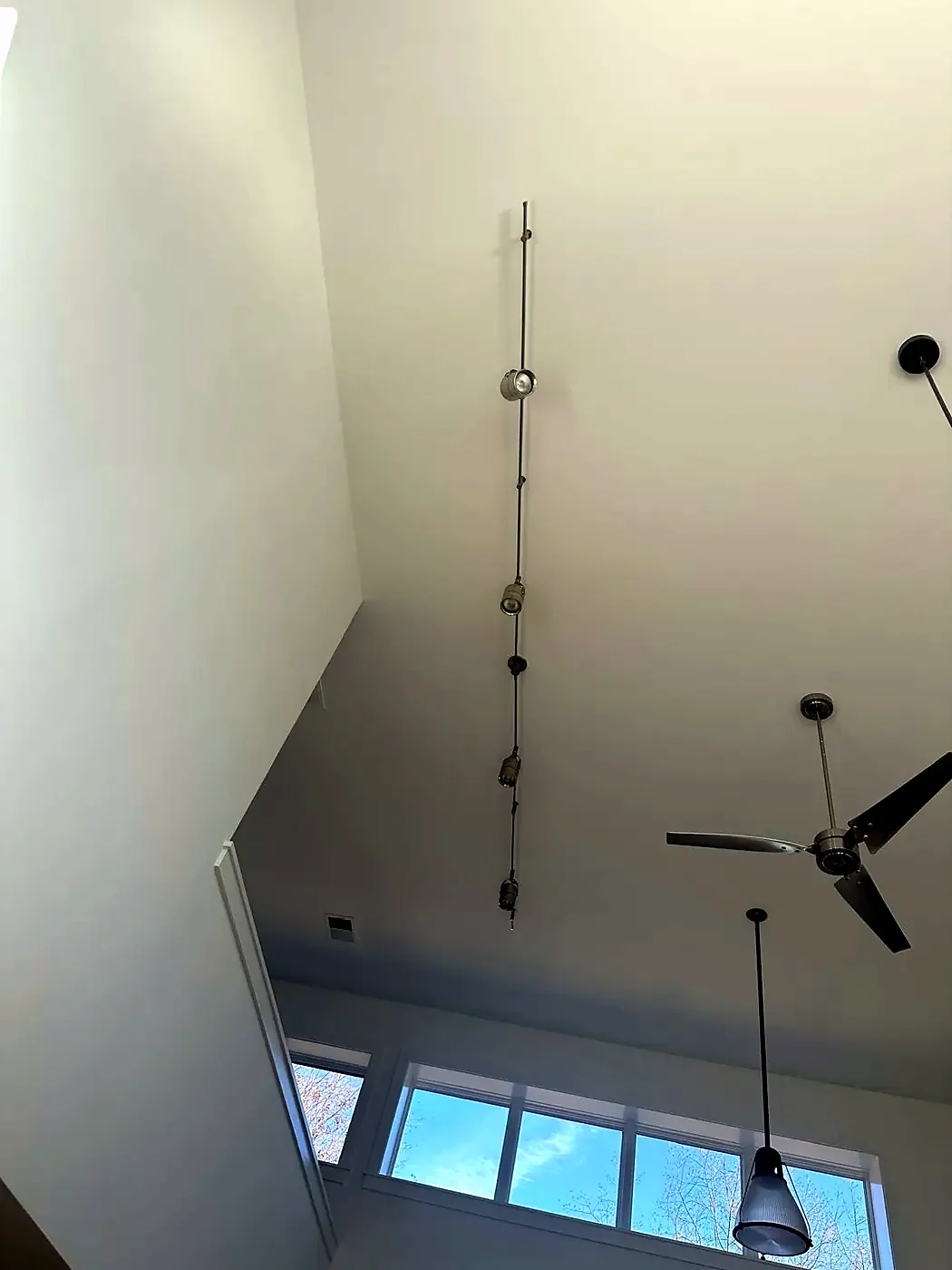
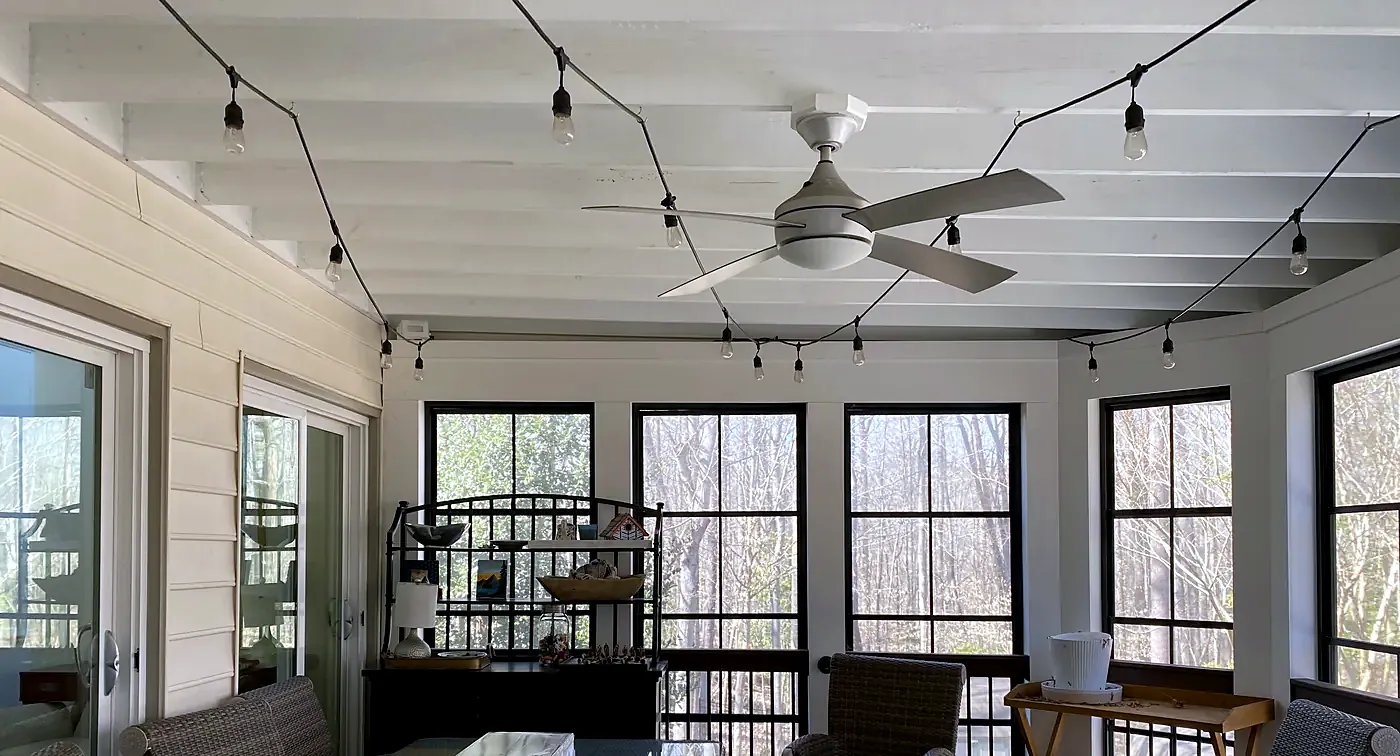
A ceiling fan cannot simply be hung from the box a light fixture used. A fan is heavier and it moves, so it needs a fan-rated box secured to framing, with bracing added where there is nothing above the opening to fasten to. Beyond that, the job is switching and wiring: a fan with a light usually wants separate control, which often means a larger switch box and a new conductor run. Sloped ceilings need the right downrod and canopy.
Can a ceiling fan go where there is no light fixture?
Yes, and it is one of the most common versions of this job — a bedroom or a room under stairs with no ceiling outlet at all, or a ceiling with a fixture but nothing rated to carry a moving load.
What it involves depends on what is above the ceiling:
- An accessible attic or open joist bay above. The easiest case. A fan-rated box is fixed to framing, bracing is added where the opening does not land beside a joist, and the circuit is brought in from the nearest suitable point.
- A finished ceiling with a finished floor above. Cable has to be fished, and a small opening is usually cut to secure the box and bracing. It is then patched, finished and painted.
- A ceiling with an existing light box. A standard light box is not a fan box. It comes out, and a fan-rated assembly goes in, secured to framing with bracing as needed — the same detail we apply when installing bathroom exhaust fans, where new units are secured to framing with bracing added where the opening needs it.
- A drop ceiling. Grid ceilings need the fan supported from the structure above, not from the grid. When we replace a drop ceiling we take out the old tiles, grid, light fixtures, fan and vent covers together and set the new supports properly.
The switch is the other half. A fan going in where there was no ceiling outlet needs a switch position, and that part is covered under outlets, GFCIs and switches.
Ceiling fan installation on a sloped or vaulted ceiling
Sloped ceilings come up regularly and they are a genuinely different installation. The fan has to hang plumb from a ceiling that is not level, which needs a canopy rated for the angle and a downrod long enough to keep the blades clear of the slope through their whole sweep.
Three things get checked before the box goes in: the pitch of the ceiling against what the fan’s canopy is rated for, the blade clearance at the high side and the low side, and what framing is actually available up there to fasten to. Vaulted ceilings often run rafters rather than joists, at an angle to where you want the fan, and the mounting has to follow the structure rather than the room.
If you already own the fan, check its documentation for an angled-ceiling rating and whether a longer downrod is available for it. Bringing that to the estimate saves a second visit.
Why a ceiling fan wobbles, hums or stops working
Most fan faults are mechanical or in the control, not in the motor. This is what we look at, roughly in the order we look at it:
- Wobble
- Usually the mounting rather than the fan. A box that is not rated for a fan, or one that was never properly secured to framing, lets the whole assembly move. Blade pitch and blade balance come next, then a bent downrod. A wobbling fan on a doubtful box is not a cosmetic problem.
- Hum or noise
- Often the speed control rather than the motor. Fans on an incompatible dimmer or a failing control hum. Loose blade irons and a canopy resting against the ceiling do the same.
- Fan will not start, or only runs on one speed
- Usually the switch, the pull chain or the capacitor. We have replaced three failing ceiling fan switches on a single visit, which is what this looks like in practice.
- The light works and the fan does not, or the reverse
- A wiring or control fault rather than two simultaneous failures. It points at the switch leg, the remote receiver or the wiring between them.
- Lights out, globes missing
- Sometimes it really is the bulbs, and we will tell you that rather than sell you a fan. Replacing burnt-out bulbs and missing fan light globes is on more than one of our repair lists.
Where the fault turns out to be in the circuit rather than the fixture — a dead switch leg, an intermittent connection in a box above the ceiling — it becomes a tracing job. See wiring, circuits and troubleshooting.
Replacing a ceiling fan with a light fixture
This goes both ways, and we do both. Sometimes the fan has to go: on one kitchen the owner did not want the ceiling fan at all, so it was removed and a blank plate fitted over the box. On another job two ceiling fans were taken down and replaced with light fixtures.
The detail people miss is the switching. A fan and light on separate controls leaves two switch legs at the ceiling; a single fixture uses one. Getting that tidy — rather than leaving a dead switch on the wall and a capped conductor above the ceiling — is part of doing the job properly.
Going the other way, from fixture to fan, means the box is replaced as described above. If the plan is a wider lighting change rather than one fitting, see lighting installation, which covers recessed lighting and fixture replacement across a house.
Ceiling fan switches, pull chains and separate fan controls
Controlling a fan properly is where a lot of these jobs actually end up. Two examples from our record show why.
On one house the existing kitchen ceiling fan had to have its wiring re-run, and the switch box was enlarged to a three-gang so a dedicated fan control could be added alongside the existing switches. On another, a master bathroom exhaust fan and its light were on one switch: we ran new wiring from the fan to a switch box and installed a new double gang box and switch so the two could be operated separately.
The pattern is the same for ceiling fans. If you want independent speed and light control, or a wall control instead of a pull chain, the wall box usually has to grow and a conductor usually has to be added between the ceiling and the switch. It is not difficult work, but it is not a device swap either, and it should be priced as what it is.
A note on dimmers: a standard lighting dimmer is not a fan speed control. Putting a fan motor on the wrong control is a common source of the hum people call us about.
Bathroom exhaust fan installation and venting
Bath fans are the other fan we install constantly, and the venting is what matters. A fan that discharges into the attic instead of outdoors is moving the moisture from your bathroom into your roof structure, and it shows up later as mold and stained ceilings.
The faults we find, and what they take to correct:
- Fan discharging into the attic. New duct is run from the fan through to an exterior termination, so the air leaves the building rather than the attic.
- No exterior termination at all. On one property we cut a four-inch hole through the brick, installed two vent caps, opened the bedroom ceiling between two joists to run duct from the bathroom fan, connected four-inch solid aluminum vent pipe to the fan and the new cap, and insulated the opened areas before closing up.
- Venting through the roof. Four-inch flex duct in the attic to a splitter with backdraft flappers, a hole cut in the roof and an exhaust vent cap installed and sealed.
- A failed vent cap causing a leak. A damaged fan vent cap on a roof was letting water in and the duct was holding standing water — the cap and surrounding shingles were replaced and sealed, and the duct reconnected properly.
- Replacing the unit. Power and venting disconnected, the old fan removed, the ceiling and vent pipe inspected, the opening resized for the new unit, the fan installed with bracing, then power and venting reconnected.
We fit quiet, appropriately sized units — for example Panasonic WhisperChoice and WhisperThin DC models in the 80 to 110 CFM range — because a bath fan that is too loud gets switched off, and a bath fan that is switched off is not doing anything.
Does a ceiling fan installation need a permit in Virginia?
Replacing an existing fan on an existing, properly rated box is maintenance. Running a new circuit or a new ceiling outlet where there was none is permitted work, and on our contracts the permit and its processing are included where the county requires them.
All of it is performed according to the Virginia building code across Northern Virginia and Washington DC. On a remodel where fans, lighting and receptacles are all being added, the electrical rough-in is inspected before the ceiling is closed, which is one reason fan locations are worth deciding early rather than after the drywall is up.
If a fan is being added because the panel is being worked on anyway, say so. On two separate jobs a 150 amp main lug panel upgrade to 200 amps and ceiling fan work were carried out under the same contract — see electrical panel upgrades.
Drywall repair and paint after a ceiling fan is moved
Electrical work leaves holes. Pretending otherwise is how homeowners end up with a working fan and a ceiling they cannot look at.
On one job an upstairs ceiling fan had to be pulled and reset, and the drywall repair was written into the same scope. On another, two drywall holes in bathrooms left over from earlier electrical repairs were patched as part of the visit that installed the new fans and exhaust fans. We also regularly prime and paint areas opened for electrical work, using the owner’s paint where they want an exact match.
So when we quote a fan in a finished ceiling, the making-good is in the price, not a surprise at the end. Larger patching is covered under drywall and ceiling repair.
What ceiling fan installation and repair costs
We do not quote by phone or publish prices. A fan replaced on a sound, fan-rated box in an accessible ceiling and a fan added to a vaulted ceiling with no existing outlet are not the same job, and nobody can tell which yours is from a description.
What moves the number: whether there is an existing ceiling outlet and whether its box is fan-rated, what is above the ceiling, the ceiling height and pitch, whether new switching or a larger switch box is needed, and how much patching and painting follows.
An estimator looks at the actual ceiling and gives you a written price before any work begins. If you are supplying the fan, have it on site — we install owner-provided fans routinely, and having the unit in hand means the downrod and canopy are checked before, not during.