 Skip to content


A renovation scope of work is a formal written document that defines every task, material, and quality standard for your project. Known in the construction industry as a “statement of work” or “project scope document,” it tells contractors exactly what to build, what materials to use, and what the finished result must look like. Without one, you are handing contractors a blank check and hoping for the best. This guide explains what a renovation scope of work must include, why exclusions matter as much as inclusions, and how to write one that protects your budget and timeline from start to finish.
What is a renovation scope of work?
A renovation scope of work is the technical manual for your project. It is distinct from a contract. The contract covers legal terms, payment schedules, and liability. The scope covers the actual work: which rooms get updated, what gets demolished, what gets installed, and what materials get used. Think of the contract as the legal wrapper and the scope as the detailed instructions inside.
The scope also sets the standard for what “done” means. Without that definition, a contractor can hand you a finished bathroom and genuinely believe the job is complete while you expected a different tile pattern, a specific faucet brand, or a particular grout color. A clear scope document sets a shared reference for pricing, scheduling, and change order management, avoiding miscommunication and costly surprises.

The scope is not a wish list. It is a working document that contractors use to calculate labor hours, order materials, and sequence trades. The more specific it is, the more accurate the bids you receive will be.
What essential elements must a renovation scope of work include?
A complete scope covers seven core areas. Missing even one creates gaps that contractors will fill with assumptions, and those assumptions almost always cost you money.
1. Area summary
List every room or zone included in the project. A kitchen remodel scope should name the kitchen specifically and note which adjacent spaces, such as a pantry or breakfast nook, are included or excluded.
2. Detailed task list
Break the work into phases: demolition, rough work (framing, plumbing, electrical), and finish work (tile, cabinetry, paint). Each phase needs its own task list.
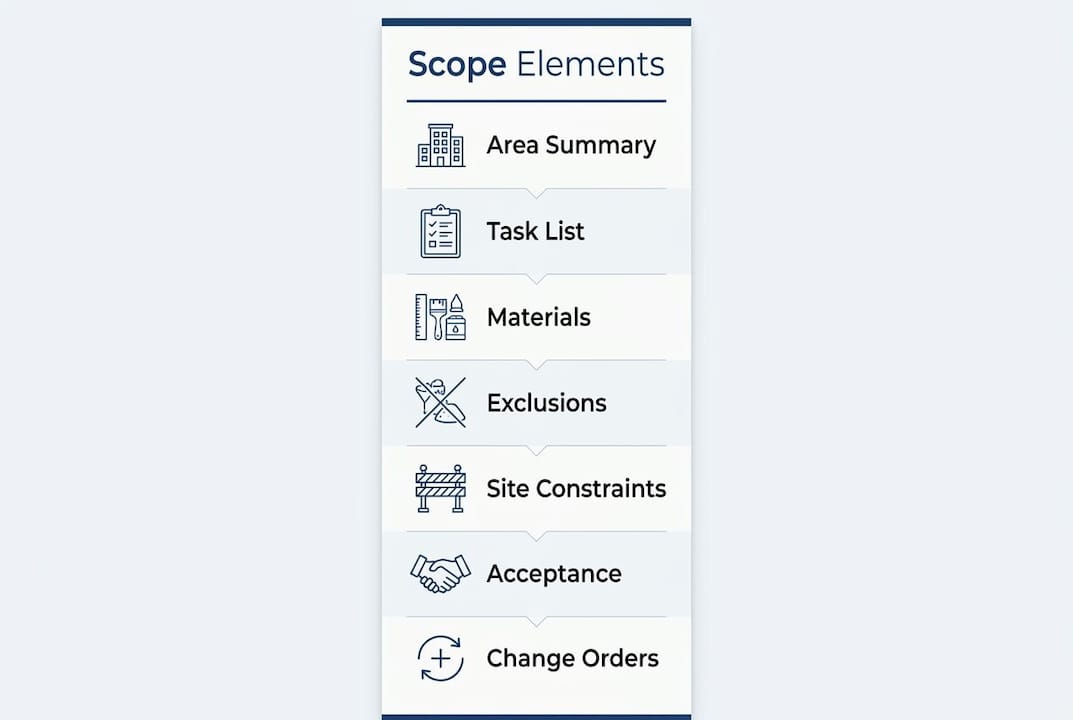
3. Material and finish specifications
Name the exact product, brand, model number, and color for every material. “White subway tile” is not a specification. “Daltile Restore Bright White 3×6 ceramic subway tile, item RE15” is a specification.
4. Explicit exclusions
List everything the contractor will not do. This section is covered in detail below, but it belongs in every scope without exception.
5. Site constraints
Note access limitations, parking restrictions, noise ordinances, building hours, and any permit requirements. Contractors price jobs based on how easy or difficult site access will be.
6. Acceptance criteria
Define what the finished work must look like and how it will be inspected. Specify that tile must be level within a certain tolerance, or that paint must show no roller marks under natural light.
7. Change order process
Describe how changes get requested, priced, approved, and documented. A written process prevents verbal agreements that neither party remembers the same way.
Pro Tip: Include product selections and marked-up floor plans in the scope packet. Contractors who can see exactly what goes where submit bids with far fewer assumptions baked in.
Why are exclusions and clear boundaries critical?
Explicit exclusions are as important as inclusions when it comes to preventing disputes. A contractor who opens a wall and finds asbestos insulation will stop work. If your scope does not address who pays for abatement, you have a dispute before the project is half finished.
Common exclusions to list in every scope include:
- Asbestos or lead paint abatement
- Structural reinforcement beyond the original design
- Repairs to adjacent areas disturbed during work
- Landscaping or exterior cleanup
- Furniture moving or storage
- Appliance installation if purchased separately
- Permit fees, unless explicitly included
Missing exclusions create “grey area” conflicts. A homeowner assumes the contractor will patch and paint the hallway wall after running new electrical. The contractor assumes that is a separate job. Neither is wrong. The scope simply did not say. That single omission can add hundreds of dollars to a final invoice and damage the working relationship.
The best practice is to write exclusions in plain language. “This scope does not include painting of any surface outside the primary bathroom” leaves no room for interpretation. Vague language like “general cleanup” invites disagreement about what “general” means.
Pro Tip: Review your exclusions list with your contractor before signing anything. Ask them to confirm in writing that they understand each item is out of scope. That five-minute conversation prevents most mid-project disputes.
How does a detailed scope improve bidding accuracy and project management?
Homeowners should never agree to cost estimates without a supporting detailed scope of work. When contractors bid from the same detailed scope, you can compare their quotes line by line. When they bid from a vague description, each contractor makes different assumptions, and the quotes are not comparable at all.
A detailed scope removes guesswork in three specific ways.
First, it eliminates material ambiguity. When the scope names a specific tile, vanity, and faucet, every contractor prices the same product. You are comparing labor rates, not guessing why one bid is $4,000 lower than another.
Second, it establishes a payment baseline. As work progresses, the scope tells you what has been completed and what has not. You pay for finished milestones, not for time spent on site.
Third, it functions as a living document with a “hidden conditions” clause. When a contractor opens a wall and finds outdated knob-and-tube wiring, the clause defines exactly how that discovery gets priced and approved. Work does not stop. The process kicks in automatically.
Pro Tip: Schedule a pre-construction scope review with your contractor before work begins. Walk through every line item together. Pre-construction reviews catch gaps that would otherwise become costly mid-project surprises.
A useful way to see how scope detail affects project outcomes is to compare two common approaches:
| Approach | What happens |
|---|---|
| Vague scope (“update the kitchen”) | Contractors make different assumptions; bids vary widely and are not comparable |
| Detailed scope (task list, specs, exclusions) | Contractors price the same work; bids are comparable and disputes drop sharply |
| No scope at all | Budget overruns and disputes are nearly guaranteed |
What practical steps can homeowners follow to write an effective scope?
Writing a scope does not require a construction background. It requires organization and a willingness to make decisions before work starts. Follow these steps to build a scope that holds up through the entire project.
- Start with a room-by-room template. List every space in the project. Under each room, write every task: demo, framing, plumbing, electrical, insulation, drywall, tile, paint, trim, and fixtures. Most renovation disputes trace back to unstated assumptions about waste handling, permits, or cleanup. A room-by-room template forces you to address all of them.
- Separate owner-supplied from contractor-supplied items. If you are buying the light fixtures yourself, say so. If the contractor is supplying the tile, say that too. Ambiguity here causes duplicate purchases and billing arguments.
- Include a timeline with milestones. List the expected start date, key milestones (demo complete, rough-in complete, inspections passed), and the target completion date. Sequencing matters because trades depend on each other.
- Define permit responsibilities. State who pulls permits, who schedules inspections, and who pays permit fees. Leaving this unaddressed is one of the most common causes of project delays.
- Specify allowances for undecided items. If you have not chosen a light fixture yet, include a dollar allowance. This keeps the bid accurate while giving you flexibility to decide later.
- Involve your contractor in the drafting process. Contractors prefer scopes that specify finished outcomes and material grades rather than exact installation methods. Ask your contractor to review a draft and flag anything unclear or missing.
- Maintain one master document. Every change, approval, and update goes into a single file. Both you and your contractor sign off on every revision. This single source of truth prevents the “I thought we agreed” conversations that derail projects.
Pro Tip: Check a home maintenance checklist before finalizing your scope. Existing maintenance issues like failing caulk, worn weatherstripping, or aging fixtures often belong in the renovation scope rather than being discovered mid-project.
Key Takeaways
A renovation scope of work is the single most effective tool for preventing budget overruns, contractor disputes, and project delays on any home renovation.
| Point | Details |
|---|---|
| Define the scope before getting bids | A detailed scope makes contractor quotes comparable and eliminates hidden assumptions. |
| Exclusions are non-negotiable | List every item not covered to prevent grey-area disputes and unexpected charges. |
| Use a living document approach | Include a hidden conditions clause so unexpected discoveries follow a clear pricing process. |
| Pre-construction review saves money | Walking through the scope with your contractor before work starts catches costly gaps early. |
| One master document, always | Every change must be written, signed, and added to a single file both parties reference. |
What 20 years of renovations taught me about scope documents
Most homeowners treat the scope as paperwork. After two decades working on homes across Northern Virginia, I can tell you it is the most important conversation you will have about your project. The paperwork is just the record of that conversation.
The costliest renovation conflicts I have seen did not come from bad contractors or bad homeowners. They came from vague scopes where both sides had reasonable but different expectations. A contractor who installs standard-grade tile when the homeowner pictured premium stone is not dishonest. The scope just did not say.
The conventional wisdom is to write a detailed scope and then hand it to the contractor. That is only half right. The better approach is to write a draft, sit down with your contractor, and revise it together. Contractors see things homeowners miss. They know which tasks require permits in your jurisdiction, which materials have long lead times, and which sequencing decisions affect the whole timeline.
One thing homeowners consistently underestimate is the value of outcome-based language. Instead of specifying that a contractor must use a particular installation method, specify what the finished surface must look like and perform like. That approach holds the contractor accountable for results while letting them use their expertise to get there.
Get involved early. Write the scope before you talk to contractors, not after. The discipline of writing it forces you to make decisions that would otherwise surface as disputes at the worst possible moment.
— Sam
Sam & Sons Services is ready to help with your renovation
Planning a renovation in Northern Virginia or the Washington, DC area means managing a lot of moving parts. Sam & Sons Services has over 20 years of experience helping homeowners plan and execute home improvements with clarity and confidence.

Whether you need help scoping a bathroom update, a kitchen refresh, or a whole-home repair plan, our licensed professionals walk you through every detail before a single tool hits the wall. Browse our handyman service FAQs to understand what to expect, or explore our home remodeling services in Annandale to see how we support homeowners from scope to completion. Contact Sam & Sons Services today to schedule a consultation.
FAQ
What is a renovation scope of work?
A renovation scope of work is a formal written document that defines every task, material, quality standard, and exclusion for a renovation project. It serves as the technical reference that contractors use to bid and execute the work accurately.
How is a scope of work different from a contract?
A contract covers legal terms, payment schedules, and liability. A scope of work defines the actual work to be performed, the materials to be used, and what the finished result must look like.
What should I always include in a renovation scope?
Every scope must include an area summary, a detailed task list, material specifications with product names and model numbers, explicit exclusions, site constraints, acceptance criteria, and a documented change order process.
Why do exclusions matter so much in a renovation scope?
Exclusions prevent grey-area disputes by clearly stating what the contractor will not do. Without them, both parties can have reasonable but conflicting assumptions about responsibilities, leading to unexpected charges and project conflicts.
When should I write the renovation scope of work?
Write the scope before you contact contractors for bids. A completed scope lets contractors price the same work, making their quotes directly comparable and giving you a clear basis for selecting the right professional for your project.


You must be logged in to post a comment.