 Skip to content


Refrigerants are the working fluids that make every air conditioner and heat pump function. They absorb heat from indoor air and carry it outside, which is the core role of refrigerant in HVAC systems. Without refrigerant, your system is just a fan. The fluid cycles continuously between liquid and gas phases, and that phase change is what moves heat rather than simply blowing cold air around. Understanding how refrigerants work, which types exist, and why the industry is shifting toward lower-impact options gives you real power as a homeowner to make better decisions about your equipment and your energy bills.
How do refrigerant in HVAC systems work?
Refrigeration in HVAC is the process of moving heat, not creating cold. That distinction matters because it changes how you think about your system entirely. The vapor-compression cycle is the standard mechanism in residential and commercial HVAC, and refrigerant is the fluid that drives it.
The cycle runs through four stages:
- Evaporation. Liquid refrigerant enters the evaporator coil inside your home. It absorbs heat from indoor air and boils into a low-pressure gas. The air passing over the coil loses heat and feels cool.
- Compression. The compressor pressurizes the gas, which raises its temperature significantly. This prepares the refrigerant to release heat outside.
- Condensation. The hot, high-pressure gas flows to the condenser coil outside. It releases heat to the outdoor air and condenses back into a liquid.
- Expansion. The liquid passes through an expansion valve, which drops its pressure and temperature rapidly. The refrigerant is now ready to absorb indoor heat again.
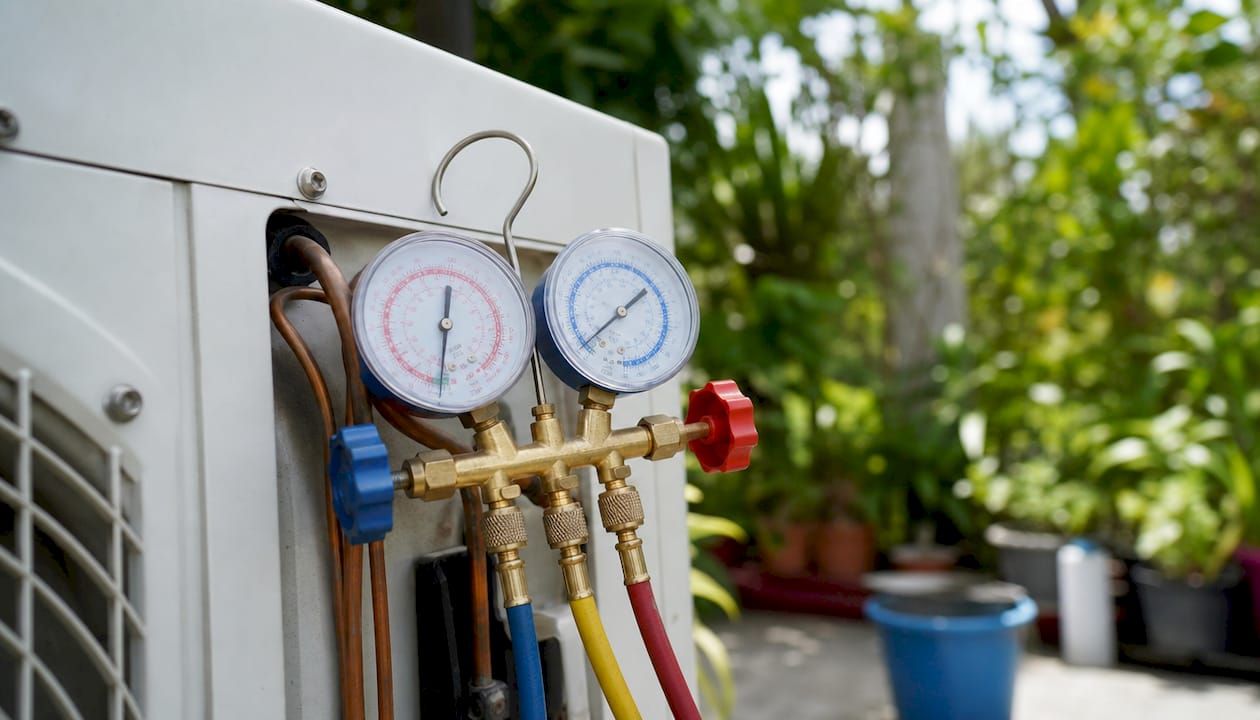
Two measurements tell technicians whether this cycle is running correctly: superheat and subcooling. Superheat and subcooling checks verify the refrigerant charge far more accurately than pressure gauges alone. Superheat measures how much the gas has warmed above its boiling point in the evaporator. Subcooling measures how much the liquid has cooled below its condensing point. Both numbers together confirm that the right amount of refrigerant is present and that the system is operating at peak efficiency.
Pro Tip: If your technician only uses a pressure gauge to check your refrigerant charge, ask for a superheat and subcooling measurement. Pressure alone does not give a complete picture of system health.
What are the main refrigerant types for cooling systems?
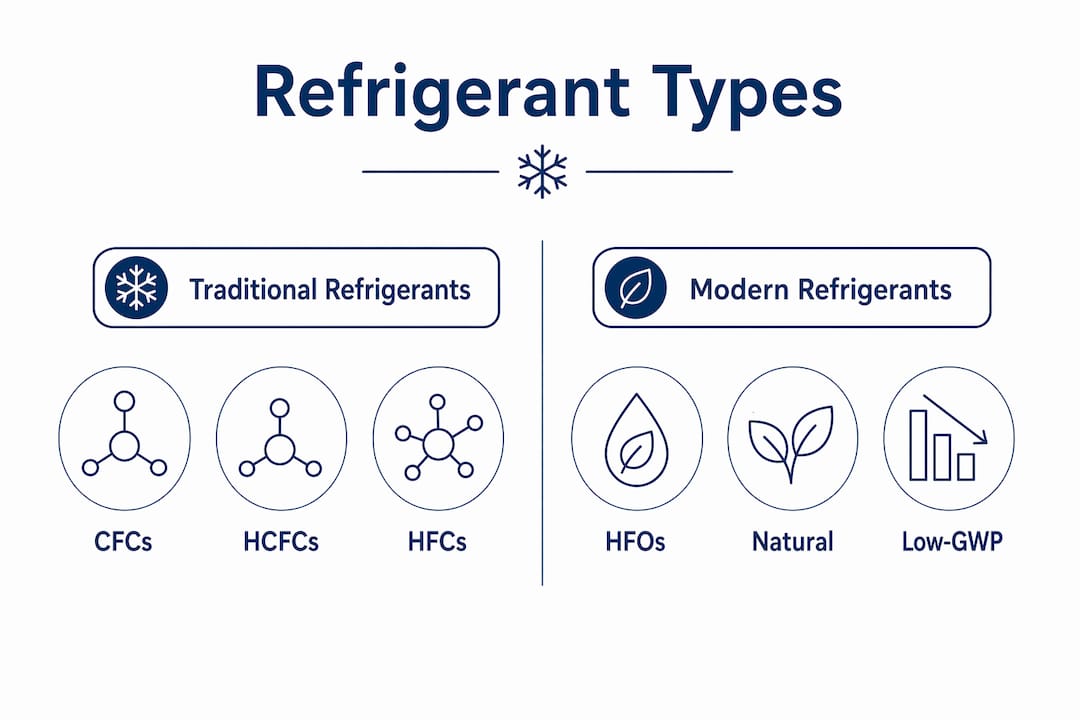
No single ideal refrigerant exists. Every choice involves trade-offs between efficiency, safety, environmental impact, and cost. Knowing the major categories helps you understand why your system uses what it does and what may change when you replace it.
| Refrigerant class | Common examples | Key concern | Status |
|---|---|---|---|
| CFCs | R-11, R-12 | Ozone depletion | Phased out globally |
| HCFCs | R-22 | Ozone depletion, moderate GWP | Phased out in the U.S. |
| HFCs | R-410A, R-134a | High global warming potential | Being phased down |
| HFOs | R-1234yf, R-32 blends | Low GWP, mild flammability | Expanding rapidly |
| Natural refrigerants | Ammonia (R-717), CO2 (R-744), propane (R-290) | Toxicity or flammability | Growing in commercial use |
CFCs and HCFCs were the industry standard for decades. R-12 powered most car air conditioners and household refrigerators through the 1980s. Both classes deplete the ozone layer, which led to their global phase-out under the Montreal Protocol.
HFCs replaced them and solved the ozone problem. R-410A became the dominant residential refrigerant in the U.S. after R-22 was phased out. The problem is that HFCs carry a very high global warming potential. R-410A has a GWP roughly 2,088 times that of carbon dioxide, which makes it a significant contributor to climate change when it leaks.
HFOs are the current industry answer. They carry a GWP near zero and perform well in modern equipment. The trade-off is mild flammability, which requires updated safety standards and equipment design. R-32 and R-454B are common examples now appearing in newer residential systems.
Natural refrigerants like ammonia and CO2 have excellent thermodynamic properties and near-zero climate impact. Ammonia is toxic in high concentrations, which limits its use to industrial settings. CO2 systems require very high operating pressures, demanding specialized components. Propane (R-290) works well in small appliances and is gaining ground in mini-split systems.
The 2026 HVAC industry shift from high-GWP HFCs to low-GWP HFOs and natural refrigerants is driven by new EPA regulations and international agreements. Your next system will almost certainly use one of these newer options.
Why does the refrigerant transition matter for your home in 2026?
The environmental stakes are significant. Global AC demand is projected to reach 5.6 billion units by 2050, with sales averaging roughly 10 units per second until then. That scale means refrigerant choice has a direct and measurable effect on global emissions.
The Kigali Amendment to the Montreal Protocol, adopted in 2016 and now ratified by over 150 countries including the United States, commits nations to phasing down HFC production and consumption by more than 80% over the next three decades. For homeowners, this means the refrigerant in your current system may become harder and more expensive to source as production quotas tighten.
The efficiency implications are real but often misunderstood. System efficiency depends more on thermodynamic design than on refrigerant type alone. Swapping refrigerant in an older system that was not designed for the new fluid rarely delivers meaningful performance gains. The right approach is matching the refrigerant to a system built for it.
Retrofitting an existing R-410A system to run on R-32 or R-454B is not a simple swap. Seals, lubricants, and sometimes the compressor itself need to be compatible. A licensed technician can assess whether your current equipment is a good candidate for a refrigerant change or whether a full replacement makes more financial sense. Proper home energy efficiency planning, including refrigerant selection, can reduce your utility costs over the long term.
How should homeowners manage HVAC refrigerants safely?
Refrigerant is not a consumable like a furnace filter. Refrigerants are working fluids, not fuels. If your system is losing refrigerant, it has a leak. Treating a low charge as a routine top-off is a costly mistake.
Key facts every homeowner should know:
- Leaks damage compressors. Adding refrigerant without fixing the leak is a temporary fix that risks compressor failure. Compressor replacement is one of the most expensive HVAC repairs.
- DIY refrigerant handling is illegal. The EPA requires technicians to be certified under Section 608 of the Clean Air Act to purchase and handle refrigerants. You cannot legally buy R-410A or R-454B as a homeowner.
- Low charge symptoms are specific. Warm air from vents, ice on the evaporator coil, and higher-than-normal energy bills all point to a possible refrigerant issue. None of these symptoms confirm a leak on their own, but they warrant a professional inspection.
- Leak detection requires proper tools. Electronic leak detectors, UV dye, and nitrogen pressure tests are the standard methods. A visual check alone is not sufficient.
Professional refrigerant management prevents both performance loss and environmental harm. The EPA recommends homeowners contact certified technicians for any refrigerant service, including retrofits and repairs.
Pro Tip: Ask your HVAC technician for a written record of the refrigerant type, charge amount, and any leak repairs after every service visit. This documentation protects you if warranty questions arise and helps future technicians service your system correctly.
You can find answers to common refrigerant and maintenance questions through HVAC expert guidance before scheduling a service call.
What future trends are shaping refrigerant technology?
The refrigerant landscape is changing faster than at any point since the Montreal Protocol. Several trends are worth watching as a homeowner planning a system purchase or replacement.
- Nanotechnology and refrigerant blends. Researchers are testing nanoparticle additives that improve heat transfer in existing refrigerants without changing the base fluid. Early results show efficiency gains in laboratory settings, though commercial adoption is still limited.
- Natural refrigerants with renewable energy. Propane and CO2 systems paired with solar power are gaining traction in net-zero building projects. The combination reduces both operating emissions and refrigerant climate impact.
- Non-vapor compression cooling. Thermoelectric, magnetocaloric, and membrane-based cooling technologies are in active development. None are ready for mainstream residential use, but they could eventually eliminate the need for refrigerants entirely in some applications.
- Circular refrigerant economy. The industry is moving toward reclaiming, recertifying, and reusing refrigerants rather than venting or destroying them. This reduces both waste and the cost of refrigerant supply as HFC production quotas shrink.
The refrigerant transition reflects a broader industry shift toward circular economy principles, balancing efficiency, safety, and compliance. For homeowners, the practical takeaway is to buy systems designed for low-GWP refrigerants now rather than waiting for regulations to force the issue.
Key Takeaways
Refrigerant is the single most critical fluid in your HVAC system, and choosing or maintaining it correctly affects your comfort, your energy bill, and the environment.
| Point | Details |
|---|---|
| Refrigerant moves heat, not cold | The vapor-compression cycle transfers heat outdoors; refrigerant is the fluid that makes this possible. |
| Refrigerant type affects efficiency and climate impact | HFCs have high GWP; HFOs and natural refrigerants are the low-impact alternatives now entering the market. |
| Leaks require repair, not just a top-off | Adding refrigerant without fixing the source damages the compressor and violates EPA regulations. |
| Superheat and subcooling are the right diagnostic tools | Pressure gauges alone do not confirm correct refrigerant charge; ask for both measurements at every service. |
| System design matters more than refrigerant alone | Switching refrigerants in an incompatible system rarely improves performance; match the fluid to the equipment. |
What I’ve learned after 20 years of HVAC refrigerant calls
The most common misconception I see is that refrigerant works like gasoline. Homeowners assume it gets used up and needs periodic refilling. It does not. A properly sealed system holds its charge for the life of the equipment. When a technician tells you the system needs refrigerant every year, that is a leak problem, not a maintenance schedule.
The second misconception is that newer refrigerants automatically mean better performance. Efficiency comes from the whole system design, including the compressor, coil surface area, and expansion device. Dropping a new refrigerant into an old system built for something else often delivers disappointing results and can void the manufacturer warranty.
What actually moves the needle is buying equipment designed from the ground up for low-GWP refrigerants, keeping the system clean and leak-free, and having a technician who understands both the thermodynamics and the regulatory environment. The Kigali Amendment is not a distant policy concern. It is already affecting refrigerant prices and availability. Homeowners who understand this make better purchasing decisions and avoid being caught with a system that depends on a refrigerant that costs twice as much as it did three years ago.
If you are in Northern Virginia and your system is more than 10 years old, now is the right time to have a conversation about what refrigerant it uses and what your options are. The heat pump maintenance decisions you make today will shape your costs for the next decade.
— Sam
Sam & Sons Services and your HVAC refrigerant needs
Sam & Sons Services has served homeowners across Northern Virginia for over 20 years, and refrigerant management is one of the most common HVAC issues our licensed technicians handle.

Whether your system is running low, you suspect a leak, or you want to understand your options before the next refrigerant regulation takes effect, our team provides honest assessments and quality repairs. We use superheat and subcooling measurements on every refrigerant service call, not just pressure gauges. Our technicians are EPA Section 608 certified and stay current on refrigerant regulations so you do not have to. Contact Sam & Sons Services today or visit our HVAC services page to schedule a refrigerant inspection or system evaluation in Northern Virginia.
FAQ
What does refrigerant actually do in an HVAC system?
Refrigerant absorbs heat from indoor air as it evaporates in the evaporator coil, then releases that heat outside as it condenses. This continuous cycle is what cools your home.
How do I know if my HVAC system has a refrigerant leak?
Common signs include warm air from vents, ice forming on the indoor coil, and rising energy bills. A certified technician can confirm a leak using electronic detectors or UV dye.
Can I add refrigerant to my HVAC system myself?
No. The EPA requires Section 608 certification to purchase and handle refrigerants. Homeowners cannot legally buy or add refrigerant without a licensed technician.
What refrigerant does my new HVAC system use?
Systems sold in 2026 and beyond are transitioning from R-410A to lower-GWP options like R-454B or R-32. Check your equipment label or ask your installer for the specific refrigerant type.
Does switching refrigerants improve HVAC efficiency?
Not reliably. System efficiency depends more on equipment design than refrigerant type alone. Replacing refrigerant in a system not designed for it rarely produces significant performance gains.


You must be logged in to post a comment.