 Skip to content


Contractor licensing is a government certification that confirms a tradesperson meets minimum skill, safety, and legal standards before working on your home. Understanding why contractor licensing protects homeowners is not optional knowledge. It is the difference between a project that adds value to your property and one that costs you tens of thousands of dollars in repairs, fines, and legal fees. Licensed contractors carry insurance, pull permits, and answer to state licensing boards. Unlicensed contractors answer to no one.
Why contractor licensing protects homeowners financially
Hiring an unlicensed contractor is one of the most expensive mistakes a homeowner can make. Financial losses average $35,000 to $75,000, with some cases exceeding $150,000 per incident. That figure reflects abandoned projects, code violations requiring full teardowns, and legal costs that pile up fast.
Unpermitted work creates a second wave of financial damage. When a contractor skips the permit process, you may be forced to tear out completed work so an inspector can verify what is behind the walls. That means paying twice for the same job. Worse, homeowner insurance frequently denies claims for damage caused by unlicensed contractors. Your policy exists to protect you, but it will not cover work that was never legally authorized.
The liability risk goes further than property damage. If an unlicensed worker is injured on your property and carries no workers’ compensation insurance, you may be personally liable for their medical bills and lost wages. That exposure can dwarf the original cost of the project. Homeowners who use licensed contractors in Northern Virginia avoid this category of risk entirely.
| Scenario | Typical Financial Risk |
|---|---|
| Abandoned project | $35,000–$75,000 in losses |
| Code violation teardown | Full redo cost plus fines |
| Insurance claim denial | Full repair cost out of pocket |
| Worker injury on property | Medical bills and lost wages |
| Unpermitted work at resale | Deal collapse or price reduction |
Pro Tip: Confirm a contractor’s license status through your state licensing board before signing any contract. This takes five minutes and can save you six figures.
How does contractor licensing ensure legal accountability?
State licensing boards are the regulatory backbone of the construction industry. They set qualification standards, test contractors, and maintain the authority to investigate complaints, issue fines, and revoke licenses. Licensing boards provide a formal complaint mechanism that gives homeowners real recourse when work goes wrong. That mechanism does not exist with unlicensed contractors.
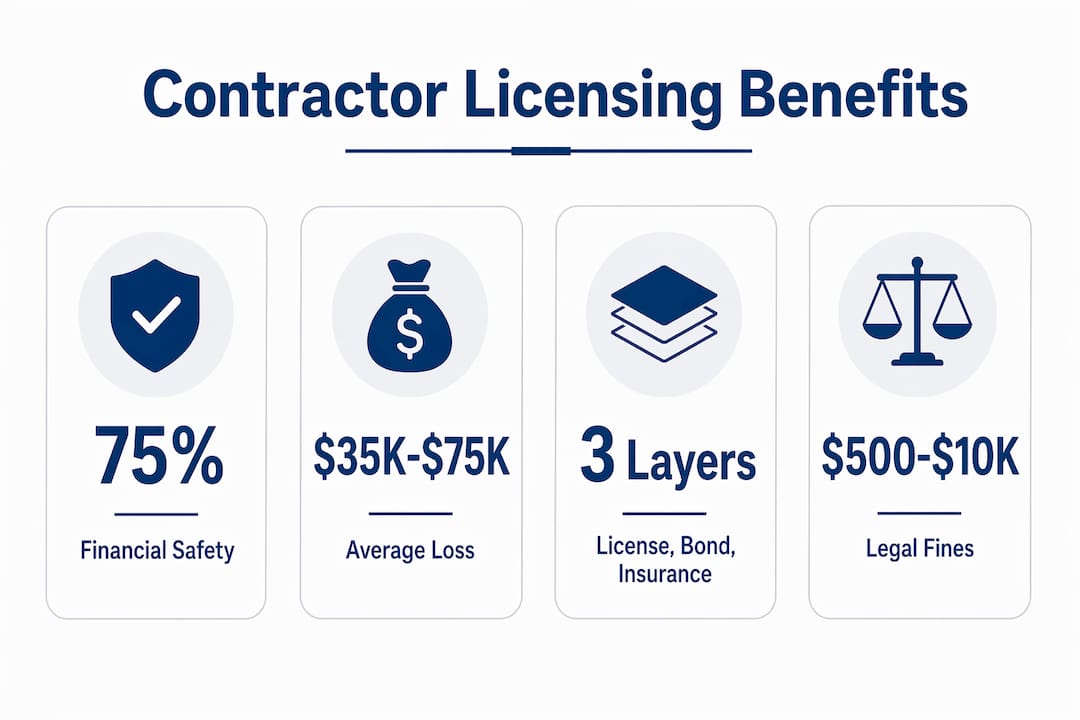
The legal consequences for operating without a license are significant. Fines range from $500 to $10,000 per violation, and criminal charges apply in some states. That penalty structure exists because unlicensed contracting harms homeowners at scale. The threat of those consequences keeps licensed contractors accountable in ways that informal agreements never can.
Licensing and insurance are distinct protections, and confusing them is a common and costly mistake. A license confirms credentials and regulatory compliance. Insurance covers the financial fallout when something goes wrong. You need both, and verifying one does not verify the other.
Here is what the licensing framework gives you that unlicensed hiring does not:
- Verified qualifications: Licensed contractors have passed exams and met experience requirements set by state boards.
- Code compliance: Licensed contractors are required to follow local building codes and safety standards on every job.
- Formal complaint process: You can file a complaint with the licensing board and trigger an official investigation.
- License revocation risk: A contractor who performs substandard work risks losing their license, which is a powerful incentive for quality.
- Legal recourse: In states like California, homeowners can sue to recover payments made to unlicensed contractors, even for completed work.
What are the layers of protection: licensing, bonding, and insurance?
The phrase “licensed, bonded, and insured” describes three separate protections that work together. Each layer covers a different category of risk, and skipping any one of them leaves a gap. Homeowners who understand the difference make better hiring decisions.
Licensing confirms that the contractor has met state requirements and is subject to regulatory oversight. A surety bond provides a financial guarantee. If the contractor abandons the job or delivers substandard work, the bond gives you a financial backstop to recover costs. General liability insurance covers property damage that occurs during the project. Workers’ compensation insurance covers injuries to workers on your property. General liability coverage is typically $1 million per occurrence, which is the industry standard for residential work.
| Protection | What it covers | Why you need it |
|---|---|---|
| License | Contractor credentials and regulatory compliance | Confirms minimum skill and legal standing |
| Surety bond | Incomplete or substandard work | Financial recovery if the job is abandoned |
| General liability insurance | Property damage during the project | Covers repair costs without out-of-pocket loss |
| Workers’ compensation | Worker injuries on your property | Protects you from medical and wage liability |
Pro Tip: Always request a current Certificate of Insurance (COI) that names you as an additional insured. This gives you direct access to the policy if a claim arises.
Why pulling permits matters and how licensing enforces it
Only licensed contractors are legally authorized to pull building permits. That authorization is not a technicality. Permits trigger inspections, and inspections confirm that work meets local building codes. Without that process, there is no independent check on whether your new electrical panel, plumbing line, or structural addition is safe.
The permit process protects you in three concrete ways. First, inspections catch errors before they become hazards. Second, permitted work creates a legal record that protects your property value. Third, permits confirm that the work was done to code, which matters enormously when you sell your home or file an insurance claim.
When an unlicensed contractor asks you to pull the permits yourself, that is a serious red flag. A contractor who shifts permit responsibility to the homeowner is effectively transferring legal liability for the entire project onto you. You become responsible for code compliance, inspections, and any violations. That arrangement benefits only the contractor.
Unpermitted work also creates problems at resale. Buyers and their inspectors routinely discover unpermitted additions or renovations. The result is either a price reduction, a demand for costly remediation, or a collapsed deal. The cost of skipping permits almost always exceeds the cost of obtaining them.
How to verify contractor licensing and insurance before hiring
Verification is a short process that takes less than 30 minutes. Most homeowners skip it and pay the price later. These steps protect you before work begins.
- Check the state licensing board: Most states maintain a free online lookup tool. Search by contractor name or license number to confirm active status.
- Request the Certificate of Insurance: Ask for a current COI before work starts. Verify the COI directly with the insurer rather than accepting a document from the contractor alone.
- Confirm coverage amounts: General liability should be at least $1 million per occurrence. Workers’ compensation coverage should be active and current.
- Check that the COI is recent: Insurance can lapse while a license remains active. A COI issued more than 30 days before the project start date needs to be refreshed.
- Watch for red flags: Any contractor who asks you to pull permits, refuses to provide a COI, or offers a price far below market rate is signaling risk.
- Check references and reviews: A licensed contractor with a strong track record will have verifiable references and consistent online reviews.
Sam & Sons Services provides all credentials upfront. Every technician is licensed, bonded, and insured, and the team handles permit requirements as part of the job. Homeowners in Northern Virginia can verify credentials before any work begins.
Key takeaways
Contractor licensing protects homeowners by creating financial accountability, regulatory oversight, and legal recourse that unlicensed hiring cannot provide.
| Point | Details |
|---|---|
| Financial risk is severe | Losses from unlicensed contractors average $35,000–$75,000 and can exceed $150,000. |
| Three protections are required | Licensing, bonding, and insurance each cover different risks; verify all three. |
| Permits protect your property | Only licensed contractors can pull permits; unpermitted work creates liability and resale problems. |
| Insurance can lapse | Always verify a current COI directly with the insurer, not just the contractor. |
| Red flags are clear | A contractor asking you to pull permits is unlicensed and shifting liability onto you. |
What 20 years in home services taught me about contractor risk
The homeowners who call us after a bad experience with an unlicensed contractor share one thing in common. They chose on price alone. The quote was lower, the contractor seemed confident, and the paperwork felt like a formality. By the time they called Sam & Sons Services, they had already spent more fixing the damage than the original job would have cost with a licensed professional.
The insight I want to share is this: licensing verification is not about distrust. It is about creating a clear framework where both parties have accountability. When a contractor is licensed, bonded, and insured, they have skin in the game. Their license is their livelihood. That changes how they approach your project.
One thing most homeowners overlook is the insurance lapse problem. A contractor can hold a valid license and carry expired insurance at the same time. Licensing boards do not track insurance renewals. That gap is why you must call the insurer directly to confirm active coverage, not just accept a document the contractor hands you.
My honest advice: treat the verification process as a standard part of hiring, not an optional step. Ask for the license number, look it up, request the COI, and call the insurer. That 30-minute process is the most valuable thing you can do before any contractor sets foot in your home.
— Sam
Trusted licensed contractors for Northern Virginia homeowners

Sam & Sons Services has served homeowners across Northern Virginia and the Washington, DC area for over 20 years. Every professional on the team is licensed, bonded, and insured. Permits are handled as part of the job, and credentials are available for verification before work begins.
Whether you need plumbing, electrical, HVAC, or general home repair, Sam & Sons Services delivers quality work backed by full regulatory compliance. Homeowners can review common contractor questions before scheduling, or contact the team directly for a consultation. For homeowners in the Alexandria area, local licensed services are available now. Call or schedule online to get started with a contractor you can trust.
FAQ
What does contractor licensing actually protect homeowners from?
Contractor licensing protects homeowners from financial loss, substandard work, code violations, and personal liability. Licensed contractors are subject to state oversight, carry required insurance, and can be held accountable through formal complaint processes.
Is a licensed contractor automatically insured?
No. A license confirms credentials and regulatory standing, but insurance is a separate requirement. Insurance policies can lapse while a license remains active, so homeowners must verify both independently.
What happens if an unlicensed contractor gets injured on my property?
If an unlicensed contractor lacks workers’ compensation insurance, you may be personally liable for their medical bills and lost wages. This is one of the most significant and least understood financial risks of hiring unlicensed labor.
Why should I care who pulls the building permits?
Only licensed contractors are legally authorized to pull permits. If a contractor asks you to pull permits yourself, they are likely unlicensed and transferring full legal liability for code compliance and inspections onto you.
How do I verify a contractor’s license before hiring?
Search your state’s contractor licensing board website using the contractor’s name or license number. Then request a current Certificate of Insurance and confirm it directly with the insurer before work begins.


You must be logged in to post a comment.