 Skip to content


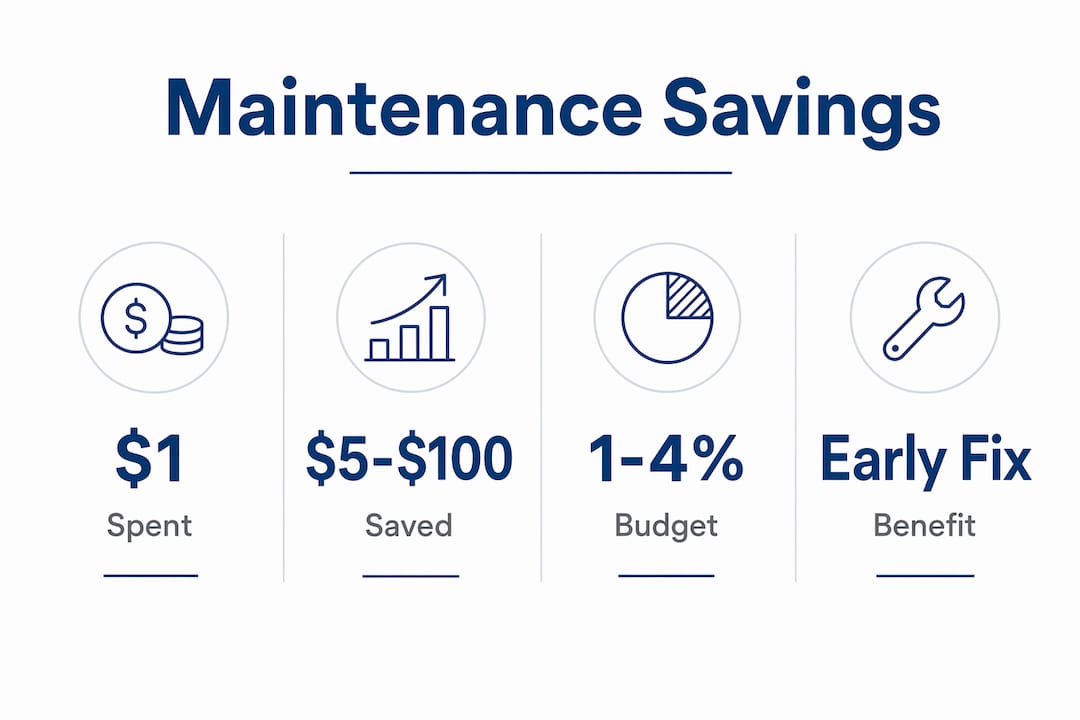
Regular home maintenance is the proactive practice of inspecting and caring for your home’s systems before minor issues grow into costly failures. Homeowners who skip routine upkeep pay a steep price. Every $1 spent on preventative maintenance saves $5 to $100 in future repairs. That ratio explains why understanding why regular home maintenance prevents damage is one of the most financially sound decisions any homeowner or tenant can make. This guide covers the financial case, the safety benefits, the most common damage triggers, and a practical seasonal plan you can start using today.
What are the financial benefits of regular home maintenance?
Preventive maintenance is the industry term for scheduled upkeep designed to stop failures before they happen. The financial case for it is clear. Emergency repair labor costs 50% to 100% more than planned maintenance because urgency forces you to pay a premium for fast scheduling. A plumber you call on a Saturday night charges far more than one you book two weeks in advance.
Budgeting for maintenance is straightforward once you know the benchmark. Homeowners should set aside 1% to 4% of their home’s value each year for upkeep. On a $400,000 home, that means $4,000 to $16,000 annually. That range sounds wide, but older homes and those in harsh climates sit at the higher end.
The table below shows how common maintenance tasks compare to the emergency repair costs they prevent.
| Maintenance task | Typical maintenance cost | Emergency repair cost if skipped |
|---|---|---|
| Annual HVAC tune-up | $80–$150 | $1,500–$5,000 (system failure) |
| Gutter cleaning (twice yearly) | $100–$200 | $2,000–$10,000 (foundation or roof damage) |
| Caulking windows and doors | $30–$80 | $500–$3,000 (water intrusion damage) |
| Dryer vent cleaning | $80–$130 | $5,000+ (fire damage) |
| Plumbing inspection | $100–$200 | $3,000–$15,000 (burst pipe or water damage) |
Deferred maintenance can turn a manageable few hundred dollars into tens of thousands in emergency repairs. The longer you wait, the more systems compound the problem.
Pro Tip: Keep a simple spreadsheet tracking every maintenance task, date, and cost. This record helps you spot overdue items, plan your annual budget, and gives you documentation for insurance claims or future buyers.
How does regular maintenance improve home safety?
Routine upkeep does more than protect your wallet. It protects the people inside your home. Annual service of furnaces, water heaters, and dryer vents directly reduces the risk of carbon monoxide poisoning and house fires. These are not rare events. The U.S. Fire Administration links thousands of residential fires each year to dryer lint buildup and faulty heating equipment.
Electrical systems, structural elements, and drainage all carry safety risks when neglected. A tripped breaker that keeps resetting signals a wiring problem. A cracked walkway creates a slip hazard. Moisture behind walls feeds mold, which triggers respiratory problems. Each of these starts small and becomes dangerous over time.
The following safety checks form the core of any responsible home upkeep strategy:
- HVAC filter replacement: Every 30–90 days to prevent equipment strain and poor air quality
- Carbon monoxide and smoke detector testing: Monthly battery check, full replacement every 10 years
- Dryer vent cleaning: Once a year to eliminate fire risk from lint buildup
- Electrical panel inspection: Every 3–5 years, or immediately if breakers trip repeatedly
- Exterior walkway and stair inspection: Each spring and fall to address cracks and settling
- Mold and moisture check: Inspect under sinks, around windows, and in basements each season
Well-maintained homes sell faster and at higher prices. Buyers treat a documented safety and maintenance history as a negotiating advantage. That means your upkeep habits directly affect your home’s market value.
Pro Tip: Tie your safety checks to the seasons. Inspect smoke detectors when you change your clocks in spring and fall. Check your HVAC before summer heat and winter cold arrive. A seasonal rhythm makes these tasks automatic instead of easy to forget.
What are the common causes of home damage that maintenance addresses?
Most serious home damage does not start with a dramatic event. Deferred maintenance causes invisible deterioration like HVAC strain and water intrusion that escalates repair costs long before any visible sign appears. A clogged gutter in october becomes a flooded basement by march. A slow drip under a sink becomes rotted subfloor within a year.
Clogged HVAC filters force the system to work harder, shortening equipment life and raising energy bills. Changing filters every 30–90 days is one of the simplest and cheapest ways to prevent a $3,000 to $5,000 system replacement. The fix costs a few dollars. The failure costs thousands.
Water is the most destructive force in any home. Improper grading around the foundation directs rainwater toward the structure instead of away from it. Failed caulking around windows lets moisture seep into wall cavities. Blocked downspouts push water under roofing materials. Each of these is a $50 fix that becomes a $10,000 repair when ignored.
“Deferred maintenance can convert a manageable expense of a few hundred dollars annually into tens of thousands in emergency repairs.” — How Preventive Home Maintenance Saves You Thousands
Homeowners insurance excludes damage caused by neglect and deferred maintenance. Policies cover sudden accidents, not gradual deterioration. That means a burst pipe from freezing, which a homeowner could have prevented by insulating exposed pipes, may not be covered. Maintenance is not just about saving money. It is about keeping your insurance protection intact.
How to implement an effective home maintenance plan
A maintenance plan works best when it follows a seasonal rhythm. Quarterly inspections of HVAC, plumbing, roofing, and drainage prevent damage from weather stressors and catch problems before they compound. Spreading tasks across four seasons also makes the workload manageable and the costs predictable.

Proactive maintenance lets you control timing and budget instead of reacting to emergencies. Scheduling a plumber for a routine inspection in September costs far less than calling one on a frozen January morning. You choose the contractor, the timing, and the price. Emergencies choose for you.+
Here is a practical annual schedule to follow:
- Spring (march to may): Inspect the roof for winter damage. Clean gutters and downspouts. Check exterior caulking and window seals. Test air conditioning before the first hot day. Inspect the foundation for cracks from freeze-thaw cycles.
- Summer (june to august): Check attic ventilation and insulation. Inspect deck and patio surfaces for rot or loose boards. Clean the dryer vent. Flush the water heater to remove sediment buildup.
- Fall (september to november): Service the furnace or heat pump before cold weather arrives. Clean gutters again after leaves fall. Insulate exposed pipes in unheated spaces. Seal gaps around doors and windows.
- Winter (december to february): Monitor for ice dams on the roof. Check under sinks for slow leaks. Test carbon monoxide detectors. Keep the thermostat above 55°F if traveling to prevent frozen pipes.
For tasks like gutter cleaning, caulking, and filter changes, most homeowners can handle these themselves. For HVAC inspections and complex repairs, licensed professionals deliver better results and catch problems that are easy to miss. A professional inspection also creates a documented record.
Documentation matters more than most homeowners realize. Records of completed maintenance support insurance claims when damage does occur. They also add tangible evidence of value when selling your home. A buyer who sees five years of service records for the HVAC, roof, and plumbing has far more confidence than one who sees nothing. You can use a simple home maintenance app, a spreadsheet, or even a physical binder. The format matters less than the habit.
A home maintenance checklist built around your home’s age, climate, and systems gives you a clear starting point. Pair it with a plumbing maintenance checklist to cover one of the most common and costly sources of home damage.
Key Takeaways
Regular home maintenance prevents damage by catching small problems early, cutting repair costs dramatically, and keeping your home safe and insurable.
| Point | Details |
|---|---|
| Maintenance saves money | Every $1 spent on preventive upkeep saves $5 to $100 in future repair costs. |
| Emergency repairs cost more | Urgent labor runs 50%–100% higher than scheduled maintenance calls. |
| Safety depends on upkeep | Annual HVAC service and dryer vent cleaning directly reduce fire and carbon monoxide risk. |
| Insurance requires maintenance | Policies exclude damage from neglect, so deferred upkeep can void your coverage. |
| Documentation builds value | Maintenance records support insurance claims and increase buyer confidence at resale. |
What 20 years of home repair calls taught me about prevention
After two decades of responding to home repair calls across Northern Virginia, the pattern is consistent. The homeowners who call us for emergencies are almost always the ones who skipped the small stuff. A $150 HVAC tune-up becomes a $4,000 system replacement. A $30 tube of caulk becomes a $6,000 mold remediation job. The math is not complicated, but the mindset shift is harder than it looks.
Most people avoid maintenance because it feels like spending money on something that is not broken. That thinking is exactly backwards. You are not paying to fix a problem. You are paying to stay in control of your schedule, your budget, and your home’s condition. The homeowners who build a seasonal rhythm treat maintenance like a utility bill. It is just part of owning a home.
The other barrier I hear constantly is time. The honest answer is that most annual maintenance tasks take a weekend spread across four seasons. Changing filters, cleaning gutters, testing detectors, and scheduling one professional inspection per season is not a full-time job. Start with the highest-risk items: HVAC, water intrusion points, and electrical. Build from there.
One thing I tell every homeowner: find a licensed, insured contractor you trust before you need one urgently. When a pipe bursts at midnight, you do not have time to research. Having a relationship with a reliable local service team means you get faster response, fair pricing, and someone who already knows your home. That relationship is worth more than any single repair.
— Sam
How Sam and Sons Services helps Northern Virginia homeowners stay ahead
Sam and Sons Services has served homeowners, landlords, and property managers throughout Northern Virginia for over 20 years. When your maintenance plan calls for professional help, our licensed and insured technicians handle HVAC inspections, plumbing checks, electrical work, and general handyman repairs with fast response times and quality workmanship.

Staying ahead of home damage is easier with a trusted local team behind you. Whether you need a seasonal HVAC inspection in Northern Virginia or a full range of home repair services in Alexandria, Sam and Sons Services is available 24/7 for both routine maintenance and urgent repairs. Schedule your service today and protect your home before a small issue becomes a costly emergency.
FAQ
Why does regular home maintenance prevent costly damage?
Regular maintenance catches small problems before they grow. Every $1 spent on preventive care saves $5 to $100 in future repair costs by stopping deterioration early.
How much should homeowners budget for annual maintenance?
Homeowners should budget 1% to 4% of their home’s value each year. A $400,000 home requires $4,000 to $16,000 annually, depending on age and condition.
Does homeowners insurance cover damage from neglected maintenance?
No. Homeowners insurance excludes damage caused by deferred maintenance or gradual wear. Only sudden, accidental damage is typically covered.
What are the most important home maintenance tasks for safety?
Annual furnace and water heater service, dryer vent cleaning, and smoke and carbon monoxide detector testing are the highest-priority safety tasks. These directly reduce fire and carbon monoxide risks.
How often should homeowners schedule professional inspections?
Experts recommend quarterly checks of HVAC, plumbing, roofing, and drainage. At minimum, schedule one professional inspection per major system each year.


You must be logged in to post a comment.