 Skip to content


A contractor workmanship warranty is a formal promise that the labor and installation performed on your home meets professional standards and will remain free from defects for a defined period. The role of contractor warranty workmanship is to hold contractors accountable for how a job is done, not just what materials were used. This warranty is the industry’s standard mechanism for protecting homeowners and property managers from faulty installation, poor technique, and substandard repairs. Understanding how it works, what it covers, and how to enforce it is the most direct way to protect your investment in any home repair or renovation project.
What does a contractor workmanship warranty cover?
A workmanship warranty covers labor and installation errors that result in defects after a project is completed. Examples include misaligned roofing shingles, faulty flashing, improperly sealed joints, and incorrectly installed fixtures. These are failures in how the work was performed, not failures in the materials themselves.

Standard written warranties define the coverage period, the contractor’s repair obligations, and the specific exclusions. Written warranty terms typically require you to submit written notice of any defect and commit the contractor to repair or replace the defective work within the warranty period. Missing that notice requirement is one of the fastest ways to lose your right to a correction.
Common exclusions from workmanship warranties include:
- Owner modifications made after project completion
- Failure to perform routine maintenance
- Storm damage or flooding
- Normal wear and tear over time
- Damage caused by a third party after the work is done
These exclusions matter. Workmanship warranties do not function as all-risk coverage. They cover only what the contractor controlled: the quality of labor and installation.
| Coverage area | Workmanship warranty | Manufacturer warranty |
|---|---|---|
| Labor and installation errors | Yes | No |
| Material defects | No | Yes |
| Faulty flashing or sealing | Yes | No |
| Defective roofing shingles | No | Yes |
| Owner modifications | No | No |
| Acts of God | No | No |
Pro Tip: Always ask your contractor for the warranty in writing before work begins. A verbal promise is nearly impossible to enforce once a dispute arises.
How do workmanship warranties differ from manufacturer warranties?
The core distinction is simple. A workmanship warranty covers the “how.” A manufacturer warranty covers the “what.” Workmanship versus manufacturer warranty responsibility separates into two clear lanes: the contractor owns the installation, and the manufacturer owns the product.
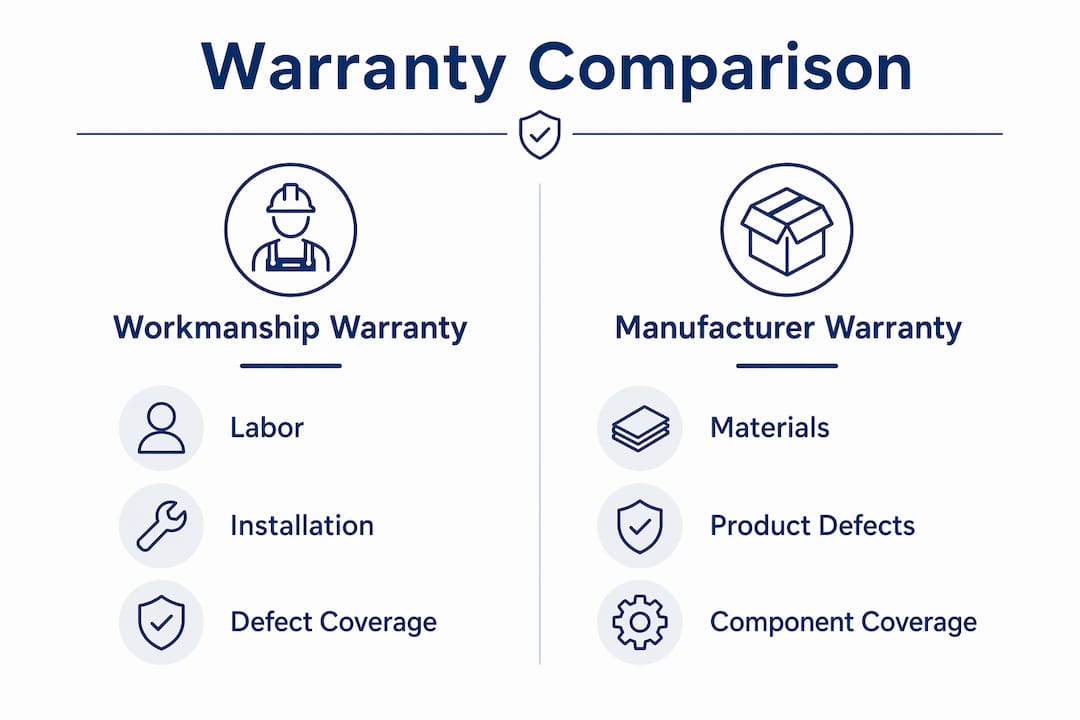
Disputes arise most often when the cause of a defect is unclear. A leaking roof could be caused by defective shingles (manufacturer’s problem) or by improper installation (contractor’s problem). Causation determines liability, and contractors are generally responsible only for defects that trace back to their labor or failure to follow the project plans.
Here is how responsibility typically breaks down:
- Contractor is liable: improper installation, failure to follow specifications, poor technique
- Manufacturer is liable: material that fails under normal conditions despite correct installation
- Shared liability: cases where both poor installation and a material defect contributed to the failure
The overlap zone is where claims get complicated. A contractor may argue the material was defective. A manufacturer may argue the installation was wrong. You need clear documentation to prove which party is responsible.
Pro Tip: When a defect appears, photograph it immediately and note the date. This creates a timestamped record before any party has a chance to dispute the timeline.
What are the legal implications of workmanship guarantees?
Workmanship warranties come in two legal forms: express and implied. An express warranty is written into the contract. An implied warranty exists by law in most states, even when no written warranty is provided.
Many jurisdictions recognize an implied warranty of workmanlike performance, which requires contractors to perform work with reasonable skill and care. This implied protection varies by state, but it gives homeowners a legal baseline even when a contractor’s written warranty is weak or absent. The implied warranty interacts differently with express warranties depending on local statutes, so the written contract language still matters.
Standard commercial construction contracts in the United States commonly include a one-year correction period. During that period, the contractor is required to fix any defects reported in writing. That one-year window is not a ceiling. Extended warranty terms referenced in contract specifications can legally bind a contractor to longer periods, even if their standard guarantee is shorter.
Common reasons warranty claims fail:
- Written notice of the defect was not submitted within the correction period
- The defect description was too vague to trigger the contractor’s repair obligation
- The homeowner made modifications that voided the warranty terms
- The claim was filed after the warranty period expired
- Documentation was insufficient to prove the defect was a workmanship issue
Timely written notice with a detailed description of the defect is the single most critical step in enforcing a workmanship warranty. Missing this requirement can waive your right to demand correction entirely, even when the defect is obvious and real.
How can homeowners maximize workmanship warranty protection?
Strong warranty protection starts before the contractor picks up a single tool. The steps you take at the contract stage and during the project determine how much leverage you have if something goes wrong later.
Follow these steps to protect yourself:
- Get the warranty in writing. Confirm the warranty period, what it covers, and the exact process for filing a claim. Verbal assurances are not enforceable.
- Read the exclusions carefully. Know what voids your warranty before you sign. Owner modifications and lack of maintenance are the two most common traps.
- Document the project from day one. Take photos before, during, and after the work. Note any concerns in writing and keep copies of all communications.
- Report defects immediately. As soon as you notice a problem, document construction defects with photos, written logs, and dates. Do not wait to see if the issue resolves itself.
- Send written notice to the contractor. Email or certified mail creates a paper trail. State the defect clearly: what it is, where it is, and when you first noticed it.
- Track the contractor’s response. Log every communication, repair attempt, and outcome. This record supports your claim if the dispute escalates.
- Verify contractor credentials. Licensed and insured contractors are more likely to honor warranty obligations. Check licensing status before signing any contract.
Selecting a contractor with a clear warranty policy is just as important as the warranty terms themselves. Tips for hiring exterior repair contractors consistently point to warranty clarity as one of the top factors separating reliable contractors from those who disappear after the final payment. The workmanship guarantee importance goes beyond paperwork. It reflects the contractor’s confidence in their own work.
Pro Tip: Maintain a dedicated folder (physical or digital) for each project. Store the contract, warranty document, all photos, and every piece of written communication in one place. This takes five minutes to set up and can save you thousands in a dispute.
Key Takeaways
A contractor workmanship warranty protects homeowners by holding contractors accountable for installation quality, but enforcement depends entirely on written notice, clear documentation, and understanding what the warranty actually covers.
| Point | Details |
|---|---|
| Workmanship covers labor, not materials | Contractor warranties apply to installation errors; manufacturer warranties cover product defects. |
| Written notice is non-negotiable | Failing to submit written notice within the warranty period can void your right to a correction. |
| Implied warranties provide a legal backstop | Most states recognize an implied warranty of workmanlike performance even without a written guarantee. |
| Documentation wins disputes | Photos, defect logs, and written communications are the evidence that makes or breaks a warranty claim. |
| Exclusions limit coverage | Owner modifications, neglect, and acts of God are not covered under any standard workmanship warranty. |
What 20 years of warranty work has taught me
After more than two decades working on homes across Northern Virginia, I have seen the same pattern repeat itself. Homeowners assume a warranty means they are fully covered no matter what happens. Then a defect appears, they call the contractor, and they discover the claim is denied because they never sent written notice, or they painted over the problem before reporting it, or they modified the area after the job was done.
The biggest misconception I see is that a workmanship warranty is a guarantee of perfection. It is not. It is a defined promise with specific terms, and those terms have teeth on both sides. The contractor has real obligations, but so does the homeowner. You have to report problems promptly, document them properly, and follow the process the contract spells out.
The second mistake is assuming the contractor will volunteer to fix something. Good contractors do. But when a dispute arises, the homeowner who wins is always the one with a paper trail. A photo taken the day you noticed the problem is worth more than any verbal account of what happened.
My advice: treat your warranty document the way you treat your homeowner’s insurance policy. Read it before you need it. Know the deadlines. Know the exclusions. And when something looks wrong, act the same day. The craftsmanship behind quality remodeling matters deeply, but so does the homeowner’s role in protecting the warranty that backs it up.
— Sam
Warranty-backed home repairs from Sam & Sons Services
Sam & Sons Services has served homeowners and property managers throughout Northern Virginia for over 20 years. Every job comes with a clear workmanship commitment backed by licensed, insured professionals who stand behind their work.

Whether you need plumbing, electrical, HVAC, or full home renovation in Northern Virginia, Sam & Sons Services delivers quality you can verify and warranty terms you can actually read before signing. The team is available 24/7 for urgent repairs across Alexandria, Arlington, Fairfax, and the greater DC area. Have questions about what a workmanship warranty covers for your specific project? Visit the handyman FAQ page for direct answers, or contact Sam & Sons Services today to schedule a service call.
FAQ
What is a contractor workmanship warranty?
A contractor workmanship warranty is a written or implied promise that the labor and installation performed on a project meets professional standards and will be free from defects for a defined period. It covers how the work was done, not the materials used.
How long does a workmanship warranty typically last?
Most standard construction contracts include a one-year correction period, though contract specifications can extend this. Always check your written contract for the exact duration.
What voids a contractor workmanship warranty?
Owner modifications, failure to maintain the work, and damage from storms or neglect typically void a workmanship warranty. Review your contract’s exclusions section before making any changes to completed work.
What happens if my contractor has no written warranty?
Most states recognize an implied warranty of workmanlike performance even without a written guarantee. This implied protection requires contractors to perform work with reasonable skill and care, though coverage varies by jurisdiction.
How do I file a workmanship warranty claim?
Submit written notice to your contractor as soon as you identify a defect. Include the location, description, and date you first noticed the problem. Attach photos and keep copies of all communications to support your claim.


You must be logged in to post a comment.