 Skip to content


A licensed handyman is defined as a contractor who meets state and local regulatory standards, including passing exams, carrying insurance, and pulling permits where required. An unlicensed handyman operates without those credentials. Understanding the licensed vs unlicensed handyman explained distinction is not just a legal formality. It directly affects your financial exposure, your home’s safety, and whether your homeowner’s insurance will pay out if something goes wrong. The difference matters most when you are deciding who to trust with your property.
What licenses and permits do handymen actually need?
The answer depends on your state and the type of work involved. A general business license is required in most jurisdictions, but a contractor license is a separate and higher bar. A contractor license is triggered when a project exceeds a state-set dollar threshold or involves a regulated trade.
Minor work exemption thresholds vary widely by state. California sets the limit at $500, Florida at $1,000, and other states allow thresholds well above $5,000 for total project cost including materials. Below these thresholds, an unlicensed handyman may work legally. Above them, a contractor license is required.
These exemptions have hard limits. Regulated trades like electrical, plumbing, and HVAC always require a licensed contractor, regardless of the project cost. A $300 electrical repair still requires a licensed electrician in most states. Homeowners who assume the dollar threshold covers all work types are making a costly mistake.
Permit requirements add another layer. Any project that requires a building permit almost always requires a licensed contractor to pull that permit. An unlicensed worker cannot legally obtain permits in most jurisdictions.
Pro Tip: Never let a contractor suggest splitting one project into two smaller invoices to stay under the licensing threshold. Splitting projects to avoid licensing is considered licensing fraud and can void your contract entirely.
- General business license: required for most handyman operations in most states
- Contractor license: required when project cost exceeds state thresholds or involves regulated trades
- Electrical, plumbing, HVAC, and structural work: always require a licensed contractor
- Permit-required projects: almost always require a licensed contractor to pull the permit
- Commercial properties: typically face stricter licensing requirements than residential jobs
How do costs and insurance compare between licensed and unlicensed workers?
Cost is the most common reason homeowners consider unlicensed handymen. Licensed contractors charge $85–$200 per hour depending on the trade. General handyman rates run $65–$125 per hour. The gap is real, but the comparison does not end at the hourly rate.

| Factor | Licensed Contractor | Unlicensed Handyman |
|---|---|---|
| Hourly rate | $85–$200 | $65–$125 |
| General liability insurance | Required | Usually absent |
| Workers’ compensation | Required | Usually absent |
| Warranty type | Written and enforceable | Verbal or informal |
| Permit eligibility | Yes | No in most states |
| Licensing board oversight | Yes | No |
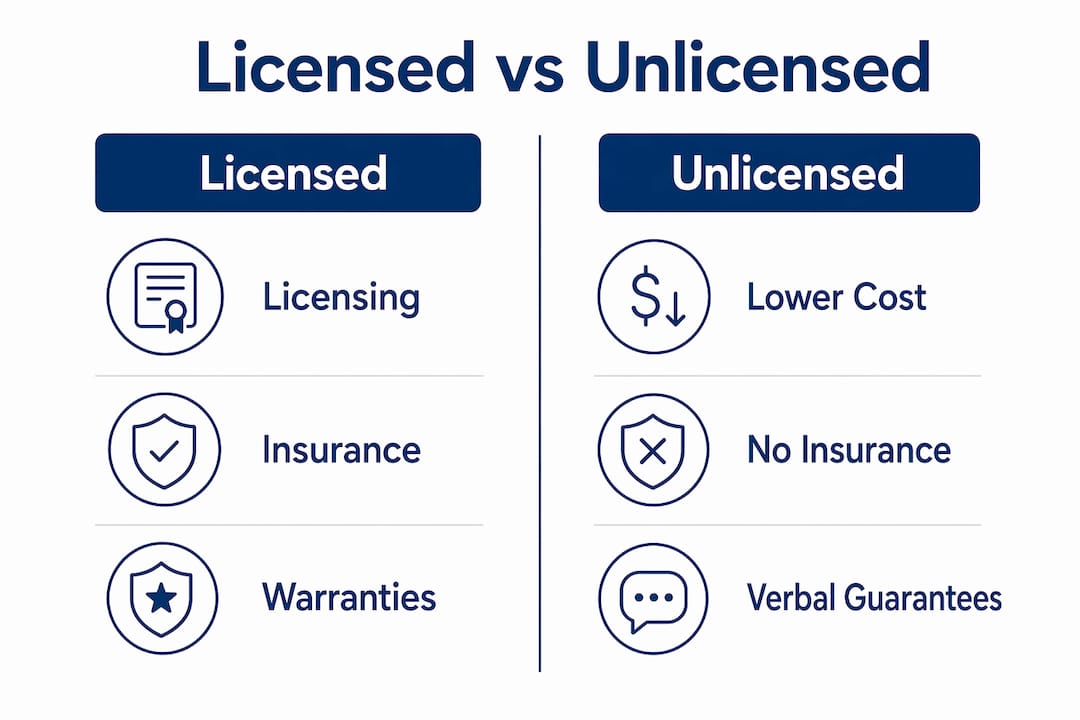
Licensed contractors must carry general liability and workers’ compensation insurance. Unlicensed workers usually carry neither. That gap creates direct financial risk for you as the homeowner.
Written warranties from licensed contractors are enforceable and provide real recourse if work fails. Verbal guarantees from unlicensed handymen are difficult to enforce and rarely hold up in a dispute. The lower hourly rate can quickly become the more expensive option when something goes wrong.
Pro Tip: Always ask for a certificate of insurance before any work begins. A licensed contractor should provide proof of both general liability and workers’ comp without hesitation. If they cannot, treat that as a red flag regardless of their license status.
What legal and safety risks come with hiring unlicensed handymen?
Homeowners consistently underestimate the legal consequences of unlicensed work. The risks go well beyond a failed inspection.
In California, Business and Professions Code §7031 allows homeowners to recover all payments made to an unlicensed contractor for work that required a license. That applies even if the work was completed correctly. The unlicensed contractor has no legal standing to enforce payment or defend the contract in court.
Unlicensed work can void homeowner insurance claims when damages trace back to unpermitted or code-violating work. Insurance companies deny claims citing non-compliance when unlicensed work is involved. A leaking pipe repaired without a license, which later causes water damage, may result in a denied claim and full out-of-pocket costs for you.
Worker injury liability is the risk most homeowners never consider. If an unlicensed worker is injured on your property and carries no workers’ compensation insurance, you may be legally responsible for their medical bills and disability expenses. That exposure can exceed the cost of the original project by a significant margin.
Safety risks from unverified competence are equally serious. Consider these common handyman tasks that carry real danger when done improperly:
- Electrical panel work or outlet wiring: fire and electrocution risk
- Gas line connections for appliances: explosion and carbon monoxide risk
- Structural modifications like removing walls: collapse risk if load-bearing walls are affected
- Water heater installation: scalding, gas leaks, and flooding risk
- HVAC repairs: refrigerant handling requires EPA certification; improper work causes system failure
Licensing ensures regulatory compliance and a verified safety net for homeowners. An unlicensed worker in these trades is not just a legal risk. They are a physical safety risk to your household.
How to decide whether to hire a licensed or unlicensed handyman
Match your project scope to the right professional to avoid legal and safety exposure. The decision framework is straightforward once you know the criteria.
- Identify the trade involved. Electrical, plumbing, HVAC, and structural work require a licensed contractor in virtually every state. No dollar threshold changes that.
- Check your state’s exemption threshold. If the total project cost including materials falls below your state’s minor work limit, an unlicensed handyman may be legal for general repairs. Verify your state’s specific number before hiring.
- Determine if a permit is required. Call your local building department or check their website. If a permit is needed, you need a licensed contractor who can pull it legally.
- Verify the license. Every state maintains a public contractor license database. In Virginia, the Department of Professional and Occupational Regulation allows license verification online. Confirm the license is active and covers the work type.
- Confirm insurance coverage. Request a certificate of insurance showing both general liability and workers’ compensation. Verify the policy is current, not expired.
- Get everything in writing. A written contract should specify the scope of work, materials, timeline, payment schedule, and warranty terms. Verbal agreements are unenforceable in most disputes.
- Check reviews and references. Look for reviews on Google, Yelp, or the Better Business Bureau. Ask for two or three references from similar projects completed in the past year.
For simple, non-specialized maintenance tasks like patching drywall, painting, or replacing cabinet hardware, an unlicensed handyman may be a legal and cost-effective option in states with higher exemption thresholds. For anything involving systems, permits, or structural elements, a licensed contractor is the only defensible choice.
Key Takeaways
Hiring a licensed contractor is the only legally and financially sound choice for any project involving regulated trades, permits, or work above your state’s minor work exemption threshold.
| Point | Details |
|---|---|
| Licensing thresholds vary by state | California sets the limit at $500; Florida at $1,000; always verify your state’s specific threshold before hiring. |
| Regulated trades always need a license | Electrical, plumbing, HVAC, and structural work require a licensed contractor regardless of project cost. |
| Insurance gap creates homeowner liability | Unlicensed workers usually lack workers’ comp, leaving you responsible for on-site injuries. |
| Unlicensed work can void insurance claims | Damages tied to unpermitted or unlicensed work are commonly denied by homeowner insurance policies. |
| Written warranties are only from licensed pros | Licensed contractors provide enforceable written warranties; unlicensed handymen typically offer only verbal assurances. |
What 20 years of home service work taught me about handyman licensing
Licensing is not bureaucracy. It is the single most reliable filter for separating professionals who are accountable from those who are not. After two decades serving homeowners across Northern Virginia, the pattern is consistent. The jobs that turn into expensive disasters almost always share one trait: an unlicensed worker was involved in a task that required a license.
The most common mistake I see is homeowners applying the minor work exemption too broadly. They hear “under $500 is fine” and assume that covers any small job, including electrical outlet work or a quick gas line reconnection. It does not. Those trades require a license at any price point, and the exemption was never designed to cover them.

The second mistake is treating a lower hourly rate as savings. A licensed contractor at $120 per hour who carries insurance, pulls permits, and provides a written warranty is almost always the better financial decision over a $70 per hour unlicensed worker who leaves you exposed to denied insurance claims and personal injury liability.
My practical advice: build a checklist before you hire anyone. Confirm the license, confirm the insurance, confirm the permit requirement, and get the scope in writing. That process takes 20 minutes and can save you thousands. The homeowners who skip it are the ones who call us later to fix what went wrong.
— Sam
Trusted licensed handyman services from Sam and Sons Services
Sam and Sons Services has served homeowners across Northern Virginia and the Washington, DC area for over 20 years with licensed, insured professionals who handle everything from general repairs to complex system work.
Every technician at Sam and Sons Services carries the proper licensing and insurance for their trade. Written warranties back every job. Whether you need a quick repair or a full home renovation, you get professionals who meet every legal requirement and stand behind their work. Browse common handyman questions to understand what licensing and service scope applies to your project. For homeowners in the DC metro area, Sam and Sons Services also provides licensed home services in Washington, DC and throughout Northern Virginia. Call today to schedule with a team you can trust.
FAQ
What is the difference between a licensed and unlicensed handyman?
A licensed handyman or contractor meets state requirements including exams, insurance, and permit eligibility. An unlicensed handyman operates without those credentials and is only legal for minor work below state-set dollar thresholds.
Can an unlicensed handyman legally work on my home?
Yes, in many states, for small general repairs below the minor work exemption threshold. However, electrical, plumbing, HVAC, and structural work require a licensed contractor at any price point.
What happens if I hire an unlicensed contractor for work that requires a license?
Your homeowner’s insurance may deny related claims, and in states like California, you can recover all payments made to the unlicensed contractor under laws like Business and Professions Code §7031.
How do I verify a handyman’s license?
Most states maintain a public online database for contractor license verification. In Virginia, the Department of Professional and Occupational Regulation provides a free license lookup tool. Always confirm the license is active and covers the specific trade.
Is a licensed handyman worth the higher cost?
For any job involving regulated trades, permits, or work above your state’s exemption threshold, yes. The written warranty, insurance coverage, and legal protection from a licensed contractor outweigh the hourly rate difference in almost every scenario.


You must be logged in to post a comment.