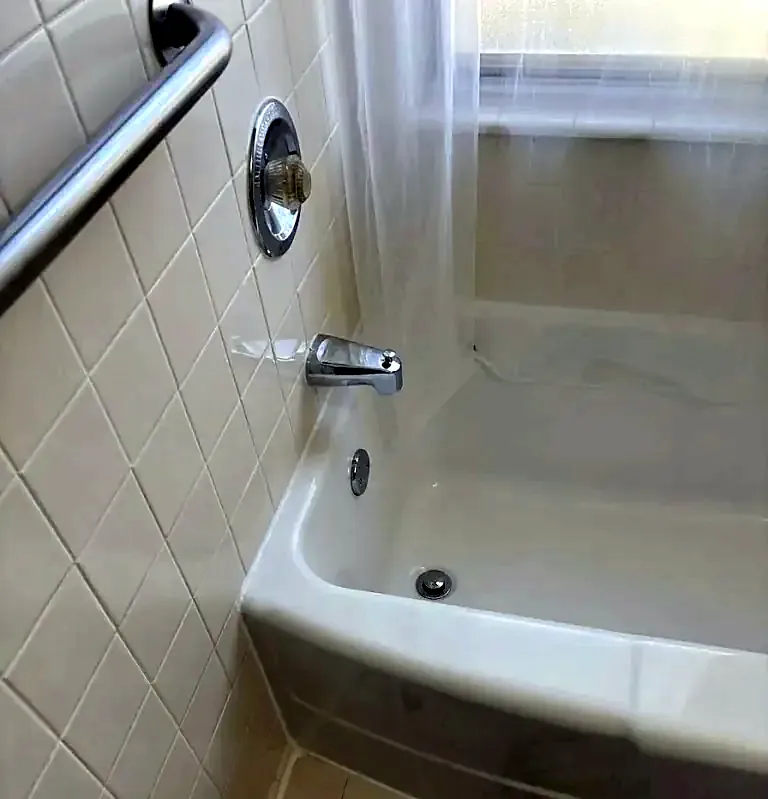
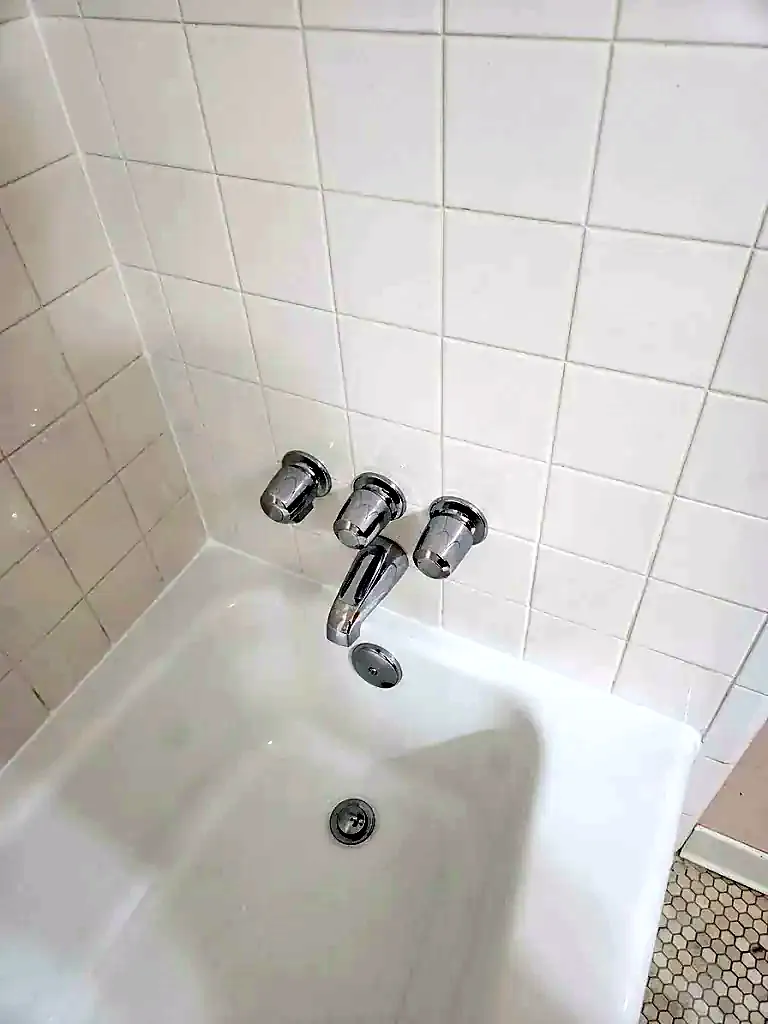
A dripping shower is almost always the cartridge inside the in-wall valve body. If the cartridge will come out, the repair is a cartridge and seals through the trim opening, with no tile disturbed. If it has seized in the body — which is what months or years of dripping does to it — the valve body itself has to be replaced, and that needs access from the front through tile or from behind the wall. Which one you have is decided at the valve, not on the phone.
Why a shower faucet keeps dripping after the handle is off
A shower valve is a mixing valve buried in the wall. Only the trim — handle, escutcheon, spout and head — is visible. When it drips, one of a short list of parts inside the wall has stopped sealing.
- A drip from the shower head with the handle closed
- The cartridge is worn. Water is passing the seals inside the valve body and running out through the head. This is the classic repairable fault.
- A drip or run from the tub spout with the handle closed
- Same cause. The water takes the lower opening because it is the path of least resistance.
- Water running from the spout while the shower head is on
- The diverter — either the pull-up gate on the spout or the diverter cartridge in the valve — has failed.
- Dripping that gets worse over months, then will not stop
- The seals have gone and mineral scale is building in the same place. This is the point where a cartridge change is still straightforward. Past it, it usually is not.
- Wet drywall or a stain on the ceiling below
- That is no longer a trim problem. One tub and shower diverter that had been leaking through the tile at the back wall was dripping down into the room below, and on another job a leak search found at least three sheets of ceiling drywall wet before the failed valve was found. See shower leak repair.
A drip is not cosmetic. It is line pressure escaping past a seal continuously, and everything downstream of it — scale, staining, and eventually the valve body — gets worse the longer it runs.
Can a shower cartridge be replaced without opening the wall?
Yes, in most cases, and it is the first thing we attempt. On a standard single-handle valve the handle, escutcheon and retaining clip come off, the cartridge pulls out through the trim opening, and a new cartridge and seals go back in. No tile is cut and nothing is opened.
Three things decide whether it works:
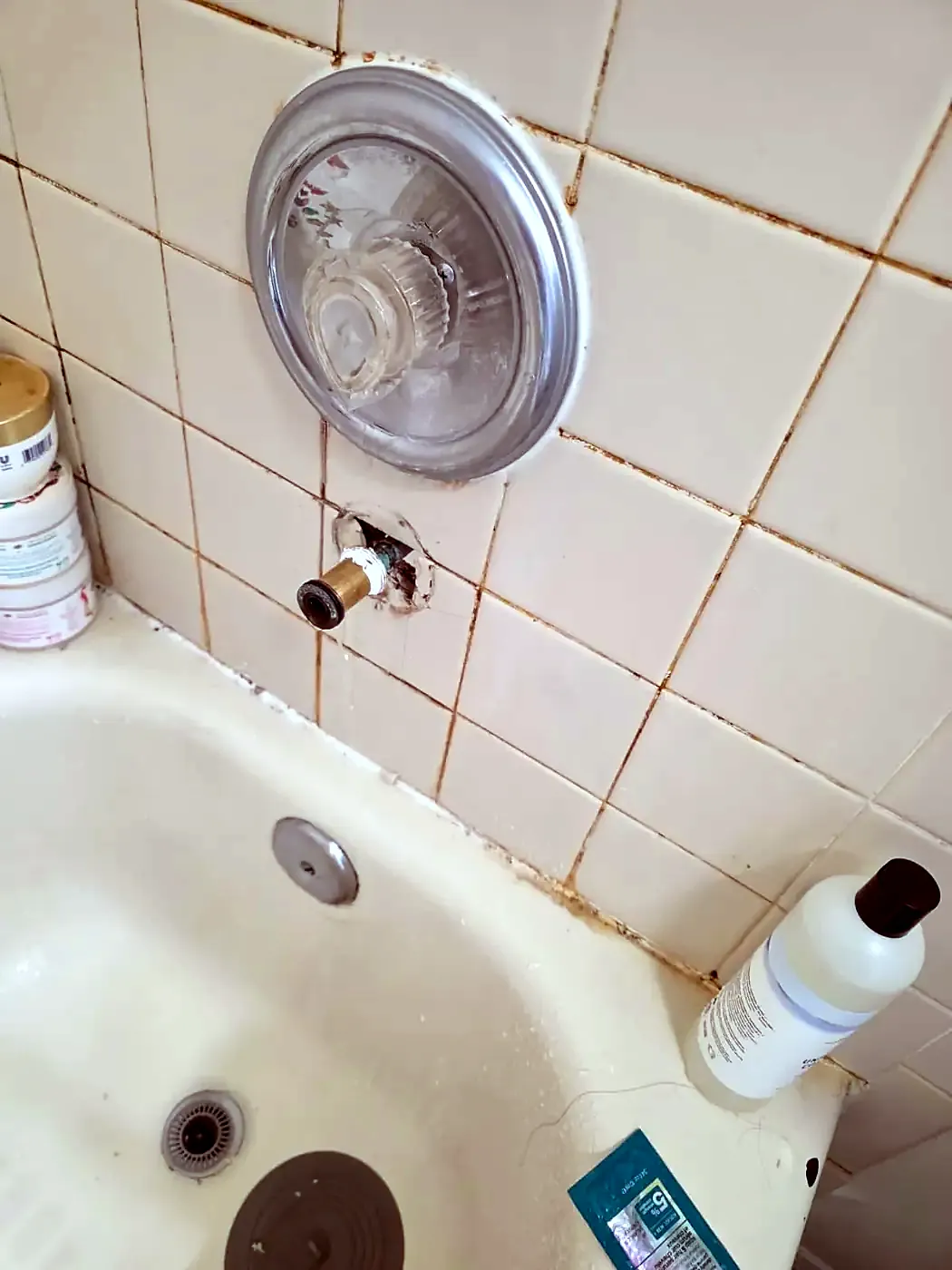
- Whether the cartridge will move. Scale and corrosion lock a cartridge into the brass body. A puller will release most of them; some will not come at any pull.
- Whether the cartridge can be identified. Major brands are supported for years and the part is on the shelf at the supply house. An unmarked or obsolete valve may have nothing available.
- Whether the valve body is sound. If the body is pitted where the cartridge seals, a new cartridge drips against the same damaged surface.
Rebuild kits work the same way on tub and shower diverters, and we attempt them first — though on a diverter that has been leaking for a long time, the gaskets themselves may be seized in place and the rebuild has to be attempted before anyone can promise it.
When a seized cartridge means replacing the whole shower valve
This is the single most important thing to understand about these repairs, because it is what determines whether you are having a small job or a real one — and it is decided by how long the fault has been left.
- One homeowner reported a shower that had been dripping for several months. When the technician attempted the cartridge, it was seized and could not be pulled. The faucet itself had to be replaced.
- Another had turned a shower off entirely at the stops roughly three years earlier because it would not stop running. Three years standing still had frozen the cartridge solid inside the valve body, so the whole faucet had to go — and wallpaper covering the wall behind the valve meant access had to be cut.
- On a call about a tub and shower diverter that had been leaking for months, the risk was named up front: after that long, the cartridge is likely seized inside the valve body, so the rebuild is attempted with the replacement in reserve.
- A valve that is replaced rather than rebuilt is fitted as a single-handle shower faucet with new supply piping as needed. Where we can, we fit a unit with integral shut-off valves in the valve body, so the next repair does not mean shutting the house down.
The practical advice is simple: a shower that drips is cheaper to fix this month than next year, and vastly cheaper than after three years shut off.
Why a tub and shower diverter leaks behind the tile
The diverter sends water up to the head instead of out of the spout, and it fails in ways that are easy to misread as a shower head problem.
The common complaint is water still running from the tub spout while the shower is on. That is wasted hot water and it is a failed diverter. Less obvious, and far more damaging, is a diverter leaking inside the wall: one that had been failing for a long time was leaking through the tile at the back wall of the tub and causing drips into the room below, and it was replaced with a single-lever tub and shower diverter together with new copper and a handheld shower. A second job of the same kind needed a full leak search, replacement of the tub and shower diverter valve, new trim and about three sheets of ceiling drywall.
Diverters are rebuildable when the gaskets have not seized. We attempt the rebuild first and tell you honestly that it may not hold. Where the tub, surround or caulk joint is also part of the problem, see shower and bathtub repair.
A shower that will not turn off, or will not shut down fully
This is treated as urgent, because a valve that will not close is line pressure with nowhere to stop.
It is not always the valve's fault. One customer's shower would not turn off, and the problem had started right after the county shut the water off at the house and turned it back on. On disconnecting the handle the technician found debris and calcium sitting in the shower line. A check of the rest of the property found six shut-off valves leaking, broken or fouled with the same calcium, and the kitchen fixture jammed with it as well. A utility shut-off and restart stirs the mains and pushes that material into every valve in the house.
On a valve that cannot be made to close and cannot be immediately replaced, the honest interim is to cap the shower off so the rest of the house keeps water while the correct valve is sourced. We say that in advance rather than discovering it in front of you. For an active leak out of hours, see emergency plumber.
Pressure-balancing, thermostatic and anti-scald shower valves
If your shower runs cold when a toilet is flushed, or scalds when the washing machine fills, the valve is doing exactly what an old valve does — nothing. Current valves are required to protect against that, and it is worth knowing which type you are being offered.
| Valve type | What it does | Where it fits |
|---|---|---|
| Pressure-balancing | Holds the hot and cold ratio steady when pressure on one side drops, so a flushed toilet does not scald you | The standard single-handle replacement. Cartridge-serviceable. |
| Thermostatic | Holds a set temperature rather than a set ratio, and usually separates volume from temperature | Specified on tiled shower builds where the homeowner wants a fixed temperature. We have installed these as part of full bathroom builds. |
| Diverter / transfer | Sends water between spout, head and handheld | Tub and shower combinations and multi-outlet showers. |
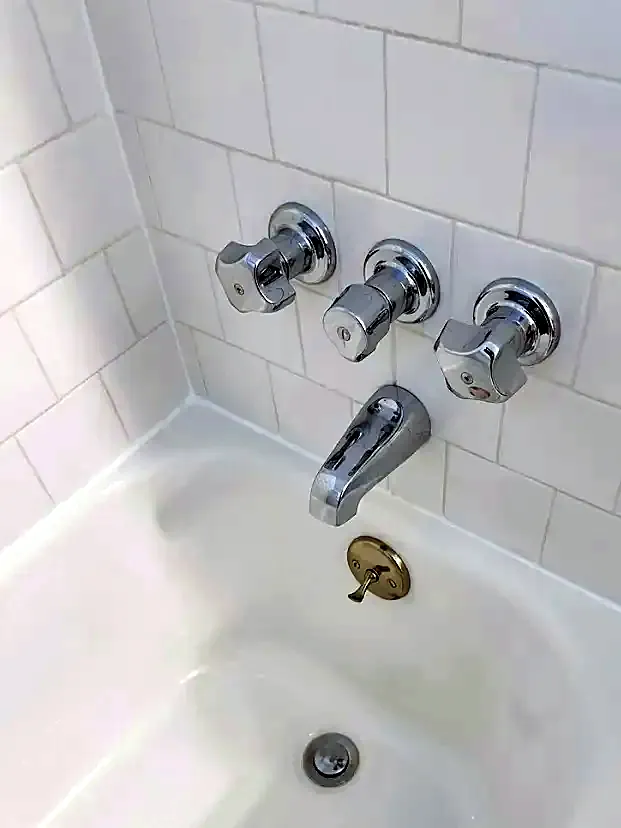
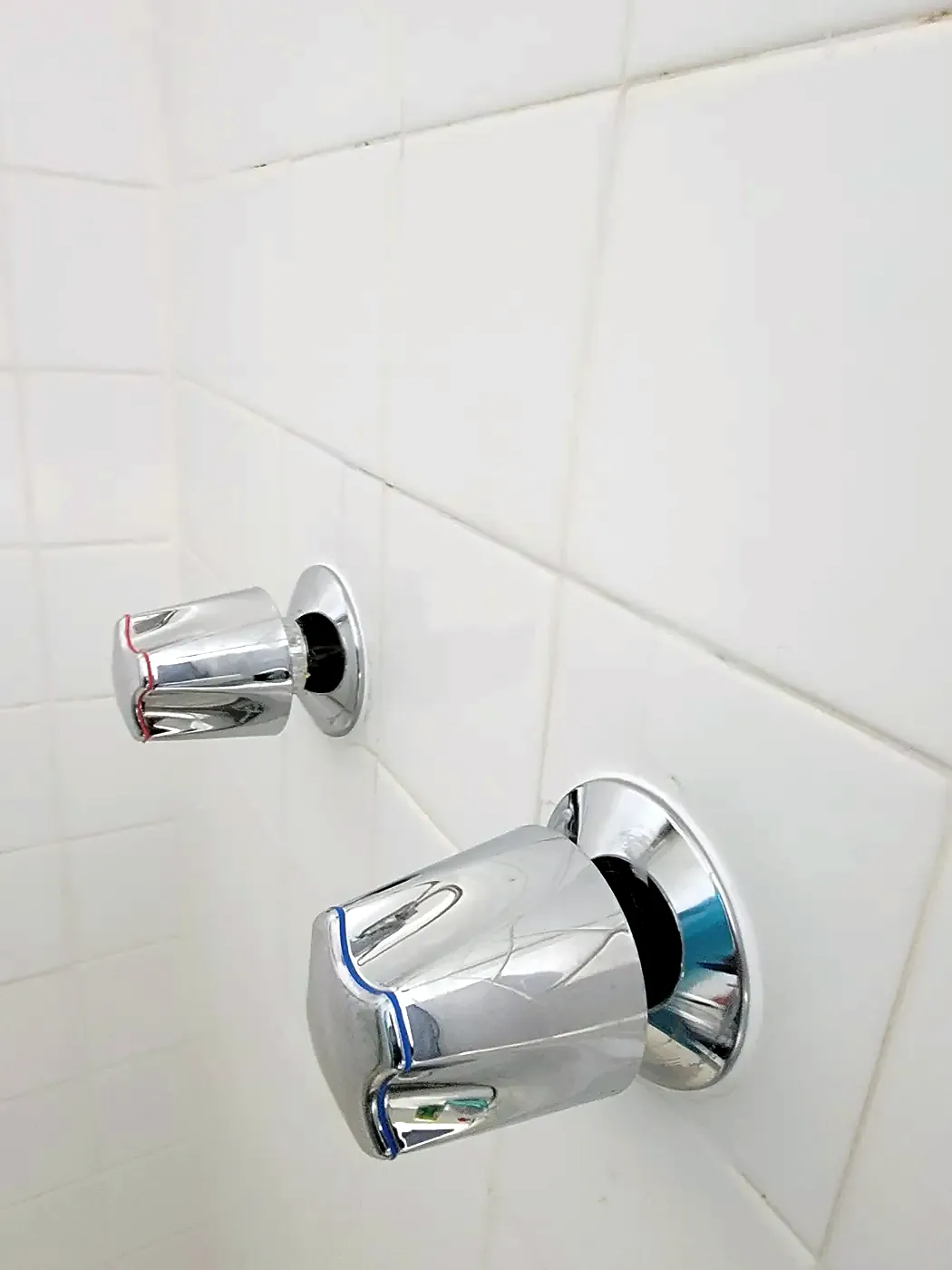
| Older two- and three-handle valves | Separate hot, cold and sometimes diverter stems, with no balancing at all | Repairable with stem kits while parts last; replaced with a single-handle balanced valve when they run out. |
Households with small children or older residents ask for this specifically, and we have replaced shower faucets purely to get child-safe temperature protection into a bathroom that did not have it.
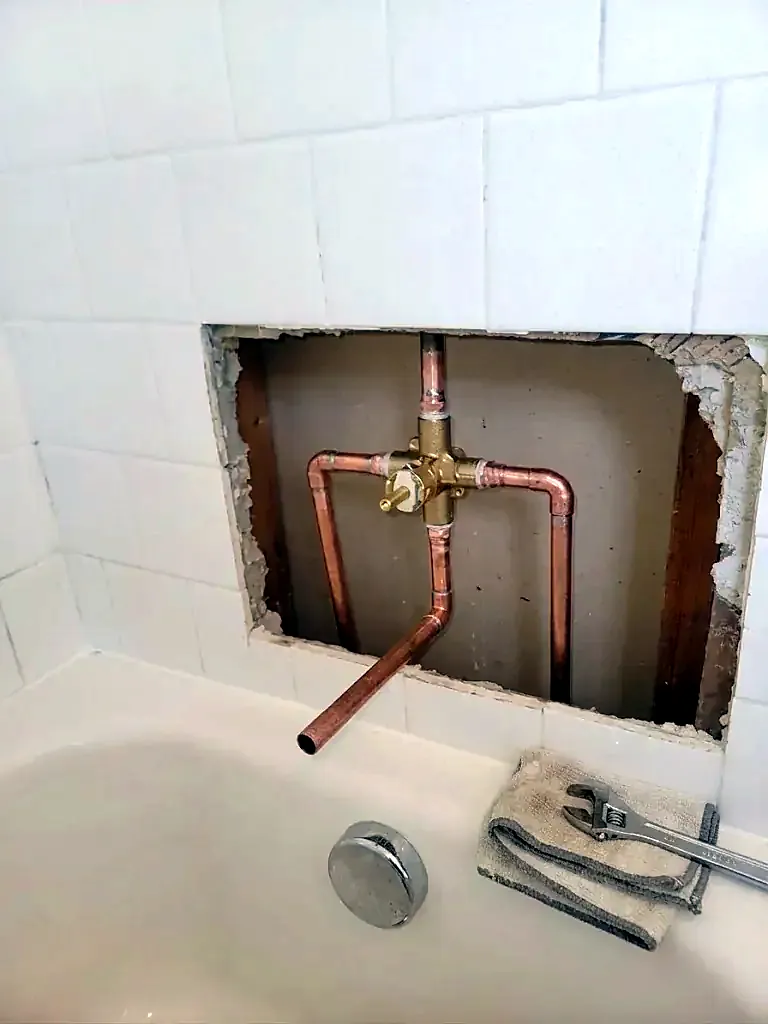
How we reach an in-wall shower valve: access panels and tile
When the valve body itself has to come out, there are only three ways in, and we will tell you which one applies before anything is cut.
- Through the trim opening. Only possible for cartridge and seal work. No damage, no repair afterwards.
- From behind the wall. The best outcome when there is a closet, hallway or adjoining room behind the valve. On one job the upstairs shower plumbing was only reachable from behind the wall, and that is how it was done. On another, a hole was opened behind a stand-up shower to reach the piping.
- Through the tile. Where nothing is behind it, access means removing tile. On a condominium unit, reaching the shower faucet plumbing meant taking out one vertical row of wall tile — and where an exact tile match no longer existed, the substitute color was approved by the homeowner before it went back.
Where tile has to come off, we recommend leaving a proper access panel behind, and we have built them into finished work at the homeowner's request. It turns the next repair into a twenty-minute job. Tile that has to be cut and made good afterwards is handled as tile repair; a valve being moved as part of a rebuilt bathroom belongs with bathroom remodeling.
Does shower valve replacement need a permit in Virginia?
Changing a cartridge, a seal kit or trim does not. Replacing the valve body means cutting into the supply piping inside the wall, and that is permitted work: we pull and process the permit, run the work to the Virginia building code, and close it out with a county final inspection with the last portion of payment held back until it passes.
Replacing in-wall piping is often part of it. We have replaced shower supply piping inside the wall as a matter of course when the wall was already open, run new copper where a section had failed, and replaced aging polybutylene feeding a basement bathroom's sink, toilet and shower with CPVC — adding hot and cold shut-off valves for the shower where there had never been any. Sam & Sons Services has held Virginia DPOR license number 2705070610 and worked across Northern Virginia since 1999.
What shower valve repair costs, and why there is no phone price
Because the same two words — dripping shower — cover a cartridge swap through the trim plate and a valve body replacement behind tile. Nobody can tell which one you have until the handle comes off, and a number quoted before that is either padded or going to change.
An estimator sees the valve, the trim, the wall behind it and what is on the other side, and puts a written price in front of you before any work starts. For the family of fixture repairs this belongs to, see faucet repair and replacement.