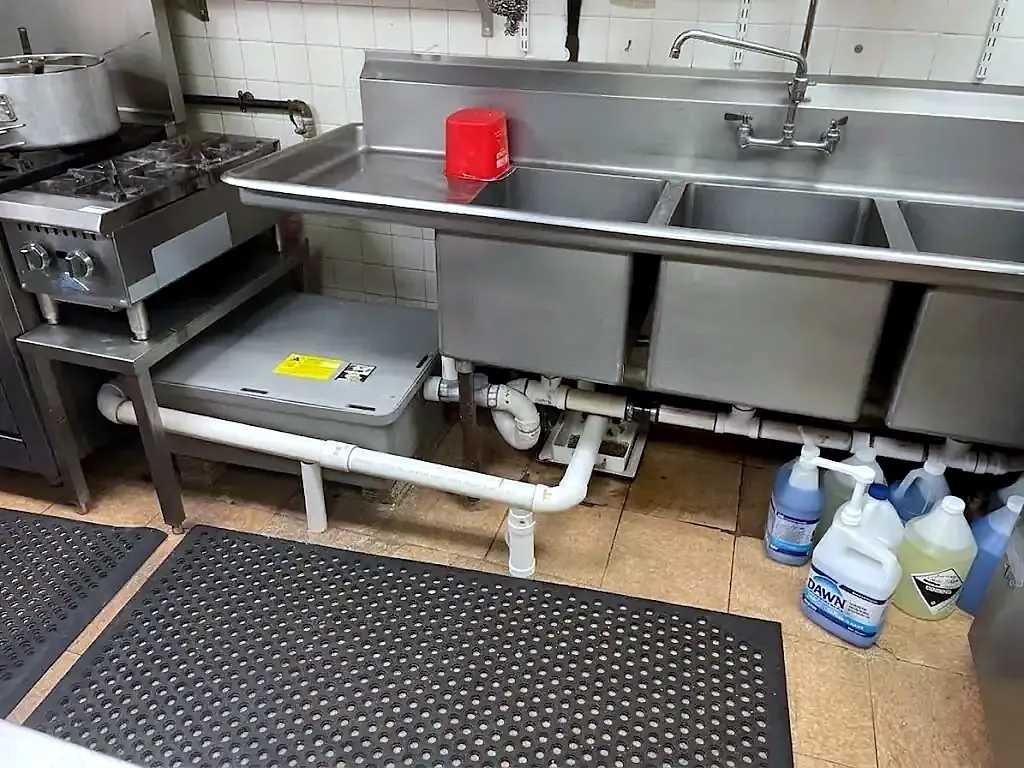
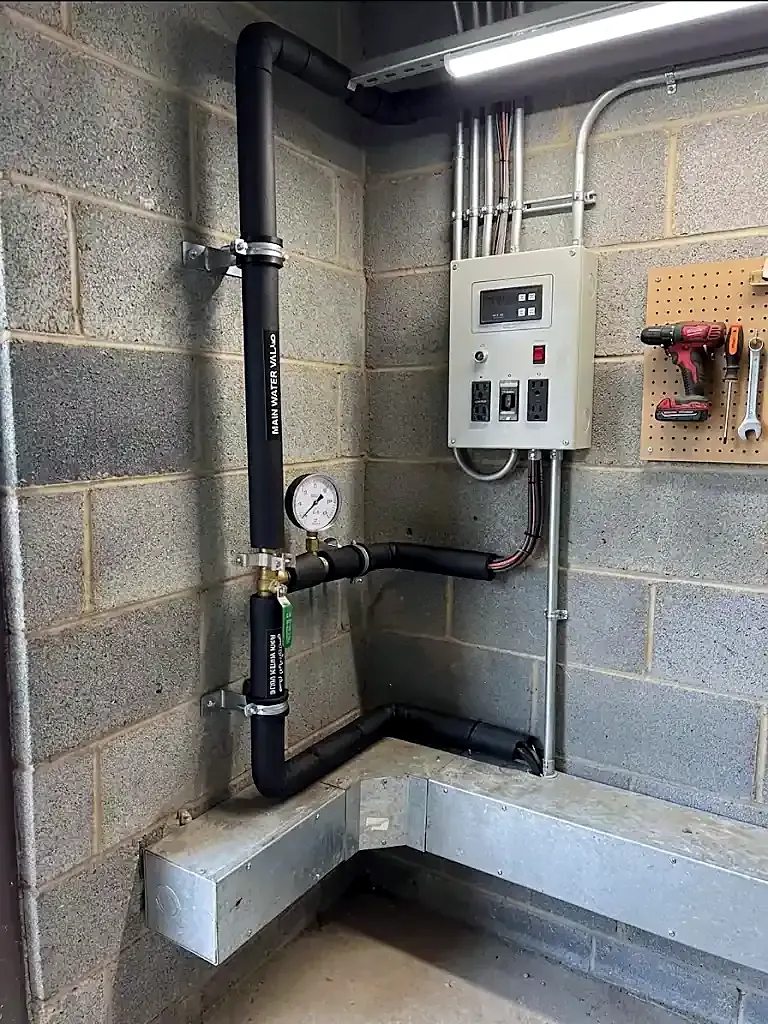
Commercial plumbing is the same trade as residential with three differences that decide everything: the building cannot be shut down at will, the person calling is rarely the person using the fixture, and the work has to be planned around tenants and trading hours. We work for property managers, multifamily and apartment buildings, offices, restaurants and retail sites across Northern Virginia, under permit and to the Virginia building code, as a licensed Class A contractor.
What commercial plumbing work we take on
The record of what we actually do on commercial and managed property, rather than a list of everything a plumber could theoretically be asked for:
- Restroom repairs — toilets, urinals, flushometers, closet flanges and bolts, mixing valves, wall-hung sinks, faucets and stops.
- Drain and main line clearing in buildings where several fixtures share one line and pulling a fixture is the only way in.
- Main shut-off valves, risers and isolation for a whole building, including the drain-down that goes with it.
- Apartment and unit work — full unit remodels, bathrooms, kitchens, water heaters, heating equipment, outlets and devices.
- Per-unit inspection programs across a multifamily building ahead of the heating season.
- New fixture and rough-in work — adding a kitchen or a restroom to an existing commercial space, tying a new waste line into the main stack and running supply off the building riser.
- Leak tracing above finished ceilings in occupied premises, with containment.
- Taking fixtures and lines out of service where a space is being reconfigured.
Where the same job spans trades — plumbing, heating and electrical in one unit turnover, for instance — it stays with one contractor and one point of contact.
Commercial restroom repairs: toilets, urinals and flushometers
Public restrooms fail differently from domestic ones. The fixtures are commercial-grade, the abuse is constant, and the same fault repeats across every stall in the room.
- A toilet that rocks or sits loose
- Usually broken closet bolts at the flange. On one commercial call the men's room toilet was loose because both bolts had failed; it came off, the flange was cleaned, two new closet bolts and a new wax ring went in and the fixture was reset.
- A flange rusted out under the fixture
- On another, a commode that would not flush had to be pulled to reach the line, and the closet flange beneath it was found rusted through with both bolts stripped. It was repaired with two spanner flanges and the toilet reset on a new wax seal.
- A blockage inside the fixture itself
- A clogged commercial toilet is not always a line problem. One women's room toilet had an obstruction inside the fixture, which meant pulling it to reach the obstruction rather than cabling the drain.
- A urinal leaking or draining slowly
- The question is whether the leak is at the fixture connection or in a cracked pipe inside the tiled wall, so the urinal is pulled and the in-wall pipe inspected. On that job the flushometer kit was replaced with a new cut-off valve, a cut-off valve was fitted for the urinal itself, and the drain was snaked and treated — with the tile wall opened to replace pipe only if the leak persisted.
- A faucet running continuously
- On one call the cause was the valves, not the faucet: two shut-offs needed replacing and the mixing valves in both restrooms were due. Both mixing valves, both faucets, the shut-offs and the supply lines were changed in one visit, with the wall-hung sinks removed and reinstalled for access.
See toilet repair and installation for the fixture work, and drain cleaning for lines that need cabling and treating.
Multifamily and apartment plumbing for property managers
A lot of our commercial work is multifamily, and the job is usually a whole unit rather than a single fixture.
Complete apartment unit turnovers in our files have run to two bathrooms and a kitchen, the electrical panel and every device in the unit, interior doors and trim, wallpaper removal and paint, the furnace, and flooring — one contract, one schedule. Apartment bathroom remodels have included the tub, wall and floor tile, vanity, toilet, fixtures and finishes, with the subfloor and wall framing inspected once the tub and wallboard were out and the findings reported before rebuilding started.
The same applies to equipment. One unit's failed gas packaged heating and cooling unit was replaced with a larger air conditioning capacity at the same heating input, with a new drain line run to the main drain and the unit reattached to the trunk supply. Another unit had every outlet and switch replaced, a dead bedroom area re-fed from an existing circuit and faulty living room wiring repaired.
For a manager, the value is that the plumbing, the heating equipment and the electrical devices in a unit are not three vendors and three schedules.
Per-unit plumbing and heating inspections across a building
We run inspection programs unit by unit. One property manager engaged us for fall heating inspections across twenty-six apartment units, with carbon monoxide venting checks and the domestic water heater inspected in each one.
Each unit received the same checklist, so the results are comparable across the building:
- Fan and motor inspected.
- Air filters inspected and serviced.
- Heating assembly inspected.
- Electrical components inspected.
- Thermostat checked.
- Heat exchanger inspected.
- Carbon monoxide checked.
- Pressure switch checked.
- Domestic water heater inspected.
A program like this is how a manager finds the unit with a venting problem before a tenant does. Where a heater is found at the end of its life, see water heater installation and replacement.
Restaurant and office plumbing in an occupied building
The constraint is not the plumbing. It is that the premises are in use.
- Leaks above a finished ceiling. On a restaurant call, the leak was in a concealed drain line above the ceiling. The method was containment first, then the ceiling and the insulation removed down to the floor drain to trace the line, the existing pipe — possibly an older plastic type — located and assessed, the repair made, and the remainder of the line evaluated with the building’s own engineer before deciding whether more of it needed replacing. Then the disturbed area re-insulated and the system tested.
- Tenant-reported faults in an office suite. One tenant reported a leaking bathroom sink faucet; the real finding was that the building's main shutoff valve needed replacing and there was no room behind it for an adapter, so the line had to be cut back and reworked.
- Adding a kitchen or restroom to a commercial space. A new waste line jackhammered through the floor and tied into the main stack, copper supply run off the building's 3/4 inch riser, and venting resolved either with an air admittance vent where the inspector permits it or by running a true vent — decided with the inspector, not assumed.
- Taking fixtures out of service cleanly when a space is reconfigured, rather than capping something and hoping.
Dust containment with plastic barriers, drop cloths and floor and furniture protection are standard on occupied sites, and we will tell you in advance where a space has to stay out of use — a recaulked restroom, for example, is out of service for 24 hours.
Main shut-off valves and risers in a commercial building
In a house, isolating a fixture is routine. In a commercial building, the same task can mean shutting down and draining the whole property, which is a scheduling decision as much as a plumbing one.
On one office suite the building was shut off and drained down so the main shutoff valve could be replaced with a quarter-turn ball valve. Because there was no clearance behind the existing valve for an adapter fitting, the line was cut back to where two tees rose, reworked and remade with two new tees, a section of PVC replaced, and the CPVC line cut and fitted with a tee and two shutoff valves so individual fixtures could be isolated afterwards without repeating the exercise.
That last part is the point. When a building has to come down, it is worth adding the isolation that stops it having to come down again. See water pressure, PRVs and shut-off valves.
Drain faults we find in commercial and tenanted property
Two things make commercial drain problems different: several fixtures usually share one line, and the person who caused the problem is often not the person reporting it.
- Improper pipe runs that trap waste. In one tenanted property the kitchen drain ran uphill and then back down — a configuration that holds waste and does not meet code. It was cut and lowered, a cleanout installed, and each bowl given its own P-trap and trap adapter.
- No cleanout anywhere on the line, so the only access is through a fixture.
- Chemical drain cleaner already in the line. The same property smelled strongly of acid drain cleaner the tenant had poured down it. It never clears a real blockage and it makes the work hazardous.
- Cabling that stops short. Where repeated cabling from the fixture stops a few feet down, the fixture comes off and the main line is cabled through the opening.
Where the fault is out in the building's main line rather than a branch, see sewer line repair and cleaning.
Commercial plumbing permits, code and licensing in Virginia
Sam & Sons Services is a licensed Class A contractor holding plumbing, HVAC and electrical classifications under Virginia DPOR license #2705070610, and has worked in Northern Virginia since 1999. On commercial work that matters, because a single job frequently crosses all three.
Where the work is permitted, we prepare what is needed and pull the building, electrical and plumbing permits with the jurisdiction ourselves. The work is performed to the Virginia building code, inspections are scheduled by us, and on permitted contracts payment milestones are tied to inspection rather than to a calendar date. Where the venting method on new work is the inspector's call rather than ours, we ask the inspector before we build it.
Scheduling commercial plumbing around tenants and trading hours
How the work is sequenced is usually the difference between an acceptable job and an unacceptable one:
- Agree what has to stay in service — which restroom, which unit, which kitchen — before the scope is written.
- Bundle the work into one mobilization where we can. Repeated visits to an occupied site cost the property more in disruption than they save.
- Set containment and protection first on every occupied site.
- Tell the manager what will be out of service and for how long, including cure times.
- Report findings behind the wall to the person responsible for the building, not just to whoever let us in.
- Close out on inspection where the work was permitted.
When something fails outside business hours — a burst line, a backed-up main, a flooding heater — the phone is answered 24 hours a day. See emergency plumber.
What commercial plumbing costs, and how we price it
We do not quote commercial work by phone or publish numbers. On a commercial building, what is behind the wall is even less predictable than in a house: the age and type of concealed pipe, whether a cleanout exists, whether the main valve can be reached, what the inspector will accept for venting, and how much of the work has to happen outside trading hours.
An estimator visits the property, looks at the actual conditions, and puts the scope and the price in writing before anything starts. Where work is bundled into one mobilization, the scope says so, and where payment milestones depend on passing an inspection, the contract says that too.