If several shut-off valves in a house begin leaking at once, the valves are rarely the cause. The pressure is. Almost every house here on public water has a pressure reducing valve at the service entry, and when that valve fails the house sees full street pressure — on one call a gauge read over 90 psi. That pressure then finds every weak point in the system: angle stops, supply lines, faucets, the water heater and the copper itself. Replacing what leaked without correcting the pressure simply schedules the next failure.
What water pressure should a house have?
The honest answer is that nobody knows what a house is running at until somebody puts a gauge on it — and most houses have never had one fitted. A pressure reducing valve is a mechanical device with a diaphragm and a spring inside it. It does not warn you when it stops reducing.
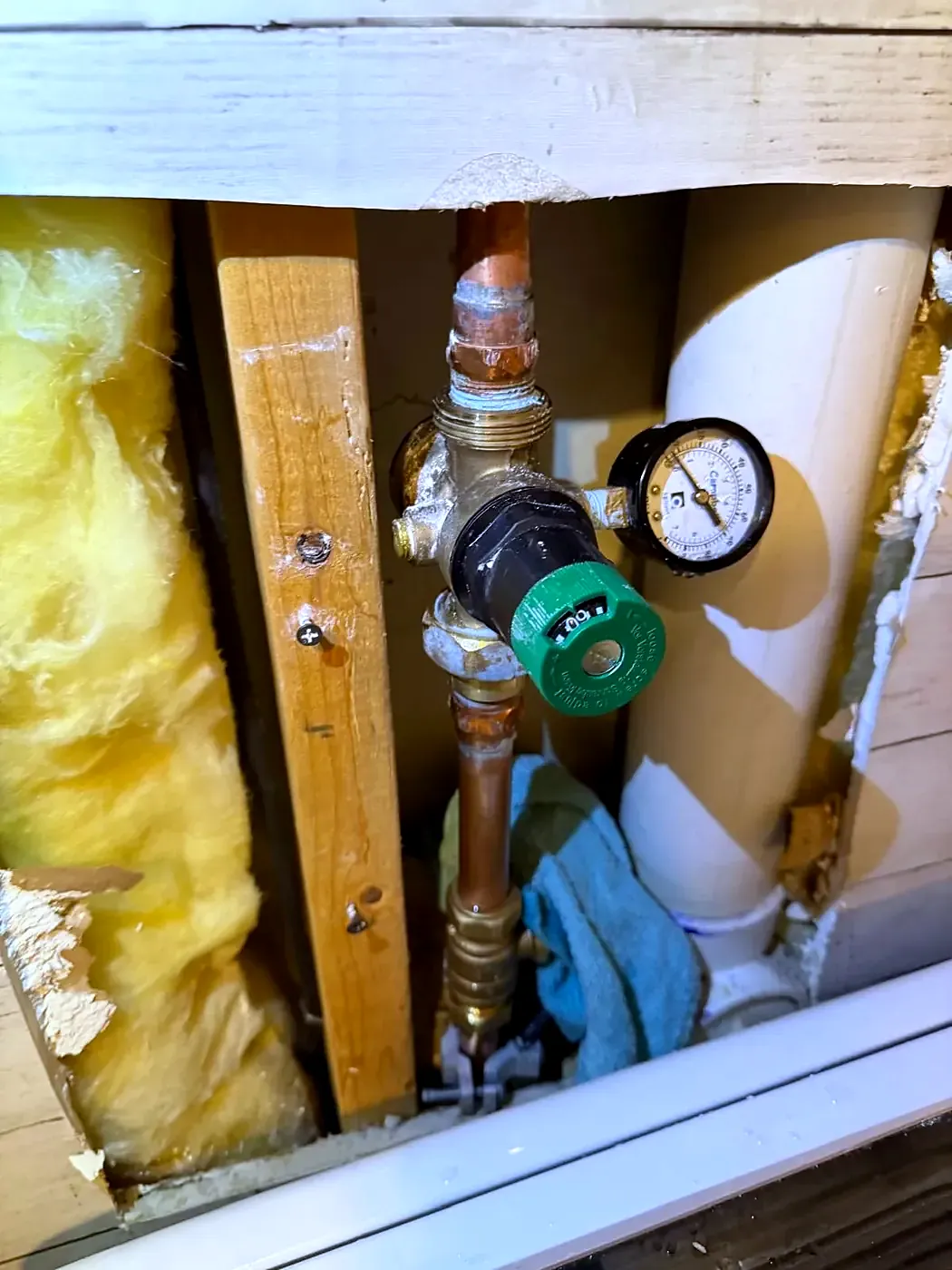
That is why a gauge goes on as standard on our plumbing calls, and why every PRV we install goes in with a pressure gauge and an isolation valve alongside it. The reading is then a permanent, visible fact about the house rather than something that has to be re-diagnosed every time something leaks.
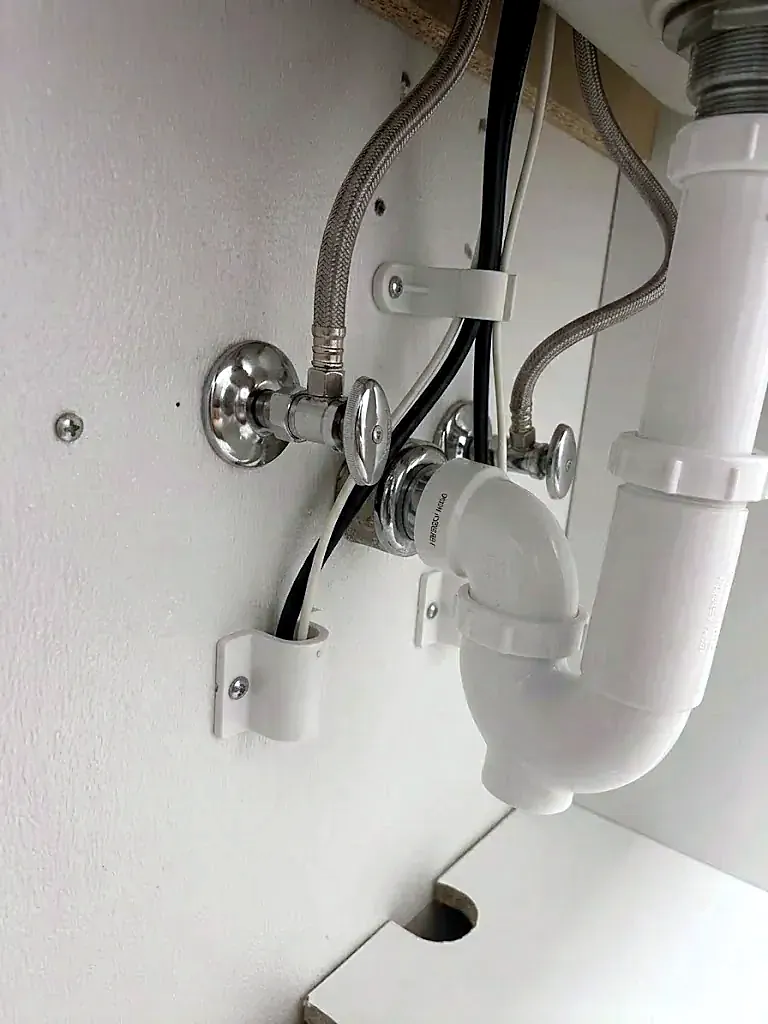
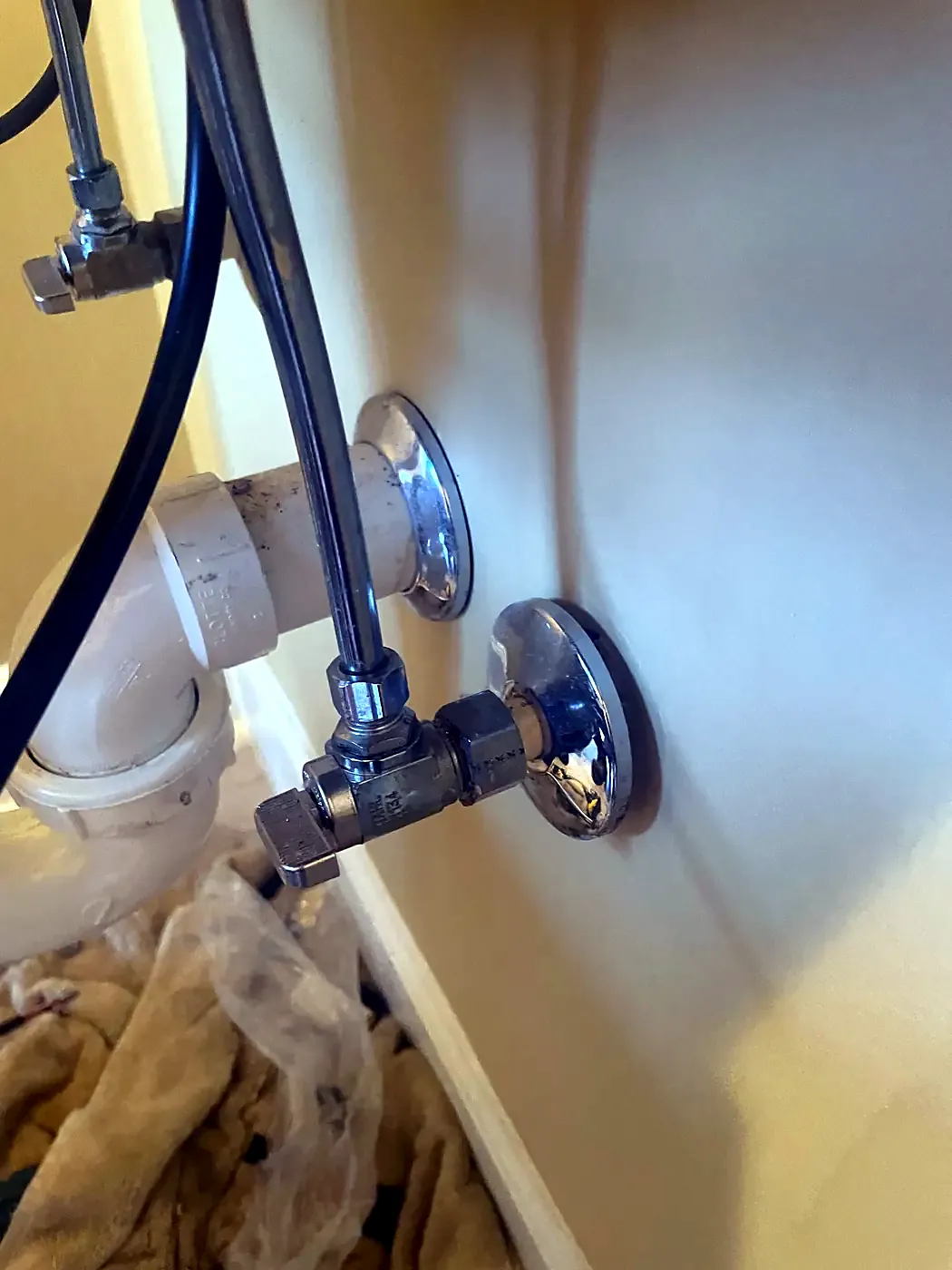
On one call the homeowner had simply asked to have a refrigerator hooked up. The technician found several shut-off valves leaking under the kitchen sink and in a bathroom, put a gauge on the house, and read over 90 psi. The PRV had failed, and that pressure had taken out the shut-off valves and the kitchen faucet along with it.
Signs your pressure reducing valve has failed
A failed PRV almost never announces itself directly. It announces itself through everything downstream of it:
- Several shut-off valves leaking at the same time, in different rooms, on different floors.
- Copper failing in more than one place. On one leak search a three-quarter-inch line had failed in three separate places, the main shut-off was no longer holding, and angle stops at two bathroom sinks had gone — all downstream of one failed PRV.
- A faucet that fails soon after the valves under it do.
- A dripping relief line at the water heater, or a heater leaking at a fitting earlier in its life than it should.
- Visible failure at the valve itself — we have found PRVs leaking, rusted through, and in one case buried under insulation where nobody would ever have looked at it.
- No PRV at all. On one flooding call, tracing the water line revealed the house had never had one fitted.
- A PRV that cannot be serviced. One had been installed so close to the main cut-off valve that it could not be worked on in place; another house had the main cut-off installed above the PRV instead of ahead of it, so the PRV could not be isolated at all.
Why shut-off valves fail all over the house at once
This is the single most useful thing on this page, and it is the reason we check the whole house when we are called out for one leaking valve.
Shut-off valves — angle stops under sinks and toilets, laundry valves, refrigerator and dishwasher stops — are small brass bodies with a rubber washer or a seat inside. Held at normal pressure for decades they are fine. Held at street pressure they weep, then drip, then fail. They do not do it one at a time, because they are all seeing the same pressure.
So when a homeowner calls about a dripping faucet or a toilet that will not stop running, and the technician finds the stop beneath it broken, the next question is not “what does this valve cost to replace.” It is “what is the pressure in this house, and how many other valves are already in the same condition.” In our contract record, the answer is usually several — and often the water heater and the copper piping as well.
What a whole-house shut-off valve check finds
These are actual findings from valve checks in our job files, and they are the reason we do them:
- A call about no hot water that ended with a failed water heater — and a follow-up check that found ten leaking cut-off valves through the rest of the house.
- A call about a leaking outside hose bib where the PRV was found failed under insulation, and the check found ten valves broken, leaking or due for replacement: powder room hot and cold, two hot and two cold at back-to-back upstairs sinks with four supply lines, two in a master bath and two in a basement bath.
- A call about water from a kitchen ceiling where five cut-off valves were found failed: two under the kitchen sink, two in a master bath, one at a hallway toilet.
- A toilet that would not shut off, where changing the stop showed it had no washer left inside it at all — and the debris from that disintegrating washer was what had jammed the toilet’s fill valve open.
- A valve somebody had wrapped in electrical tape rather than replace, still dripping.
- A valve that had been buried in spray foam and could not be reached.
- A kitchen where a visitor simply touched one of the failed valves during the visit and flooded the room.
None of this is dramatic. It is what a house looks like when nobody has ever gauged the pressure.
Thermal expansion tanks and closed plumbing systems
A pressure reducing valve does something else besides reduce pressure: it makes the house a closed system. Water can come in, but it cannot push back out to the street. So when the water heater fires and the water in the tank expands, that extra volume has nowhere to go and the pressure in the house rises on every heating cycle.
A thermal expansion tank absorbs it. It is a small pressurized tank on the cold side, and on our installations it goes in with its own dedicated shut-off valve so it can be isolated and replaced without draining the house, and it is strapped or anchored for inspection.
- Missing entirely. We have opened up installations with no expansion tank and no drain pan at all, left that way by whoever fitted the heater.
- Waterlogged or failed. One inspection found an expansion tank about six years old that had failed, with the relief line dripping onto the floor as the symptom.
- No isolation valve. A tank with no valve of its own means a whole-house drain-down to change it, so we add one when we find it.
- Relief valve dripping. A weeping T&P relief line is a pressure symptom, not a faulty relief valve, until proven otherwise.
Where the main water shut-off valve should be
The main is the valve you will need on the worst day of the year, and it is the one most likely to be unusable. What we find, and what we do about it:
- Seized or non-functional
- Old gate valves that will not close. We have arrived to find one that could only be moved with a pipe wrench, one that would not stop the water at all while a frozen pipe was flooding the house, and one that was pulling out of the wall.
- Hidden
- Buried behind finished drywall by earlier work, so the wall has to be opened to reach it before anything else can be done.
- Unreachable
- Mounted so low it could not be operated. On one job the main was replaced and raised three to five feet so a person could actually turn it.
- Wrong order
- A water service installed with the main cut-off above the PRV rather than ahead of it, which leaves no way to isolate the PRV for service.
- The right arrangement
- A quarter-turn ball valve with a bleeder as the main, then the PRV with its own isolation valve and a pressure gauge, and a bonding clamp keeping the metal piping electrically continuous across the assembly.
If the buried line feeding that valve is the real problem, see water service line replacement.
Quarter-turn valves, gate valves and saddle valves
- Quarter-turn ball valves
- What we fit. They either work or they obviously do not, they do not seize from years of standing still, and with a bleeder they let a section be drained rather than just closed.
- Multi-turn stops
- The older screw-down angle stops. They are the ones found broken, weeping at the stem, or turning without shutting anything. We replace them with quarter-turn stops as a matter of course — including dishwasher valves, which are frequently still multi-turn and awkward to reach behind the machine.
- Gate valves
- Common as old mains. The gate corrodes and stops sealing, and the stem packing weeps. These are replaced, not repaired.
- Saddle valves
- The clamp-on taps used to feed humidifiers and ice makers. They are a standing leak risk and we convert them to proper quarter-turn valves — on one job three of them on the same house.
- Hose bib valves
- Outdoor faucets need a quarter-turn cut-off with a bleeder on the inside and a vacuum breaker on the outside. See outdoor faucet and hose bib replacement.
Water hammer, knocking pipes and pressure spikes
A bang in the walls when an appliance shuts its fill valve is water hammer — a moving column of water stopped abruptly with nothing to cushion it. On one call the knocking happened every time the washing machine filled, and the cause was straightforward: there were no air chambers on the laundry lines at all.
It is worth taking seriously rather than living with, because the same shock loading works every joint, every stop and every appliance connector in the house. Where the underlying static pressure is also high, the two problems compound, which is why the gauge reading comes first and the hammer arrestor second.
Do you need a permit to replace a PRV or shut-off valve?
Yes. PRV replacement and main valve work are permitted plumbing work in the jurisdictions we serve. We pull and process the permit, perform the work to the Virginia building code, and the county final inspection follows completion — with the final portion of payment held until it passes.
There is one item on that inspection that surprises homeowners. A PRV interrupts the metal water piping, and in most houses here that piping is part of the electrical grounding path. So a PRV goes in with a ground clamp and bonding wire across it, keeping the piping electrically continuous. We do the same wherever copper is cut for any other reason.
The work itself always starts with a full system drain-down. Nobody changes a main valve or a PRV on a live line, which is also why a house with a broken main turns a one-hour job into a much longer one — see burst and frozen pipe repair for what that looks like in practice.
What PRV and shut-off valve work costs
We do not quote this by phone and we do not publish numbers, and on this particular job that matters more than usual. A call that starts as one dripping stop under a sink regularly turns out to be a failed PRV plus eight or ten valves and their supply lines. Quoting the stop sight-unseen would be quoting the wrong job.
An estimator comes to the property, gauges the pressure, checks the valves through the house, and gives you a written price for what is actually there before any work starts. You will also be told which items are urgent and which can wait, because those are not the same list.