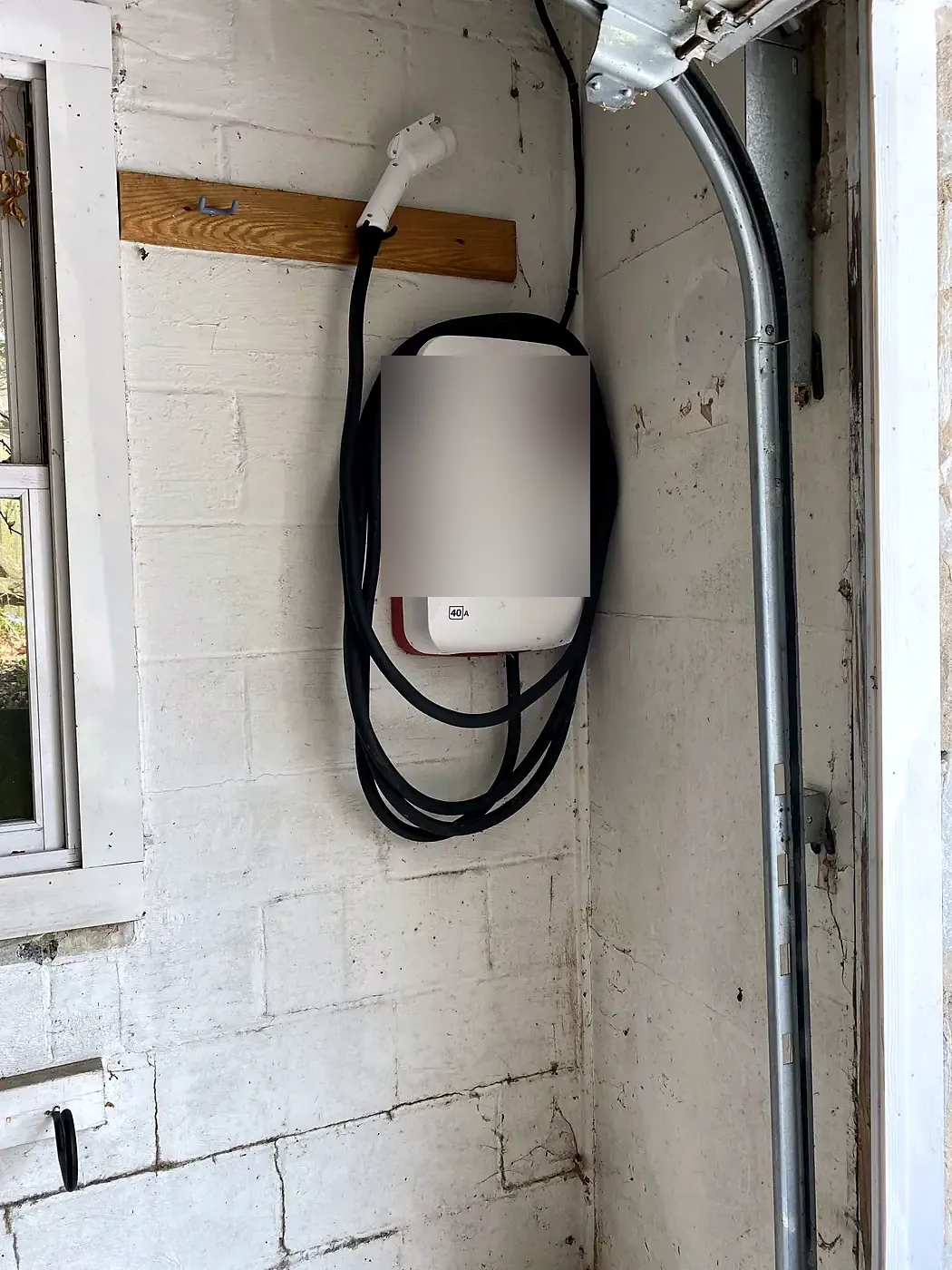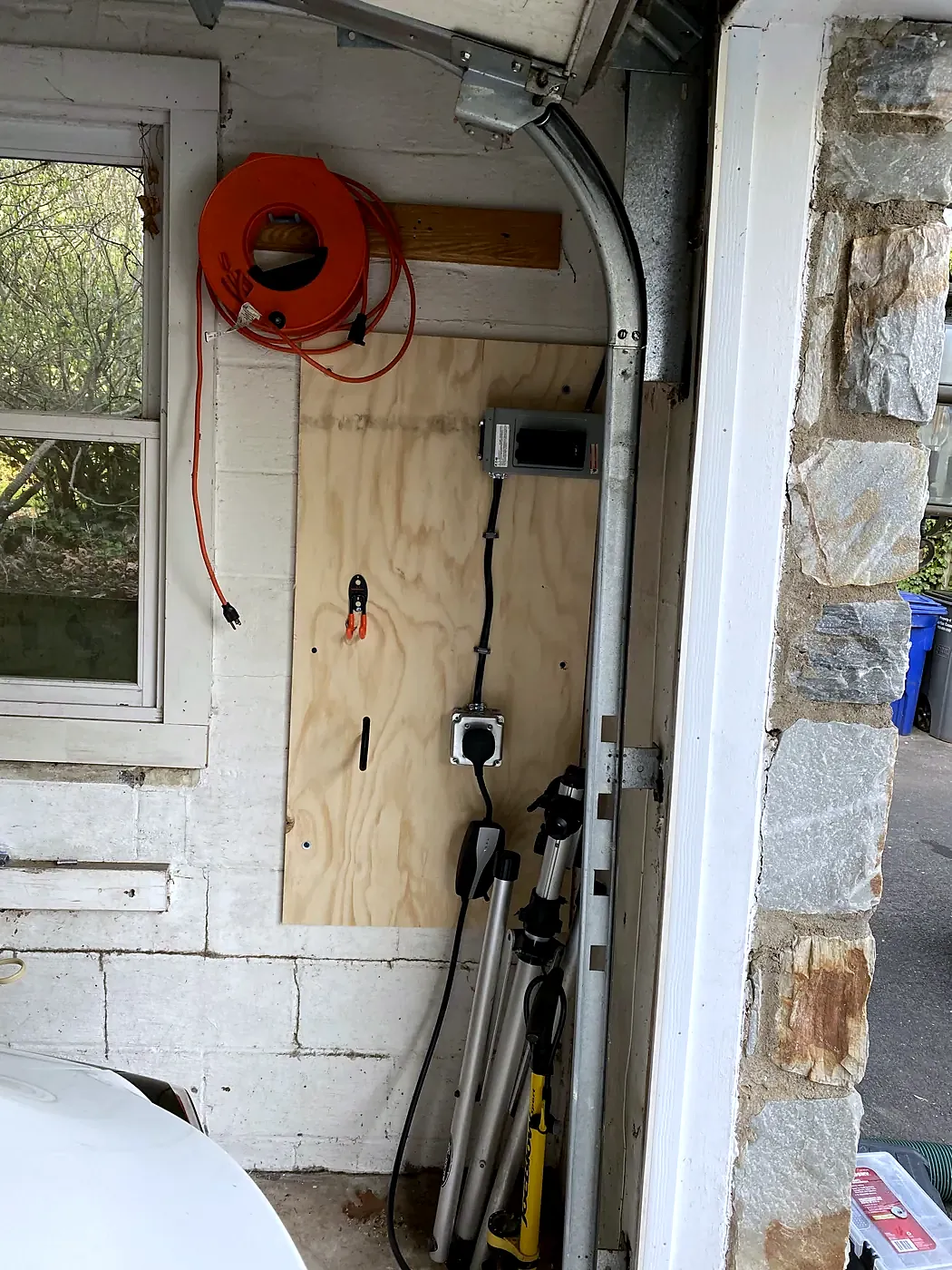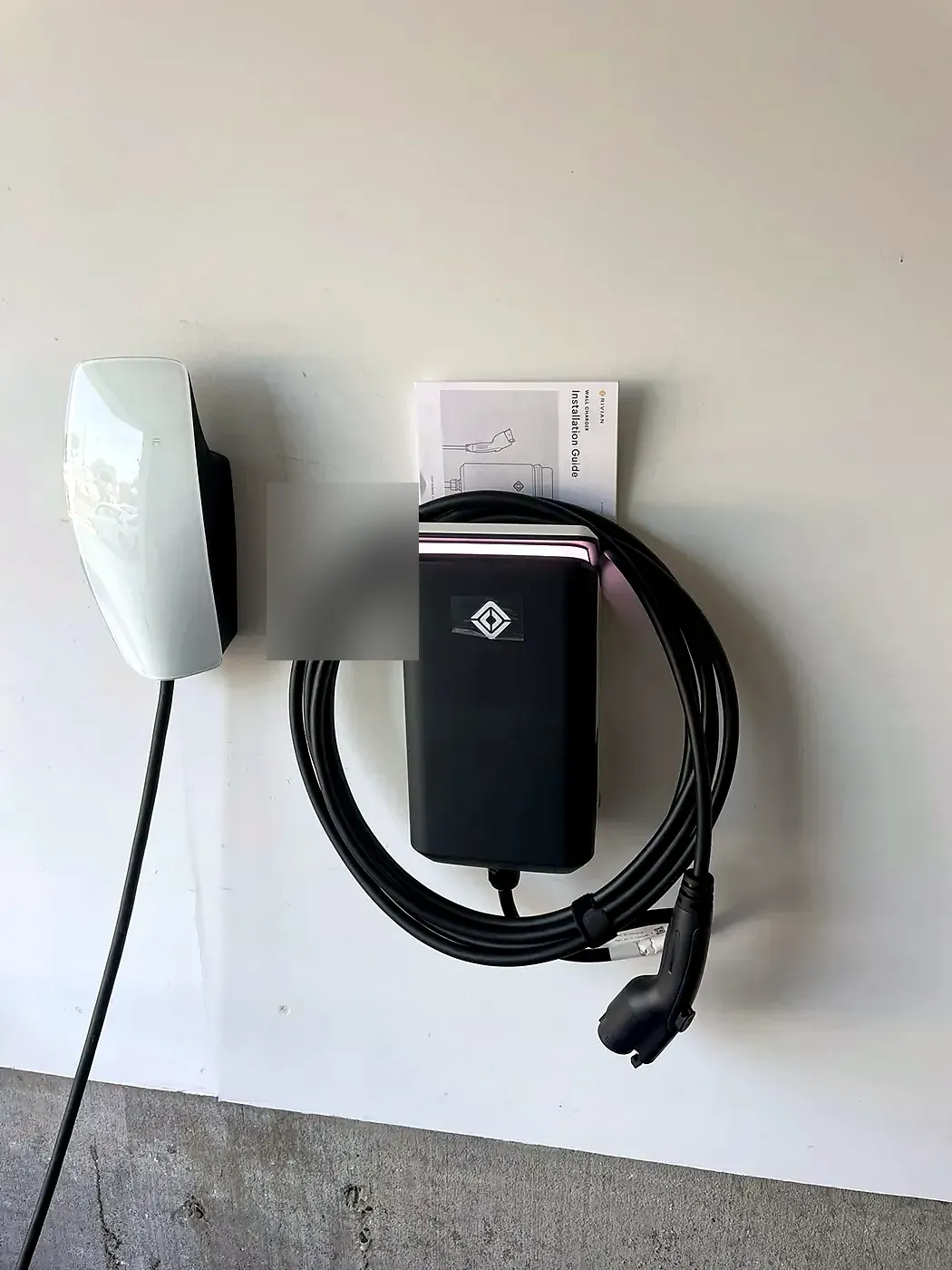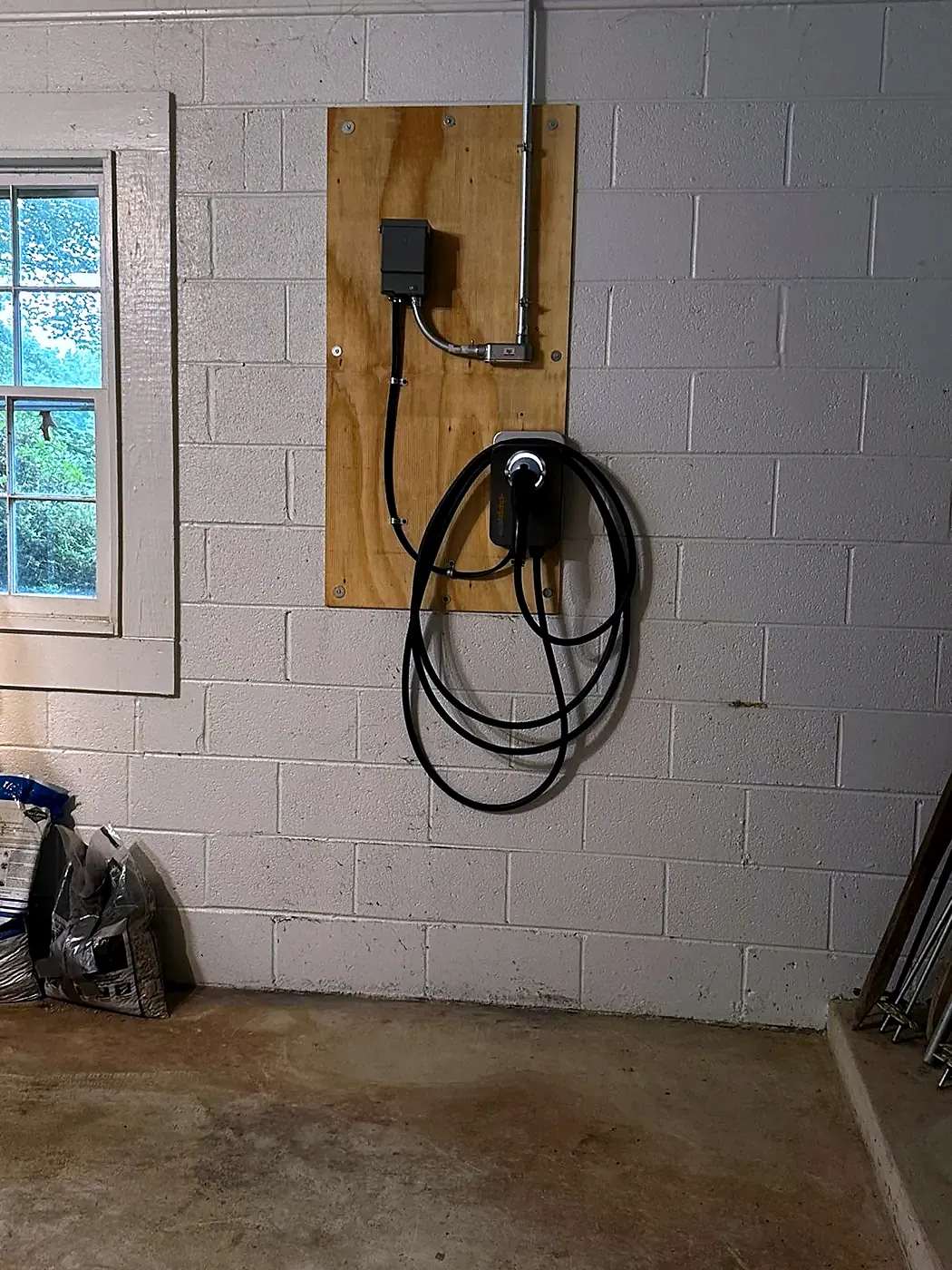
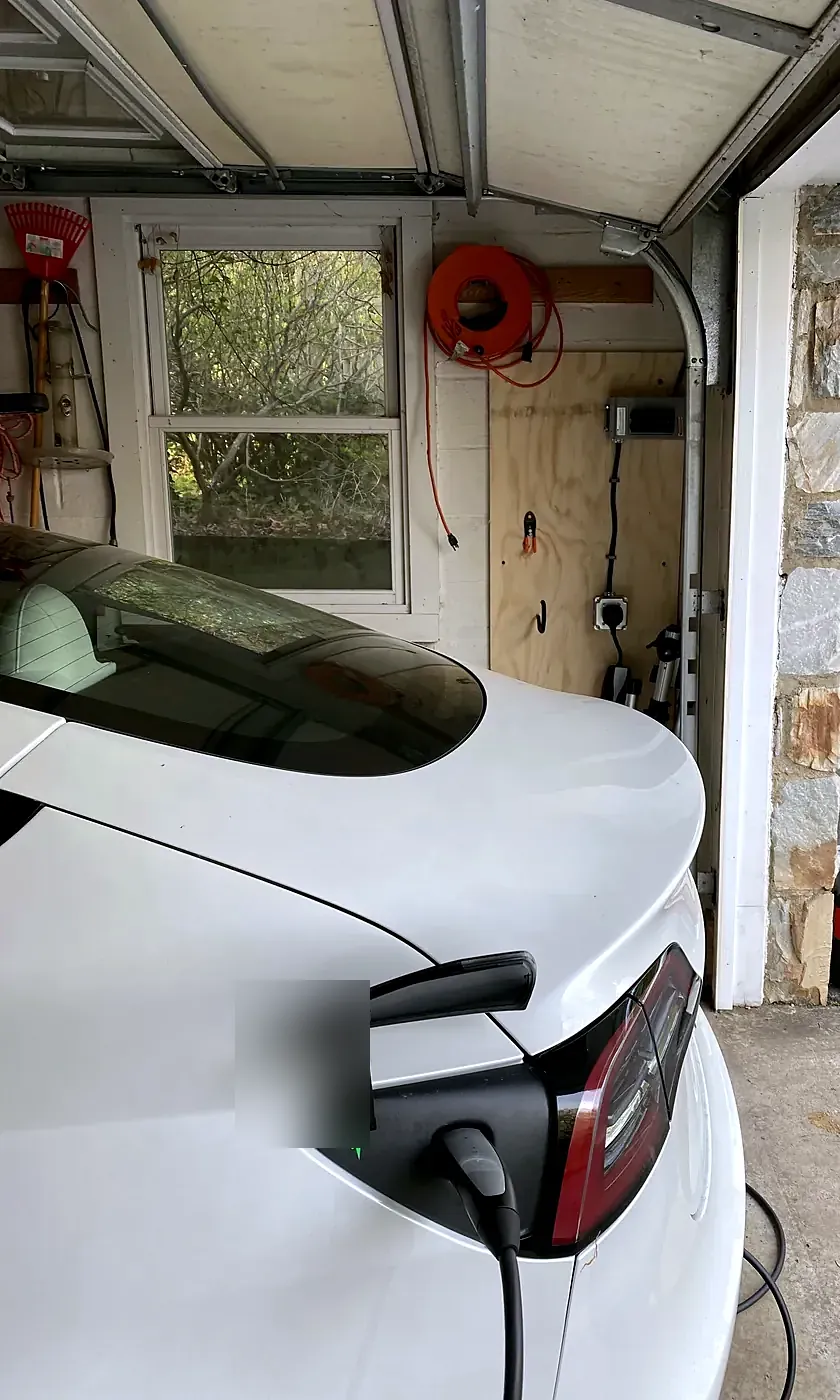
Installing a Level 2 EV charger at a house means running a dedicated 240 volt circuit from the main panel to the charger, protecting it with a double pole breaker — most commonly 50 amp — and terminating it either at a hardwired charger or a NEMA 14-50 receptacle. We fit a lockable 60 amp 240 volt disconnect ahead of the charger, protect exposed runs in conduit, pull the electrical permit before starting, and schedule the county electrical inspection once the work is complete.
What an EV charger installation actually involves
Almost every charger we install was bought by the homeowner. The unit is the easy part. The circuit feeding it is the job, and it decides whether the install is straightforward or turns into panel work. This is how it runs:
- An estimator looks at the panel first, then at where the car parks and how the cable gets there. Have the charger’s documentation on hand — a 40 amp unit and a 50 amp unit are different circuits.
- We pull the electrical permit. Work starts once the permit is issued.
- The panel is made ready. That may mean landing a double pole breaker in a spare position, consolidating circuits onto tandem breakers to open two positions, or upgrading the service.
- The dedicated circuit is run from the main panel to the charger location, with conduit over any exposed section.
- A lockable disconnect goes in ahead of the charger — on our installs, most often a 60 amp 240 volt 7.4 kW non-fused AC disconnect.
- The charger is mounted and connected, or a NEMA 14-50 receptacle is installed in a junction box or weatherproof enclosure where the unit plugs in.
- All terminations are made, the charger tested and the voltage verified. Debris is removed and the area cleaned up.
- The county electrical inspection is scheduled after completion, and the final payment is tied to it passing.
What varies between one house and the next is the panel and the distance — and those two questions are the rest of this page.
Does my electrical panel have room for an EV charger?
This is where most charger jobs are decided, and it is two separate questions that get confused.
Space in the panel
A Level 2 charger needs a double pole breaker, which occupies two positions, and we regularly open panels with nothing available. On one install the owner wanted a charger receptacle in the garage and the main panel was full: we removed about four single pole breakers, moved those circuits onto two tandem breakers, and that opened the two positions the 50 amp double pole GFCI breaker needed. The same consolidation was done on a wall-mounted charger install. It is a legitimate solution when the panel accepts tandem breakers in those positions and the service has capacity.
Capacity in the service
Consolidating breakers does nothing about load. A Level 2 charger is a large, continuous load on top of whatever the house already draws — heat pump equipment with electric heat strips, a range, a dryer, a water heater. On one job the existing 150 amp main lug panel had insufficient capacity, and the panel upgrade became a prerequisite before the charger circuit could be installed at all. On another the house was still on its original fuse box, and the 200 amp service replacement and the charger circuit were written as one permitted job.
A load calculation separates those two cases. It is done at the estimate, from the existing service size and the actual connected loads, not guessed from the size of the house. Where the service is the constraint, see electrical panel upgrades for what that work includes. There is a third route when the panel is out of positions but the service is sound: feed a sub-panel and take the charger circuit from there.
What size breaker and cable does an EV charger need?
It follows the charger, not the car. The unit’s rated output sets the circuit, and the circuit sets the conductor. These combinations come up most often in our work:
| Charger | Breaker we install | Circuit and termination |
|---|---|---|
| Level 2 hardwired or plug-in, 50 amp circuit | 50 amp double pole — BR, GE or Square D QO | Dedicated 6/2 or 6/3 cable to the charger or a NEMA 14-50 receptacle |
| Level 2 smart charger rated 40 amp | 40 amp double pole | Dedicated 8/2 run to the unit, hardwired or on a receptacle to suit |
| Receptacle-fed charger requiring ground fault protection | 50 amp double pole GFCI breaker | Dedicated run to a NEMA 14-50R in a junction box, or a weatherproof box outdoors |
| Charger fed from a garage sub-panel | 100 amp breaker feeding the sub-panel, then the charger breaker in it | Feeder to the sub-panel, then a short run to the charger |
Conductor size is not only about amps. Distance matters, because voltage drop over a long run is real, and so do the conditions the cable passes through. We have run 6/2, 6/3, 8/2 and 8/3 on charger circuits depending on the breaker, the length and whether the run was open or buried in finished construction. What we will not do is put a larger breaker on an existing conductor to make a charger fit — that is the same mistake as upsizing a breaker to stop nuisance tripping, dealt with under wiring, circuits and troubleshooting.
How far can an EV charger be from the panel?
Further than most people expect, and the distance is usually the biggest variable in the job. Our charger runs span roughly twelve feet where the panel backs onto the garage, through twenty-five, thirty to forty-five, fifty to sixty, fifty-five to sixty-five, seventy to ninety, and up to ninety-five to a hundred and ten feet from a basement panel through finished space.
The routes are what a phone quote cannot see:
- Panel to attached garage, open basement. A dedicated line through the ceiling of an unfinished basement into the adjacent garage wall. The short, clean version of the job.
- Panel to garage through finished ceilings. We have run a dedicated line from a rec room ceiling, through a closet ceiling, into the garage. Fishing cable through closed construction is slower, and sometimes drywall has to be opened and made good afterwards — see drywall and ceiling repair.
- Panel to an exterior wall or a detached garage. One run went from a rec room wall and ceiling out to the exterior, along the side of the house to the front corner, with the exterior section in conduit. Outdoors the termination is a weatherproof box and cover.
- Long runs in closed condition. A ninety-five to one hundred and ten foot 240 volt run from a basement panel to a garage in a finished house is a real job, and priced as one.
Exposed cable inside a garage is protected in conduit — commonly half-inch PVC with the matching connectors — rather than stapled across a wall where a bicycle or a ladder will eventually find it. That is in our standard scope for garage runs.
Sub-panel feeders and garage sub-panels for an EV charger
Where the charger is going into a garage or shop that already has its own sub-panel, the feeder is the first thing we check: a sub-panel is only as good as the cable feeding it. On one job the owner had bought a charger and the existing sub-panel feeder was only 50 amp — nowhere near enough to carry it on top of what that sub-panel already served. The 50 amp feeder came out, a 100 amp service cable was run from the main panel to the sub-panel with a 100 amp breaker landed in the main, and only then was the dedicated 6/3 line run into the garage.
On another, the garage sub-panel itself was inadequate. We ran a dedicated 3 gauge THHN stranded feeder from the main panel to the garage for a 100 amp sub-panel, installed the 100 amp breaker, hauled away the old sub-panel, installed an eight-space BR sub-panel in its place, and fitted the 60 amp 240 volt disconnect ahead of the charger.
A sub-panel earns the extra work when the garage is detached, when a workshop or a second charger is in the picture, or when the panel is a long way from where the car parks. It also leaves capacity out there for outlets and switches and lighting installation.
Hardwired EV charger or a NEMA 14-50 receptacle?
We install both, and the right answer depends on the unit you bought and where it is going.
- NEMA 14-50 receptacle
- A 50 amp 125/250 volt flush-mount receptacle in a junction box, or in a weatherproof box and cover outdoors. The charger plugs in, which makes it simple to swap or take with you. Receptacle-fed installs are where we most often fit a 50 amp double pole GFCI breaker.
- Hardwired charger
- The charger is mounted on the wall and the conductors terminate inside it. This is what higher-output units and many outdoor installations require, and what several of the customer-supplied chargers we have fitted specify. No plug, no receptacle to weather.
- An existing 240 volt outlet in the garage
- Check the configuration before you count on it. On one install the garage had a 30 amp NEMA 14-30R dryer-style outlet, not rated for a Level 2 charging station. It was removed and replaced with a 50 amp NEMA 14-50R on a correctly sized circuit.
Whichever it is, the charger location is agreed with you before anything is cut — cable length matters, and so does where the car parks and which side its port is on.
Disconnects, ground fault protection and testing on an EV charger circuit
A lockable disconnect ahead of the charger is standard on our installs — in practice a 60 amp 240 volt 7.4 kW non-fused AC disconnect, mounted where it can be reached. It is the switch that isolates the charger for service, and what an electrician working on that circuit in ten years will be glad someone fitted.
Ground fault protection is fitted where the installation calls for it, typically as a double pole GFCI breaker in the panel on receptacle-fed chargers. On one install with two charging outlets, both circuits were protected by two-pole GFCI breakers.
The last step is not mounting the charger, it is proving it. All terminations are made up, charger operation is tested and the voltage verified before the job goes in for inspection. Equipment ahead of the charger is serviceable too: we have replaced a failed 30 to 40 amp electric vehicle charge controller as its own repair call.
Do you need a permit to install an EV charger in Virginia?
Yes. An EV charger circuit is a new dedicated 240 volt branch circuit, and that is permitted work in the Northern Virginia jurisdictions we serve and in Washington DC. We pull the permit and handle processing. Work starts once it is issued, the installation is performed according to the Virginia building code, and the county electrical inspection is scheduled after completion.
On permitted work the last portion of payment is tied to that inspection passing, which is also why we will not begin a charger install on the day you call, however simple the run looks. The risk of an unpermitted install is not theoretical: it surfaces when the house is sold, when an insurer asks, or when a charger on an undersized circuit starts tripping and nobody can say why. An inspected circuit with a labeled breaker and a disconnect is a document as much as a wire.
What EV charger installation costs, and how we price it
We do not quote charger installs by phone and we do not publish numbers, because the same charger on the same wall can be two entirely different jobs. A twelve-foot run from a basement panel into an attached garage, with two spare positions in the panel, is not the work a hundred-foot run through finished ceilings to a detached garage is — still less when the 150 amp main lug panel has to be replaced first.
What changes the price: the length and route of the run, open or closed construction, conduit and weatherproof enclosures outdoors, whether the panel has positions available or needs consolidation, whether a sub-panel feeder has to be upsized, and whether the service itself needs upgrading first.
An estimator comes to the property, opens the panel, walks the route and gives you a written price before anything starts. Permit and processing fees are written into that contract.