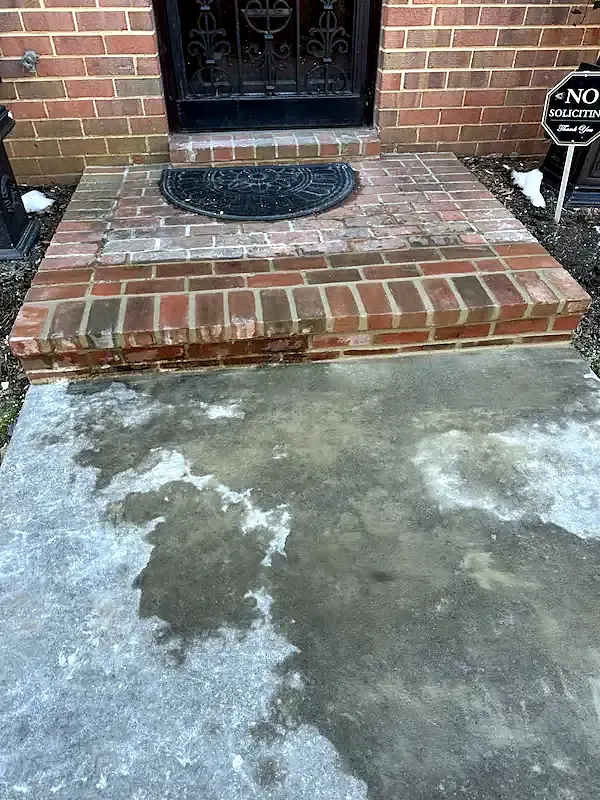
Concrete cracks for two different reasons, and they get two different repairs. Surface cracking and separation at a joint are usually cosmetic: the crack is cut into a V groove, filled or epoxy-injected, and finished. Cracking that comes with settlement — a slab that has dropped, a stoop pulling away from the house, steps that have sunk out of level — means the ground under it has moved or washed out, and filling the crack alone will not hold. Those repairs start underneath, with support and drainage, not on the surface.
What causes concrete to crack, settle and break up
Almost every concrete failure we are called to comes back to one of four conditions, and three of them are about water rather than about the concrete:
- The ground under it has washed out
- Concentrated water erodes the soil supporting a slab or a set of steps. On one property the front of a garage slab had settled with two corners broken clean off, and the slab was found undermined at the front — the ground that was meant to be carrying it had simply gone.
- The grade sends water at the house instead of away from it
- We have found landscaping that raised a front grade by roughly two feet so the ground sloped toward the building. Code calls for a minimum five percent drop away from the house; that one had the opposite.
- Roof water has nowhere to go
- With no downspout serving an elevation, roof water falls straight to the ground and runs by gravity to the lowest point. In one case that concentrated flow eroded and moved the adjoining asphalt until it sat two and a half to three inches below the concrete garage floor, which put pressure on the slab and opened hairline cracks in the concrete above.
- Something below has settled
- A stoop, a porch slab or a set of steps set on ground that consolidates will drop with it. That is a settlement problem, and it is repaired from underneath.
Getting this distinction right is the whole job. A crack filled over a void opens again in a season.
Concrete walkway repair: loose stone, flaking mortar and trip hazards
Walkways are where concrete and masonry problems get personal, because a lifted edge or a rocking stone is something somebody trips on.
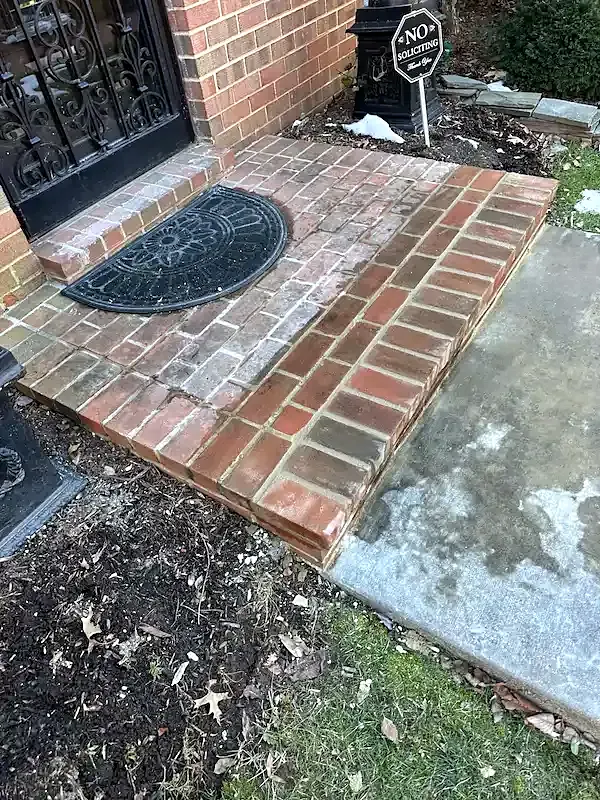
On a front walkway we were called to, the mortar between the stones had flaked away and several stones were loose and damaged. The sequence there is straightforward and it matters: power wash the moss, mold and mildew off with a stain remover and multi-surface cleaner first, so you can actually see the joints, then lift and reset the loose and damaged pieces and re-mortar the joints to match what is there. Cleaning before assessing is not cosmetic — moss holds water in a joint and is usually growing where the drainage is worst.
Poured concrete walkways get a different answer. Where a section has cracked and dropped enough to catch a foot, or where an old walkway has broken up across its length, the section comes out and is re-poured rather than patched. We have replaced worn decking and an old walkway around a pool with poured concrete as part of a larger exterior job, which is often the cheaper way to do it when the walkway is going anyway.
Cracked concrete steps, stoops and settled entry landings
Steps and stoops take more abuse than any other concrete on a house: foot traffic, freeze cycles, salt, and roof water dropping on them from above.
- Steps that have settled out of level. On one property the side steps had sunk and needed a concrete footing installed underneath the existing steps to stop them moving again. Leveling steps without dealing with what they sit on is temporary.
- A crack opening between the stoop and the house. This is the one to take seriously, because it is a water path as much as a cosmetic defect. On one job a crack between the concrete stoop and the brick had let water into the wall, and the framing and plywood at the interior corner behind it had rotted. The repair meant taking a foot of siding and J-channel off along the stoop on both sides of the door, removing the PVC corner trim, inspecting the framing behind it, and installing metal flashing ten to twelve inches high against the house before anything went back — see siding repair.
- A cracked stair or riser. A single cracked concrete stair is usually a straightforward repair. Several cracked in the same run, or a run pulling away from the structure, is a settlement question first.
- Brick facing coming loose from a stoop. Repaired as masonry — the loose material comes off, the substrate is checked, and the brick is reset and repointed rather than glued back on.
- A stoop that has cracked all the way around. On one porch an engineer measured a front stoop eight inches thick cracked about a quarter of an inch, alongside a main floor that had dropped four to six inches. That is not a concrete repair; that is a foundation investigation.
Why a concrete slab settles, and how the repair actually works
A settled slab is repaired from below, and the repair has to tie the new concrete to the old or you have simply placed a second slab beside the first.
On the garage slab that had settled at the front with two corners broken off, the underside could only be reached by cutting back the adjoining asphalt driveway. The two broken corners were removed and cut back to a clean corner shape rather than feathered. Two half-inch metal bars went in at the bottom of the front of the slab, and half-inch rebar was set to tie the old concrete to the new. Then 3500 PSI concrete was placed under the slab and at the broken corners, twelve inches deep, filling the void the water had made. The downspout that had been discharging against the garage was extended clear of it, because otherwise the new concrete would be sitting over the same washing action as the old.
That last step is the one homeowners are most often tempted to skip, and it is the one that decides whether the repair lasts.
Concrete crack repair: which cracks get filled and which get cut out
Not every crack is repaired the same way, and the honest answer sometimes is that the crack is a symptom and should be left alone until the cause is fixed.
- Clean and dry the surface first. Loose, powdery or flaking material has to come off, or the filler is bonding to nothing.
- Chisel the crack into a V groove. Widening a crack before filling it sounds backwards and is essential — it gives the repair material a key instead of a hairline.
- Inject the groove. On foundation and wall cracks we inject 4000 PSI concrete epoxy and scrape the excess off to a smooth finish. On above-ground cracks in masonry and surfacing, mortar mix is the right material.
- Sand and dress the repair with fine sandpaper to take off excess filler and residue so the patch does not stand proud of the surface.
- Deal with the water. Where a wall has been damp, mold control goes on before any coating, and a masonry waterproofer such as Drylok is applied over the repaired surface.
Where concrete surfacing on a foundation has come loose and damaged rather than simply cracked, resurfacing is the repair: mesh wire and a scratch coat over the sound substrate, exposed cracks filled with mortar mix, and an asphalt coating below grade where the wall is being buried again. Cracks that are moving, widening or accompanied by a sloping floor are a different conversation — see foundation, grading and crawl space repair.
Brick, mortar and masonry repair around steps and chimneys
Masonry sits alongside concrete work on most of these jobs, and the repairs are governed by the same rule: match the existing material and finish, and find out why the joint failed.
- Open gaps in brickwork at the rear or sides of a house are repointed with mortar mix, finished to match the surrounding joints as closely as possible.
- Cracked masonry that has lost its support is braced rather than merely filled. Where broken concrete beside a gate post had left it unsupported, we chiseled grooves six to eight inches long into the sound concrete, set half-inch rebar into them to tie the broken piece back, then packed the grooves with mortar finished to match.
- Fireplace hearths and chimney floors crack from heat as well as movement. A cracked chimney hearth is repaired with a heat-resistant mortar, not a general-purpose mix, and failed hearth grout is cut out and replaced with cracked tiles swapped.
- Cut openings through masonry — a new crawl space access, for instance — are cut through the brick veneer and the cinder block behind it to a matched opening, the edges finished with cement, and the frame sealed against the brick with caulk.
- Cinder block basement walls are inspected for cracks, filled and then coated with a mildew-resistant masonry waterproofer before anything is framed against them.
Water is what breaks concrete: grading, downspouts and drainage
If you only remember one thing from this page, make it this one. Concrete does not settle on its own. It settles because water took the soil out from underneath it.
On a call about cracks in the concrete ceiling of a room below a garage, the cracks themselves were three hairlines, classified as a foundation problem but not a structural one. The real finding was the grading: landscaping had raised the front ground about two feet so it sloped toward the house against code, and with no downspout serving that elevation, roof water fell straight down and ran to the low point at the front of the garage. Our recommendation was to correct the grading as the root cause — a swale about five to seven feet from the house with a proper drop feeding a pop-up drain, and a channel drain running across the front — before re-pouring anything.
Downspouts get extended well clear of the foundation as a matter of course, and the ground is regraded to the code minimum five percent drop away from the house. Gutters that overflow put the same water in the same place every storm — see gutter repair, cleaning and downspouts.
Cleaning, sealing and finishing concrete walkways, patios and porches
Some of what looks like failed concrete is dirty concrete. Front porches, patios, steps and walkways collect moss, mold and mildew, which hold moisture against the surface and make a sound walkway slippery and a sound joint look failed.
The treatment is a moss, mold and mildew remover and a multi-surface cleaner, then a power wash, then an honest look at what is underneath. On several jobs that has been the whole repair. On others it revealed the loose stone and flaking mortar that needed resetting. Either way it is the first step, not an add-on at the end.
Where concrete adjoins wood — a walkway meeting a deck, steps landing on a porch, a slab under a deck post — both materials get looked at together. See deck, porch and railing repair and fence repair and installation, since post footings and walkway edges are usually the same excavation.
What concrete, walkway and step repair costs, and how we price it
We do not quote concrete work by phone and we do not publish prices. A crack that gets grooved and filled and a slab that has to be undermined, tied with rebar and re-poured twelve inches deep are not comparable jobs, and the difference is invisible from a description or a photograph.
An estimator comes to the property, looks at the grade, the downspouts and what the concrete is bearing on, and gives you a written price for the work before anything starts. Where the finding is that the concrete is a symptom and the drainage is the cause, we tell you that plainly rather than selling you a pour that will crack again. Sam & Sons Services has worked across Northern Virginia since 1999 under Virginia DPOR license #2705070610; call (703) 256-8080.