
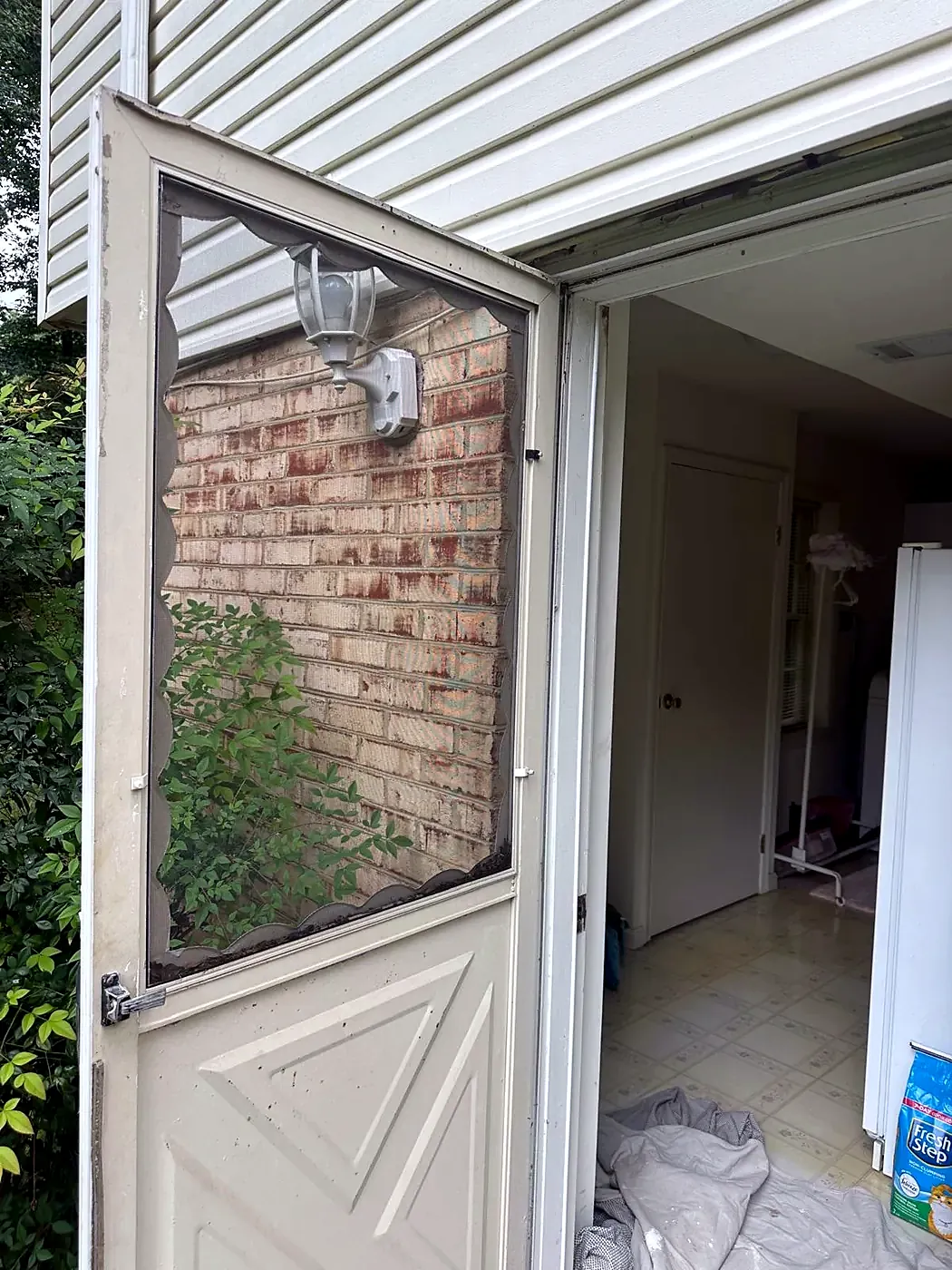
A storm door is a second, outward-opening door mounted to the trim around your entry door. It takes the weather, the sun and the wind so the entry door does not, and it lets you ventilate the doorway behind a screen. Installation is less about the door than about what it fastens to: the frame and brick molding around the opening have to be sound and secured before the unit is hung, because a storm door screwed to soft wood will sag, bind and pull loose within a season.
What a storm door does for your entry door
Homeowners usually ask for a storm door for one of three reasons, and they are all legitimate:
- It takes the weather instead of the entry door. Wind-driven rain, sun and grit hit the storm door first. The finish on the entry door behind it lasts longer, and so does its weather stripping.
- It lets you open the house without opening the house. Full-view units with sliding up-and-down glass give you a screened doorway in mild weather and a glazed one when it turns. We have fitted pairs of those, owner-selected color, on front and back entries in the same visit.
- It adds a layer at the draftiest opening in the house. An entry doorway is a hole in the wall with a moving part in it. A second door in front of it helps — though a storm door is not a substitute for sealing the entry door properly, which is door weatherstripping and draft sealing work.
- It gives you a screen door where you need one. Storm and screen doors are the same product family, and we replace and repair both, including damaged sliding screen doors at the back of a house.
What a storm door will not do is rescue a failing entry door. If the door behind it will not close or seal, that is the job — the storm door is the second conversation.
Storm door installation: how the unit is fitted to your opening
A storm door does not fit into the rough opening. It fastens to the exterior trim and brick molding around the entry door, which is why our scopes always deal with that trim first.
- Protect the entry. Floor and furniture protection goes down inside before the doorway is opened up.
- Remove the old unit. The existing storm door, its closer and its frame come off and are hauled away. On repairs, the old unit is set aside for reinstalling.
- Inspect and secure the door frame. This is the step that matters. Our contracts read that the door frames are inspected and re-secured as needed before the storm door is hung, because a unit fastened to loose or soft trim will not stay square.
- Repair what the old door was hiding. Rotted jamb sections are cut out and spliced, damaged frame areas are filled with wood filler, and rotted wood brick molding is replaced with composite.
- Hang and square the unit. The storm door is fitted to the prepared trim, hung so it closes evenly against its own seal, and latched and cycled to check it.
- Fit the closer, the stopper and the latch. Closer, safety chain or stopper and latch hardware are set and adjusted so the door neither slams nor drifts open.
- Finish the trim. New or repaired trim around the storm door is caulked, spackled, nail holes filled, then primed and painted to match the existing color — see interior and exterior painting.
Why a storm door won't close, latch or stay shut
Storm doors are light, they live outdoors and they get slammed by the wind. They come out of adjustment faster than any other door in the house. The findings repeat:
- The closer has failed
- A worn or blown closer is the most common single cause of a storm door that will not close on its own, or that closes too hard. On one job the entry door frame was damaged and the door would not close by itself; the fix included reinstalling the existing storm door with a new closer rather than a new door.
- The stopper has failed
- Storm door stoppers wear out and let the door swing past where it should. We have replaced failed stoppers on two doors as part of a wider punch list, because it is cheap and it stops the closer being torn out of the frame.
- The unit is binding in the opening
- Storm doors that bind are frequently corrected by removing and reinstalling the unit so it opens and closes properly, rather than replacing it. Racked units usually mean the trim they are screwed to has moved.
- The frame behind it is soft
- Screws pull out of rotted or filled trim and the door drops on the latch side. Fixing the door without fixing what it is fastened to just repeats the failure.
- The entry door is the real problem
- A storm door that will not close draws attention away from an entry door with hinges, lockset and frame out of adjustment. On more than one call we have corrected both in the same visit — see door repair.
Storm door closers, stoppers and hardware
The hardware on a storm door does more work per year than the hardware on any other door on the house, and it is where the product fails first.
- Closers. The pneumatic cylinder that pulls the door shut and controls how fast. Replaceable on their own; we fit new closers to existing storm doors regularly rather than selling a whole unit.
- Stoppers and hold-opens. The catch that stops the door blowing past its limit. Failed stoppers are a small part that prevents a large repair, and they get replaced on their own.
- Latches and handle sets. Storm door latches are shallow and go out of engagement as soon as the unit racks. They are adjusted when the door is squared rather than forced.
- Glass and screen inserts. Full-view units with sliding up-and-down glass let you switch between glazed and screened. Damaged screens and sliding screen doors are replaced without touching the frame, the same way we handle window repair and replacement.
- Frame fixings. The screws into the brick molding are the whole installation. If that trim is composite and sound, the door stays where you put it.
What we find when an old storm door comes off
This is the part of the job homeowners are not expecting, and it is the reason we pull storm doors before quoting the rest of an entry. A storm door and its frame cover the exact strip of trim that rots.
- Short rotted sections in the jamb. On door frames where rot was confined to two areas of about four inches each, top and bottom, the frame was spliced: the bad sections cut out, new stock installed and secured with glue and nails, then caulked, spackled, nail holes filled and painted — including across the area where the storm door had been.
- Damaged wood at the bottom of the frame. We have removed about six inches of damaged wood at the bottom of a front door frame and inspected the framing behind the trim before rebuilding, with the homeowner told what was found.
- Rotted brick molding. Around one back door the wood brick molding had gone entirely; it was removed and replaced with composite PVC brick molding, then caulked, filled and painted to match.
- Trim, paneling and molding past saving. On one entry, rotted 1x6 and 1x10 trim, paneling and crown molding around the door area came off with the storm door. The plywood and framing behind were inspected, a moisture barrier went on, the flashings were sealed and PVC trim was fitted to match.
- Nothing at all. Sometimes the trim is sound, the frame gets re-secured and the new unit goes straight on. We would rather find that, and we tell you either way — see rotted wood and trim repair.
Storm door repair or replacement: how we decide
Storm doors are one of the few products where repair genuinely competes with replacement, because the expensive parts are the ones that fail.
- Repair when the frame and panel are sound. A binding door is removed, reinstalled and adjusted. A door that will not self-close gets a new closer. A door that swings too far gets a new stopper. None of that needs a new unit.
- Repair when only the screen or glass has gone. Inserts and screens are replaceable, including damaged sliding screen doors.
- Replace when the unit itself is worn out. Where a storm door is at the end of its life — racked frame, failed seal, hardware no longer holding adjustment — we remove the door, its closer and its frame and fit a new unit.
- Replace when the entry door is being replaced anyway. If the old storm door is tired, doing both in one scope avoids taking the new entry apart again later.
- Match what is there where you want it matched. On several jobs the scope reads to supply a storm door matched to the existing as closely as possible, and in-stock units cover most standard openings without a special-order wait.
Storm doors and entry door replacement: doing both at once
Most of our storm door work happens alongside an entry door job, and the sequence matters.
On a front door replacement the storm door and its framing come off first so the entry unit, interior casing and exterior brick molding can be stripped out. Where the storm door is still good, our scopes say plainly that it is reinstalled when the work is complete — that is standard on our entry jobs, not an upgrade. Where it is worn out, it is hauled away with the old entry door and a new unit goes on at the end.
The reason to decide before the job starts rather than during it is that the new entry unit brings new brick molding with it. Fitting a fresh storm door to fresh composite trim, at the same time, in the same visit, is a different quality of installation from screwing an old storm door back onto new trim. If you are replacing the entry door, front door repair and replacement sets out how that job runs, and the storm door is written into the same contract.
How storm door installation is scheduled and priced
In-stock storm doors can usually go in without a long wait, and we fit owner-selected colors and owner-supplied units as readily as ones we supply. Where the door is a special order, the scope says work begins on delivery so nobody opens up an entry to wait on a truck.
We do not quote storm doors by phone and we do not publish prices. What decides the job is almost never the door — it is what the old one was hiding. A frame that has to be re-secured, a jamb that needs splicing, brick molding to replace in composite, trim to prepare and paint, a closer and stopper to fit: those are the variables. An estimator comes to the property, takes the old unit into account, and gives you a written price before any work begins. Work is performed according to the Virginia building code by a licensed contractor holding Virginia DPOR license #2705070610, serving Northern Virginia and Washington DC since 1999. Call (703) 256-8080.