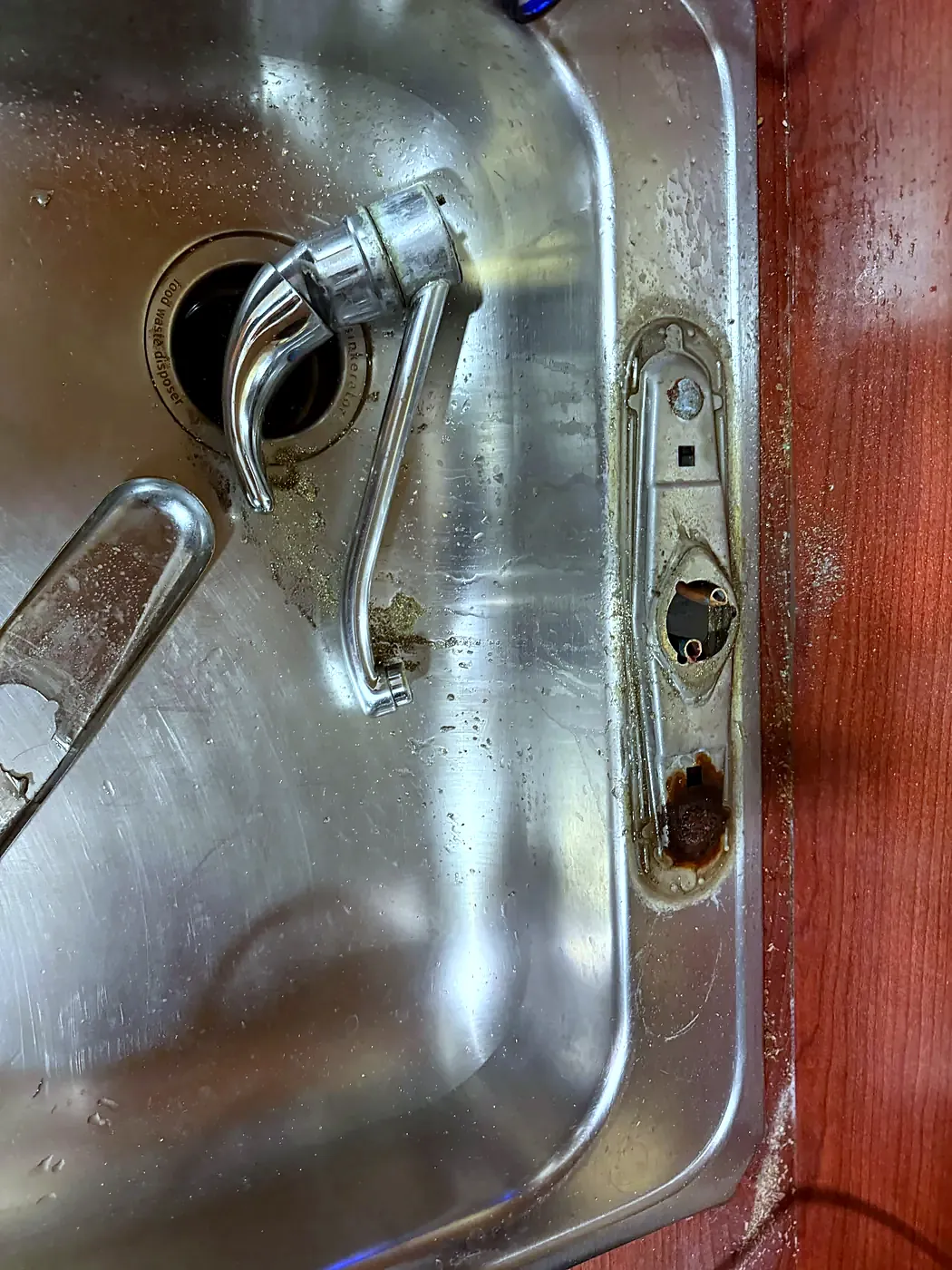
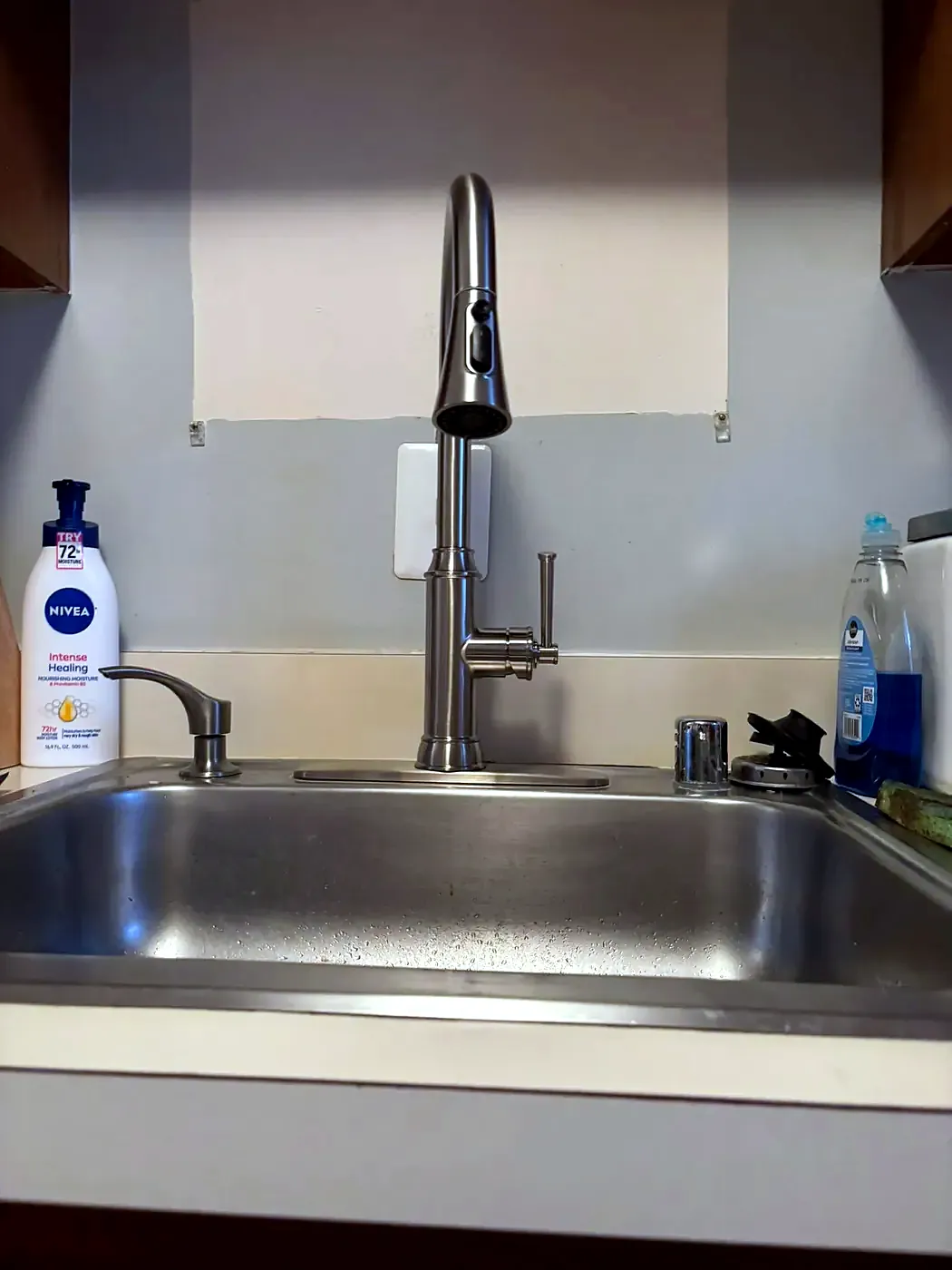
A kitchen faucet that drips at the base has failed body seals; one that drips from the spout has a worn cartridge. Weak flow or no flow is normally the aerator, the spray head, or debris from stop valves that have broken apart inside. On almost every one of these calls the hot, cold and dishwasher stops under the sink turn out to need replacing as well, and on many of them the underlying cause is a failed pressure reducing valve feeding the house.
Why a kitchen faucet drips at the base
A drip at the base is not the same fault as a drip from the spout, and the difference matters when you are deciding whether to repair or replace.
- Dripping from the spout tip. The cartridge is worn and no longer seals against its seat. On a major brand with a live parts channel, this is a cartridge swap.
- Weeping or pooling at the base of the spout. The O-rings around the spout body, or the body seal under the deck plate, have failed. Water escapes sideways, runs down the fixture and collects on the counter or drains straight into the cabinet below. One homeowner who called about this had already sprayed penetrating oil on the fixture trying to loosen it.
- Leaking from the top down into the cabinet. Sometimes real, sometimes not. On one call the technician inspected the fixture, the drain, the disposal, the waste pipe and the valves, and ran water for several minutes with no leak found — the water was coming from failing stops.
- Leaking internally through a worn body. A fixture leaking through the body rather than at a single seal is not a repair. The body is the fixture.
If water has already been sitting in the cabinet, the sink base floor is worth checking. We have replaced deteriorated sink base floors that had been quietly rotting under a slow drip.
No water or weak flow at the kitchen faucet
This is the call where the obvious answer is often wrong, and it is worth explaining how the diagnosis actually runs.
- The spray head and aerator come off first. On a brushed nickel gooseneck pull-down with no flow, the technician removed the spray head and flushed the fixture to rule out a blocked head. Pressure was still low to nothing.
- Supply lines are checked for obstruction. On the same job they were clear.
- The stops are checked — open, not just present. They were open all the way. That is where most diagnoses stop and where this one did not.
- The stops are tested internally. Both valves had broken apart inside, and the debris shed from them was what had blocked the fixture. The repair was to remove both stops, tee into each line, run new copper on the hot and cold sides and fit new valves.
- Supply lines themselves fail. On another no-flow call the kitchen supply line was simply deteriorated, alongside leaking stops around the house and copper lines that had frozen inside a garage wall.
Debris is also carried in from outside the house. After a utility shut-off and restart, we have found kitchen fixtures jammed with the same calcium and debris that fouled valves throughout the property. Intermittent high and low pressure at the sink has the same root — a failing dual valve or stop, not the fixture.
Why a pull-down spray head stops sealing on a kitchen faucet
Pull-out and pull-down fixtures are the most common style we replace, and they have two failure points a standard fixture does not have: the head itself and the hose and weight assembly behind it.
- The head will not seat back into the spout
- The docking magnet or collar is worn, or the threads have been cross-started. We have been called to leaks that began when a spray head was screwed back on at an angle and never seated fully afterwards.
- The head leaks around the collar while running
- Seals inside the head. Head assemblies are replaceable on major brands.
- Spray and stream will not switch
- The diverter inside the head has stuck, usually with scale.
- Water in the cabinet only when the head is pulled out
- The hose or its connection under the sink, not the fixture above the deck.
- A deck-mounted side sprayer that drips
- Often the simplest answer is deletion. We remove obsolete side sprayers and unused instant hot water dispensers and fit a sink hole cover, sealed with caulk, rather than leave a dead fitting in the counter.
Touchless kitchen faucets and what fails on them
Motion-sensor fixtures add electronics to a plumbing fitting, and the electronics are not separately repairable in most models. We were called out to one where the motion sensor had stopped working; the fixture had to be replaced rather than repaired, and the same visit found eight shut-off valves around the house needing replacement and a pressure reducing valve with no ground and no gauge on it.
That is the honest position on touchless: when the valve body or the sensor module fails, you are usually buying a fixture. If you want one, it is worth knowing that before it is installed rather than after.
Can a kitchen faucet be repaired, or does it have to be replaced?
We would rather repair it. These are the four conditions where we will tell you a repair is the wrong answer.
- The fixture cannot be identified. One dripping kitchen fixture had no brand marking anywhere on it, so no supply house could source a repair part. It had to be replaced.
- The fixture is seized to the counter. One had rusted out so completely that the mounting hardware could not be backed off at all; it was cut out with a reciprocating saw. Another was frozen to the countertop and came out the same way.
- It is leaking internally. A worn body leaking through itself has no serviceable part left.
- The handle assembly has failed on an old fixture. We have been called to a kitchen handle that came off in the homeowner's hand, and found failing stops under the sink in the same visit.
Where a repair does work, it works well. We have fitted an owner-supplied cartridge to a kitchen fixture that had nothing else wrong with it, and rebuilt a dripping bar sink fixture with new hot and cold cartridges rather than replacing it. On replacements we standardize on Moen — chrome and brushed nickel, single-lever, pull-out and pull-down — because the parts stay available years later. Owner-supplied fixtures are welcome and we install them regularly.
The stops under the kitchen sink: hot, cold and dishwasher
A kitchen sink usually has three shut-off valves under it, not two, because the dishwasher is fed from the hot side. In our records all three fail together more often than not.
- On one dripping-fixture call the hot and cold dual valves were both broken, the cold actively dripping, and the dual valve serving the dishwasher would not turn at all.
- On another the technician found three leaking or broken valves under the sink — dishwasher, cold and hot — and a whole-house check turned up more, including a trap under a bathroom sink that a previous party had wrapped in electrical tape.
- Previous work causes its share. On one job a compression shut-off had been fitted to PVC pipe instead of the correct fitting.
- Failing stops are genuinely hazardous to disturb. On one visit a bad valve was handled while the technician was working and let go, flooding the kitchen before it could be closed.
So the stops are tested as part of the call, replaced with quarter-turn valves and metal braided supply lines where they have failed, and the system is drained down to do it. Whether that spreads to the rest of the house is your decision — one homeowner chose to replace twelve leaking stops as preventive work once they had been shown. See water pressure, PRVs and shut-off valves and the parent page on faucet repair and replacement.
What the drain side adds to a kitchen faucet replacement
A kitchen fixture rarely stands alone. The same cabinet holds the trap, the tailpieces, the disposal and the dishwasher connection, and they are usually the same age.
- Tailpieces rot out. We have found a metal flange tailpiece completely rusted through with a hole in the nut. Replacements go in as PVC with a threaded extension tailpiece.
- Traps push food back. One P-trap was pushing waste back into the bowl and had to be remade.
- Mixed materials corrode. A drain assembly running PVC into brass into copper is a corrosion joint waiting to happen. When one was opened, black grease poured out, confirming a blocked line.
- Old galvanized stubs. Where the drain in the wall is galvanized we cut it back and adapt to PVC with a shear band coupling.
- Badly run drains get corrected. We have found trap adapters facing upward and waste lines that dropped in size and picked back up again. Those get redone in PVC with a proper cleanout — often cutting the drain back to within six to eight inches of the wall.
- Disposals and dishwashers. A half-horsepower disposal and a properly anchored dishwasher drain line are frequently part of the same visit. See garbage disposal repair, dishwasher installation and kitchen sink repair.
If the line itself is slow, it gets snaked and treated rather than ignored — see drain cleaning.
Do you pull a permit for kitchen faucet and valve work?
Changing a fixture on sound existing stops does not require one. Replacing the shut-off valves, running new copper under the sink, repiping the drain or replacing a pressure reducing valve does, and we pull and process that permit ourselves. On the no-flow job where both stops had to be removed and new copper run, the system was drained down and a permit was pulled before the work started.
Permitted work is performed to the Virginia building code and closed out with a county final inspection, with the final portion of payment held back until it passes. Sam & Sons Services has worked in Northern Virginia since 1999 under Virginia DPOR license number 2705070610.
What kitchen faucet repair costs, and why we will not quote it by phone
Because the fixture is not the job. One kitchen sink has quarter-turn stops, a sound trap and a fixture that unbolts in minutes. The next has three broken valves, a rusted-out tailpiece, a fixture that needs cutting off the counter and a pressure reducing valve delivering street pressure to the whole house.
An estimator comes to the property, opens the cabinet, tests the stops and gives you a written price for the work in front of him before anything starts.