The water service line is the buried pipe running from the meter, or from a well, into the house. We replace it when it has been proven to be losing water, never on assumption. That means photographing the meter and re-reading it with the house shut down, testing every toilet, shut-off valve, supply line and faucet inside first, and only calling it an underground leak once the interior has been cleared. On a well system the same logic covers the pump, the pressure tank and the buried run.
Signs your buried water service line is leaking
An underground leak is quiet by definition. What reaches the homeowner is second-hand evidence:
- A water bill that has climbed while nothing inside the house can be found to explain it. This is the most common way the buried line announces itself.
- The meter still moving with the house shut down. With every fixture off and the interior valves closed, anything the meter records is happening between the meter and the house.
- Ground that stays soft, wet or unusually green along the run, or water surfacing near the foundation.
- A drop in flow that no interior work fixes. Replacing faucets and valves changes nothing if the restriction is outside.
- On a well, no water at all. One call started exactly that way and ended with a failed pump and a buried line that had cracked along its length.
- Corrosion visible where the line comes in. We have documented green corrosion developing along the three-quarter-inch main line inside a house, driven by the mineral load in the supply.
How we rule the underground water line in or out
Digging is the expensive answer, so it is the last one. The sequence is designed to make the underground line prove itself:
- Photograph the water meter and re-read it after a hold period with the house shut down. On one high-bill call the reading had not advanced at all, which ruled out a continuous underground leak and moved the whole search back inside.
- Test the toilets. Running fill valves and siphoning bowls account for an enormous share of unexplained water loss.
- Test every cut-off valve, supply line and faucet in the house, including hose bibs and laundry valves. On one whole-house inspection for a high bill these turned up several failing valves, a couple of failing faucets and toilets needing rebuilds — all of it inside.
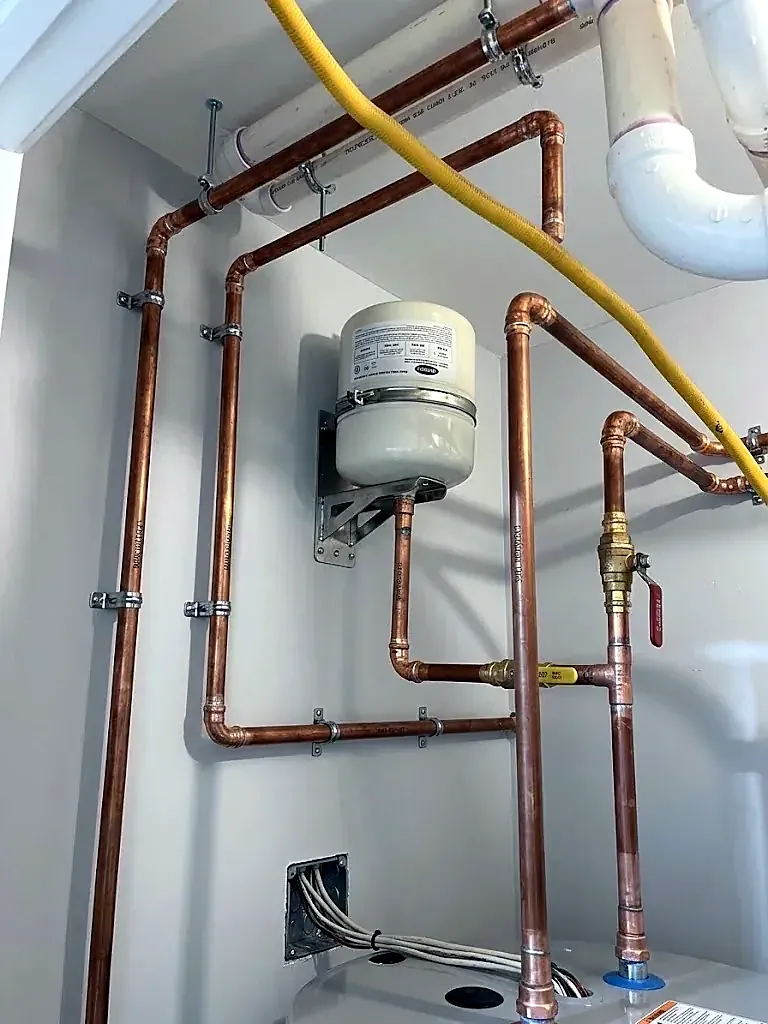
- Check the water heater connections, where electrolysis at dissimilar metals produces slow, hidden losses.
- Then test the underground service line specifically. On one job the outside testing indicated the house may still have had an underground leak after everything interior had been corrected — and that is the point at which this page becomes the right page.
If the loss turns out to be inside, the work belongs on pipe repair and leak detection instead, and we will say so.
What a water service line replacement involves
- Locate the run and agree the route between the meter or well head and the point of entry into the house.
- Pull the plumbing permit before anything is excavated.
- Shut down and drain the system. Every service-side job on our contracts starts with a drain-down.
- Excavate the run and open the entry point, which may mean cutting through a foundation wall penetration or, where the line comes up inside, breaking out a section of basement slab.
- Install the new line and make up both ends, with a proper transition at the meter side and a new main cut-off valve inside.
- Re-establish the electrical bond across any metal piping that has been cut or replaced.
- Pressure test, refill and check the rest of the house for anything the pressure change reveals.
- Backfill, restore the grade and make good the slab, drywall or finishes that had to be opened.
Where the buried pipe in question is the drain rather than the supply, that is a different job again: we have broken up a basement floor out to an outside floor drain, replaced the underground pipe running over to the stack and installed new floor drains with a check valve. See sewer line repair and cleaning.
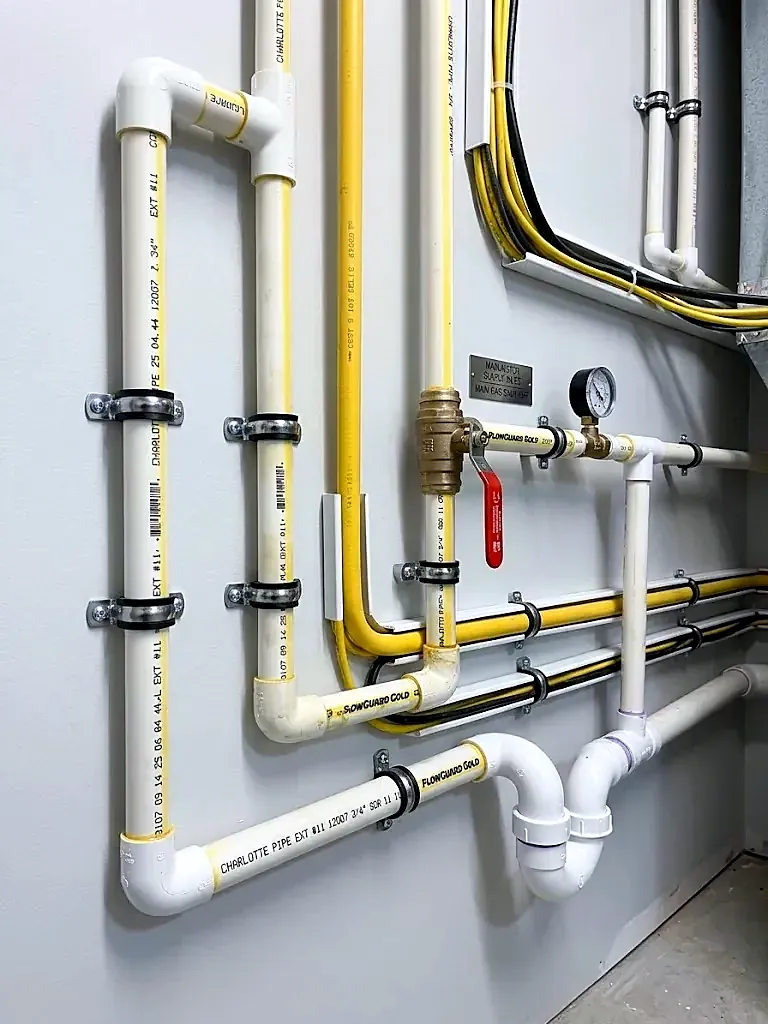
Where the main shut-off valve meets the water line
The point where the service line enters the house is where we find the largest number of avoidable problems, and it is almost always worth correcting at the same time as the line.
- A main valve that will not shut
- Old gate valves that are seized, will not hold, or are leaking. We have replaced one that had to be worked with a pipe wrench, one that was pulling out of the wall, and more than one that simply would not stop the water at all.
- A main valve nobody can reach
- Buried behind finished drywall, or mounted so low it could not be operated. Both get corrected — on one job the main was raised three to five feet and given a bleeder, so it can actually be used in an emergency.
- A valve installed in the wrong order
- On one house the water service had been installed with the main cut-off valve placed above the pressure reducing valve instead of ahead of it, which means the PRV cannot be isolated for service. That gets rebuilt in the right sequence.
- No isolation and no gauge
- The correct arrangement at the service entry is a main cut-off, then the PRV with its own isolation valve and a pressure gauge, so the house pressure can be read without guesswork. That is covered in detail on water pressure, PRVs and shut-off valves.
Well water line and well pump replacement
Houses on a private well have the same buried problem with more moving parts. One call came in as no water at all, and the diagnosis ran in this order: check the electrical panel — the breakers had not tripped; confirm the water heater shut-off; note that the pressure and holding tank and the pressure switch had recently been replaced; inspect the crawl space, where the well wiring looked undamaged and a boiler drain valve was found leaking. The pump itself was then diagnosed as failed.
The buried line only revealed itself once the pump came out. With the drop pipe pulled, the well water line was found cracked throughout its length, and roughly 120 to 240 feet of one-inch well line was replaced along with the pump and its wiring. A standoff was fitted to hold the drop pipe off the well casing while the pump came out and went back in, so the casing is not scored on the way.
The practical lesson for anyone on a well: the pump, the pressure tank, the switch, the wiring and the buried line are five separate failure points, and replacing the wrong one is easy to do. Pump horsepower is confirmed when the pump is out of the ground, not assumed from what is on the invoice from years ago.
Grounding and bonding when a metal water line is replaced
This is the part homeowners are never told about, and it is a real code item, not a technicality. In a great many Northern Virginia houses the metal water piping forms part of the building’s grounding electrode system — a ground wire runs from the main water line back to the electrical panel.
So when the service line is cut, replaced, or changed from metal to a non-metallic material, that path has to be maintained or re-established. On panel and service work we routinely drive ground rods outside the house and run a separate ground wire from the main water line to the panel and ground bridge. On plumbing work we install a ground clamp and bonding wire at the pressure reducing valve so the metal piping stays electrically continuous across it.
We have also found this done wrong by others: on one house the panel ground wire had been attached to the water heater pipe instead of the main water line, which does not perform the function it was installed for, and we relocated it. If your electrical service is also due, see electrical panel upgrades.
Do you need a permit for water service line replacement?
Yes. Service-side work is permitted plumbing work in the jurisdictions we serve. We pull and process the permit before the job starts, the work is performed to the Virginia building code, and the county or city inspection is scheduled after completion.
On larger permitted contracts the payment is released in draws, and the last draw is tied to passing that inspection. That is deliberate. It means the inspector, not the contractor, decides when the job is finished — which is the only arrangement that protects a homeowner on work that is about to be buried under a yard or a slab.
Putting the yard, slab and drywall back after a water line replacement
Excavation near a foundation is an opportunity as well as a nuisance, and we treat it that way. Where we have the ground open at the house we apply mastic tar and plastic sheeting across the work area, carrying it roughly ten inches up the foundation wall and about two feet out, before the fill goes back.
- Backfill is returned and tamped, and the grade rebuilt to the code minimum five percent drop away from the house.
- Where downspouts were discharging into the work area, we run corrugated pipe underground eight to ten feet out and connect it, or extend the downspouts roughly ten feet from the foundation.
- Mulch, landscape lighting and downspout trays that were lifted are reinstated.
- Inside, slab that was broken out is made good and any floor drain is reinstalled and anchored; drywall that had to be opened is patched, taped, blocked, skimmed and sanded ready for paint.
Where grading is the real problem rather than a side effect, see foundation, grading and crawl space repair.
What water service line replacement costs
There is no honest phone price for a buried pipe. The length of the run, the depth, what is on top of it, whether the entry is through a foundation wall or up through a slab, the condition of the main valve and PRV at the house end, and whether the house is on a meter or a well all change the job completely.
An estimator comes to the property, confirms where the loss actually is, and gives you a written price for the work before anything is dug. If the diagnosis shows the loss is inside the house after all, you will be told that plainly — it is a much smaller job, and we would rather do the small one correctly.