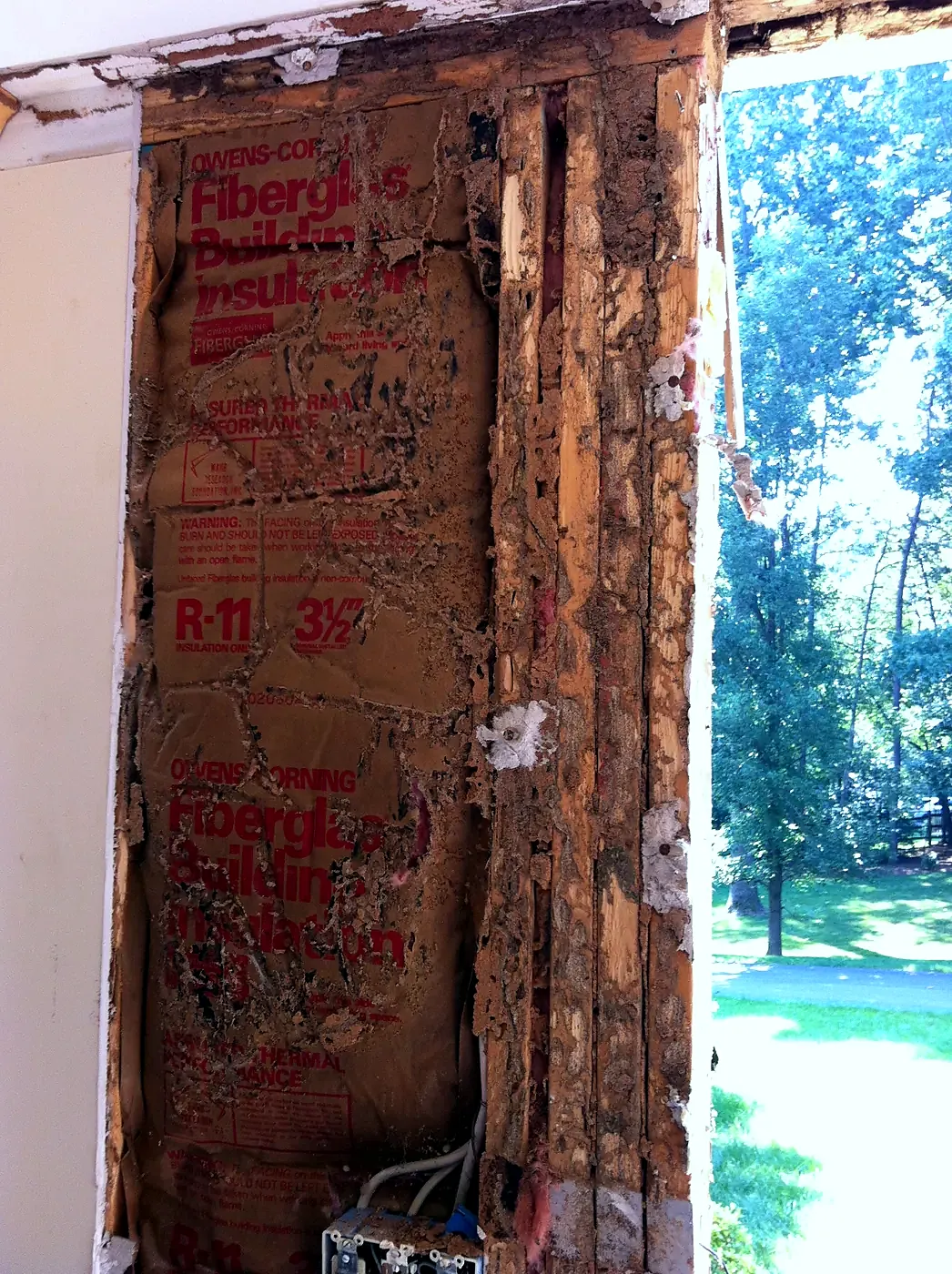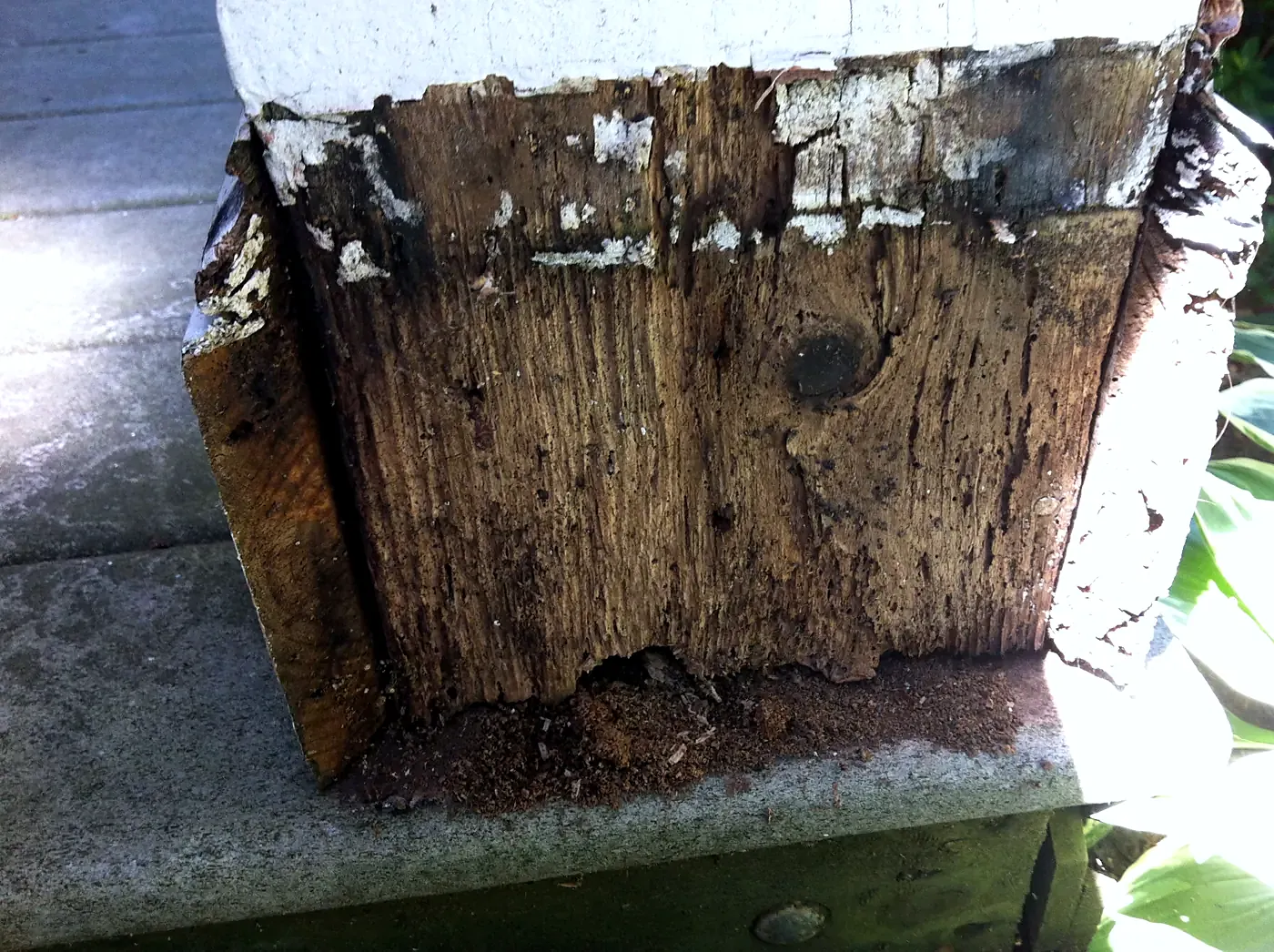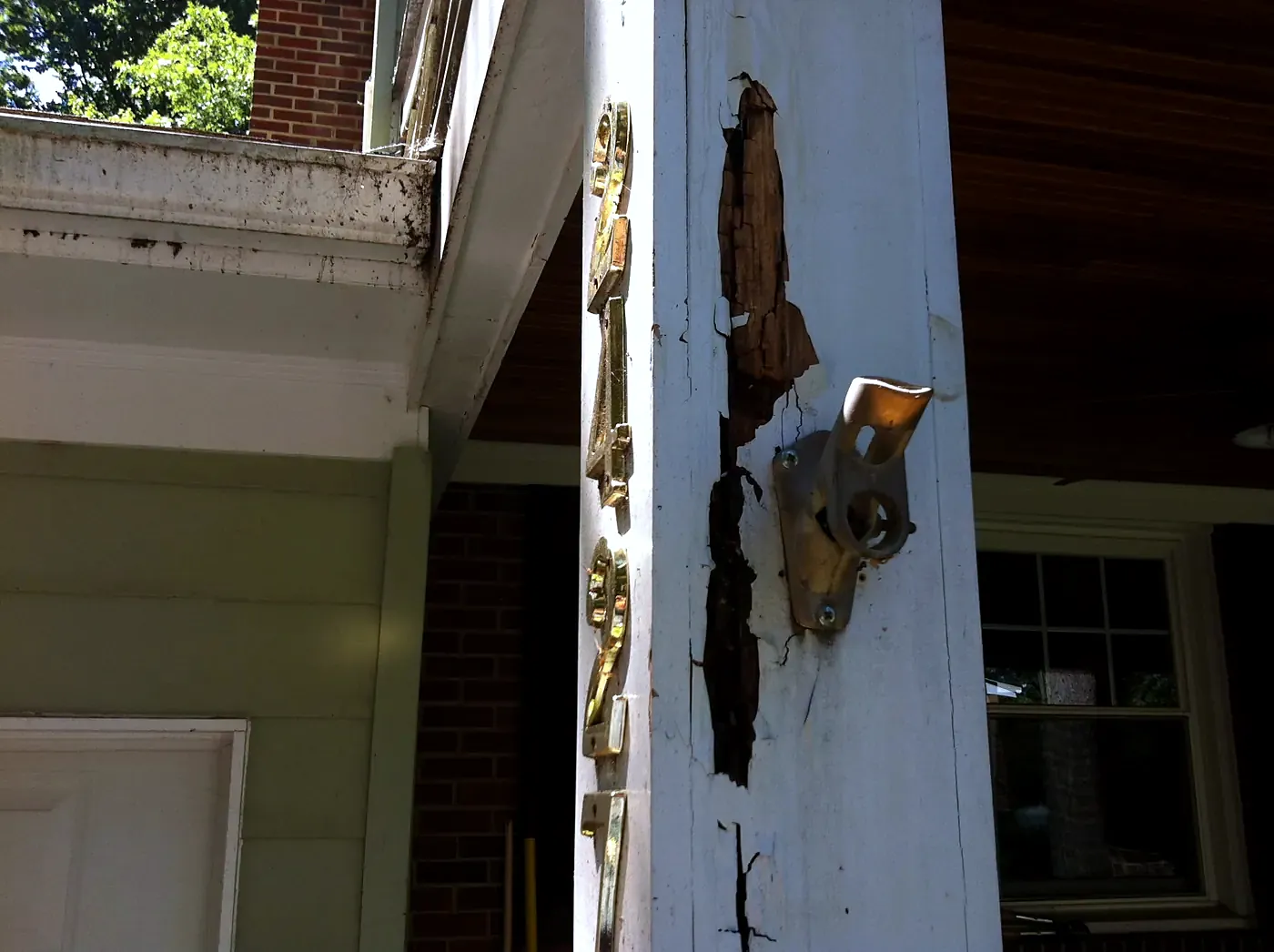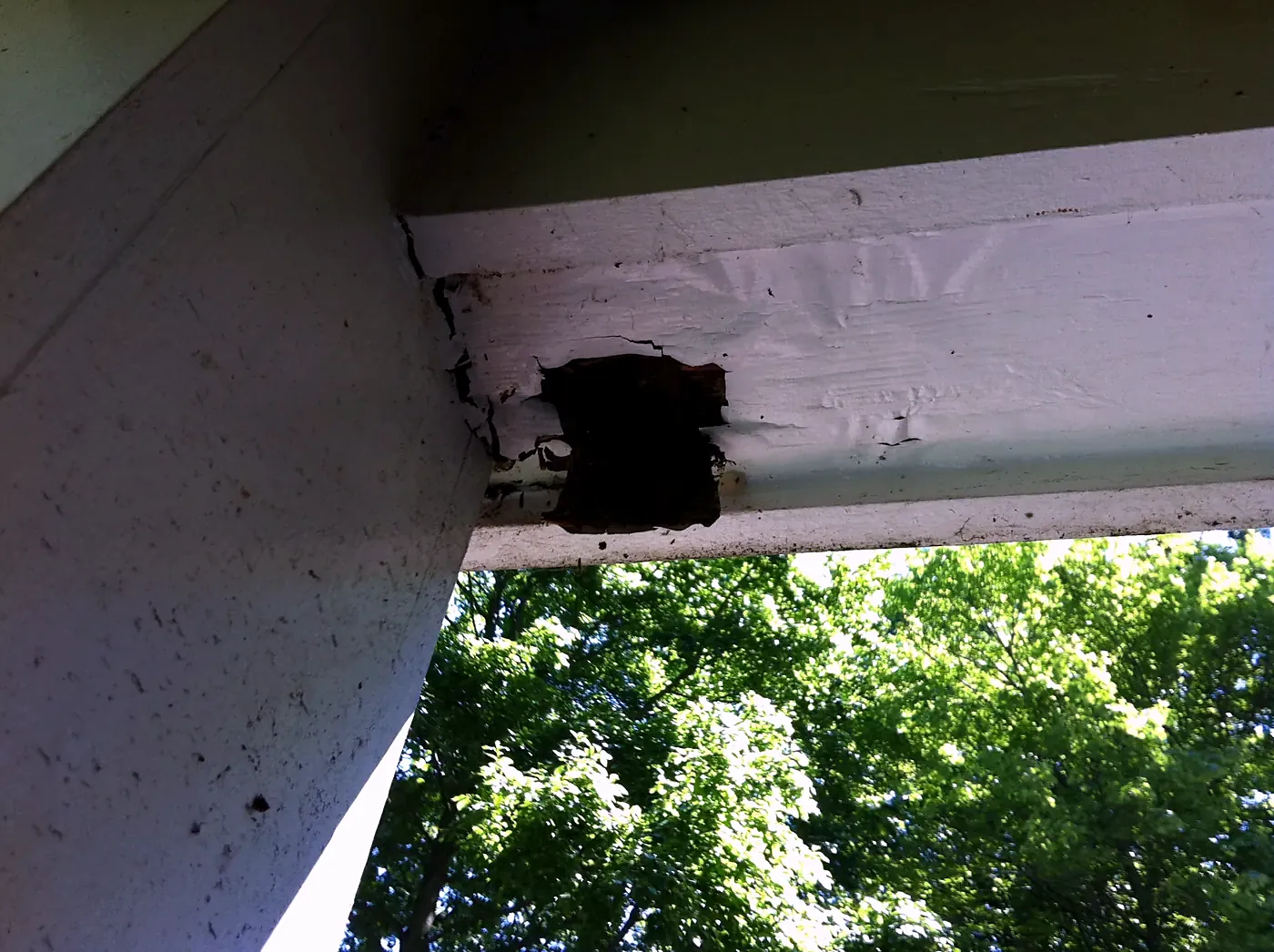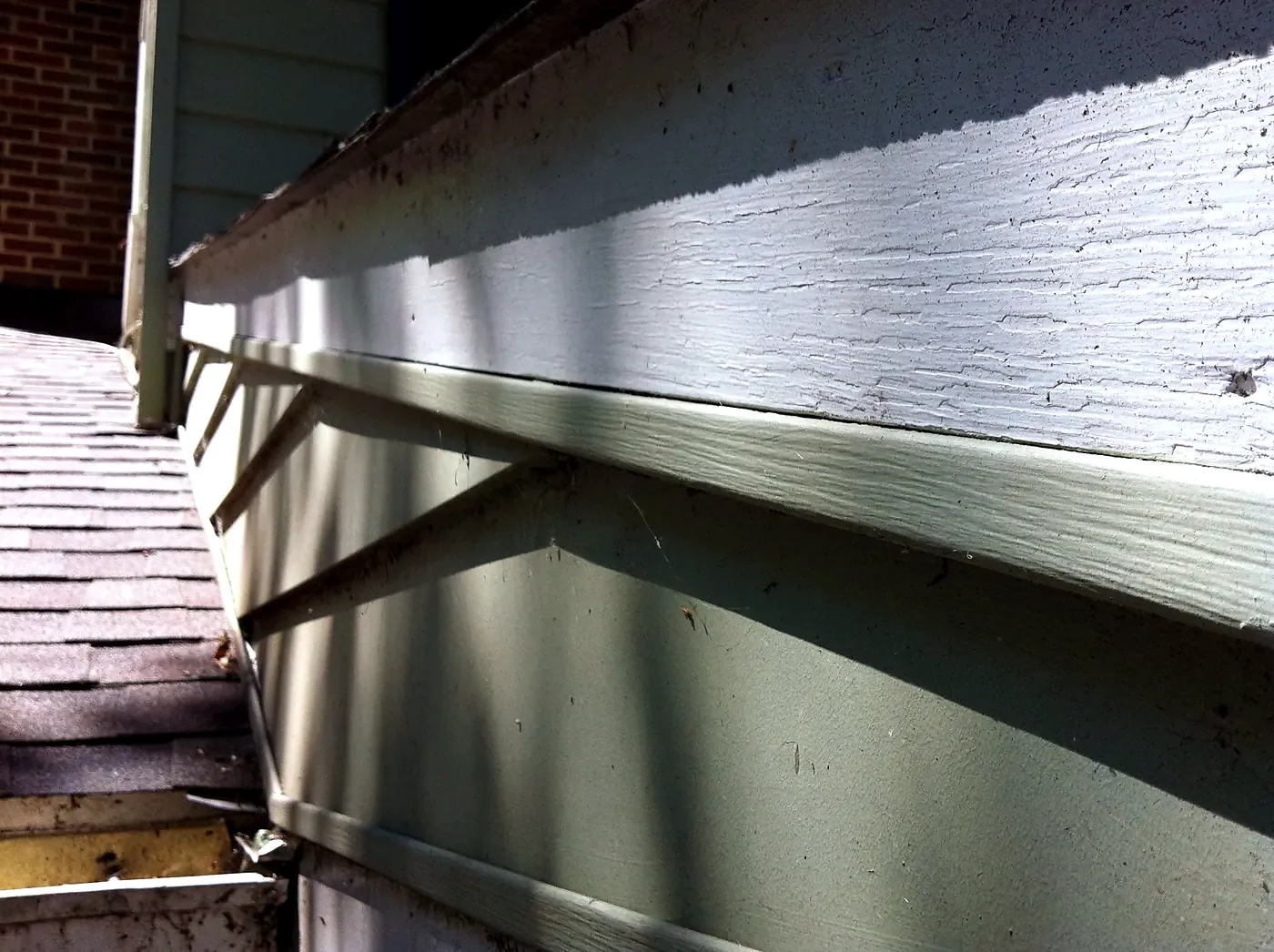
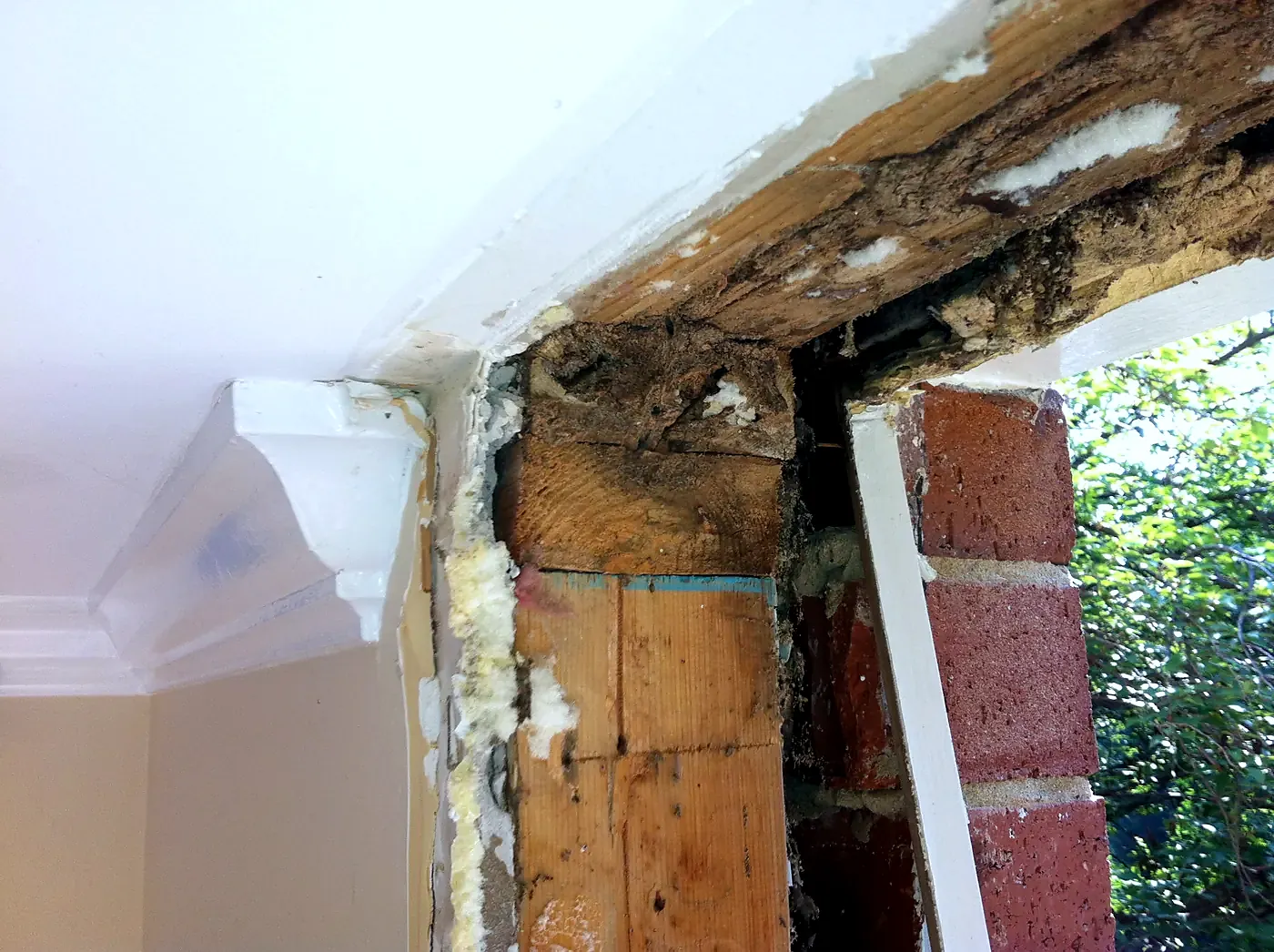
Wood rots because water is reaching it. Trim, fascia, soffit, porch columns, beams, band boards and sill plates decay because a flashing is missing or too short, a caulk joint has opened, a gutter overflows, or a deck ledger was fastened to the wall with nothing underneath it. Replacing the rotted board on its own guarantees a repeat. A proper rotted wood repair cuts back to sound material, opens the assembly far enough to inspect the framing behind it, corrects the water source, and rebuilds in material that is primed and sealed on every face.
What causes wood rot on a house
Almost every piece of rotted wood we are called to replace has water arriving at it from somewhere specific. These are the sources we find once the board comes off:
- Missing or undersized flashing. We have opened walls where there was no top flashing above a window at all, and others where the flashing was simply not tall enough, so in heavy rain water backed up behind the siding. Trim rots from the back first in that situation, which is why it looks sound until the day it does not.
- Deck ledgers fastened with nothing behind them. Where no flashing was installed under the siding above the ledger board and joists, every rainfall runs into the rim joist and sill plate. We have removed eleven feet of rotted sill plate and band joist, plus an eight by eight foot area of sheathing, from exactly that condition.
- Metal wrap over wood. Wrapping a board in aluminum or vinyl does not stop rot; it hides it. We have pulled metal wrap off the two by twelve board between siding and foundation and found the band board and sill plate behind it decayed along a thirty foot run.
- Gutters that overflow or drain the wrong way. Water running over the front edge of a gutter soaks the fascia it is bolted to. We have found rotted fascia at two corners of a house with no flashing between the gutter and the roof at all.
- Door thresholds and jambs with no flashing. Exterior door frames rot from the bottom up. Damaged wood on both sides of a front door frame to roughly six inches high is a routine finding on a door replacement.
- Failed caulk joints and paint film. Once the paint skin splits at a joint, the end grain drinks. Gable trim, gable molding, corner trim and column baseboards go first because they sit where two planes meet.
- Carpenter bees. Bored galleries in soffit, fascia and trim admit water behind the surface, and the damage spreads past the visible holes.
Where rotted wood shows up first on a house
If you are walking your own property, these are the places worth pressing a thumb into:
- Fascia board and soffit
- The board the gutter hangs on, and the panel behind it. We have replaced fascia in short sections of three or four inches, and replaced whole runs along with soffit vents on a carport where the soffit, the vents and the gable and side trim had all gone.
- Porch columns, column baseboards and porch beams
- Columns wick water up from the deck they stand on, so column bases rot from the bottom — which is why a column can look perfect from the street. The beam carrying a porch roof is structural: we have found one rotted clean through.
- Band board, rim joist and sill plate
- The structural band where the floor framing sits on the foundation. This is the one that matters, and it is almost always concealed — behind siding, behind metal wrap, or behind a deck.
- Deck posts, joists and stair stringers
- Rotted posts get replaced on new footings. We have also found porch joists and stringers simply loose and needing metal hangers — a different fault, same symptom underfoot.
- Subfloor and framing inside
- Rot does not stop at the sheathing. Water entering at a siding and stoop junction rotted framing and plywood at an interior corner — inside the house, from an exterior detail.
How to tell if wood is rotted or just weathered
Weathered wood is gray, rough and still hard. Rotted wood has lost its structure. Most of these checks you can run yourself:
- Press it. A screwdriver pushed into sound wood stops. Into rot it sinks, and comes back with soft fibers.
- Check the ends and joints, not the faces. End grain and mitred corners absorb first, so a board can be sound in the middle and gone at both ends.
- Look for paint blistering in a straight line. A line of blisters follows a joint or framing member behind the surface, which means the water is behind the board, not on it.
- Look at what is above it. A rotted patch almost always has a gutter seam, a flashing termination, a deck ledger or a caulk joint directly above it.
- Be suspicious of anything wrapped. Metal wrap, vinyl coil stock and heavy filler are all ways a previous repair covered a problem rather than solving it.
- Open it up. Past a certain point nobody can tell from outside. We remove the board, inspect the framing and panels behind it, and tell you what is actually there before any rebuild is agreed.
That last step is not a formality. We write the inspection into the scope deliberately, because what is behind a fascia board changes the job more than the board does.
Rotted trim, fascia, soffit and column repair by location
| Where the rot is | What the repair involves | What it is rebuilt in |
|---|---|---|
| Fascia and soffit | Gutters disconnected and reconnected afterwards, soffit and vents removed, framing behind inspected, drip edge set between roofing and new trim | New soffit trim and panel, or PVC panel over an exposed run |
| Gable trim, gable molding and corner trim | Rotted members cut out and replaced before any preparation or painting starts | Matching dimensional trim or PVC exterior trim |
| Porch columns and column bases | Damaged wood removed in sections, the surface beneath inspected, mold and mildew cleaned off and the assembly washed down | New wood trim, primed with a tinted sealer matched to the finish color |
| Porch and portico beams | Temporary support wall built first, beam removed, remaining framing inspected, flashing added where the porch meets the house | New two by ten beam on structural screws and brackets |
| Door frames, jambs and brick molding | Unit removed, wall frame and sill plate inspected for water and insect damage, new threshold flashing set and sealed with polyurethane caulk | Rot-resistant composite brick molding and new casing |
| Window and garage door trim | Rotted lengths cut out and replaced, then scraped, sanded, filled and caulked ready for coating | Matching one by four or one by ten trim stock |
| Carpenter bee damage | Galleries cleaned out and filled, then sanded, primed and painted | Exterior wood filler, where the board is sound |
Where trim is replaced ahead of a repaint, the two jobs belong together — see interior and exterior painting.
Rotted band board, sill plate and rim joist repair
This is the serious end of rot work, and it is why we do not quote this kind of job from a photograph. The band board and sill plate carry the floor framing. When they go, the repair is structural.
A temporary load-bearing wall goes up in the basement, set in from the foundation, to take the floor load off the affected run. Where a deck is attached, the deck comes off. Siding, trim, the ledger board and its flashing are removed. The rotted sill plate and band joist are cut out — we have taken out eleven foot runs — along with the moisture barrier and any wall sheathing gone soft behind it.
The rebuild uses material sized to match: two by ten pine for a band board, pressure-treated stock where the member sits low or close to masonry, secured with metal plates or blocking. Moisture barrier goes back on, then sheathing, then the flashing that should have been there originally, then siding and trim, to the Virginia building code.
Where the fault has moved past the framing into the footing or the grade, it becomes a foundation, grading and crawl space repair as well, and we will say so rather than rebuild framing above a problem that is still running.
Can rotted wood be repaired, or does it have to be replaced?
Both, depending on how far it has gone. We would rather repair. The honest dividing lines are these:
- Filler suits surface damage in a sound board. Carpenter bee holes, small checks and shallow weathering get cleaned out, filled with exterior wood filler, sanded, primed and painted, and that repair lasts.
- Rot gets cut out, not filled. Once fibers are soft, filler is cosmetic. We cut back past the damage into sound material and splice in new stock.
- Structural members get replaced, not spliced. Beams, band boards, sill plates, rim joists and posts are replaced in full sections.
- Where a board will rot again, we change the material. PVC exterior trim, rot-resistant composite brick molding and pressure-treated lumber go into the positions that keep failing — low trim, column bases, soffit panels, thresholds.
- Nothing gets painted over rot. A board that is not sound is replaced before preparation starts, because coating rotted wood only buries the evidence for a year.
Stopping the water that caused the wood rot
This is the part of rot work that separates a repair from a patch. The details that actually stop water are unglamorous:
- Flashing the right size and in the right plane. Surface flashing at a roof-to-wall junction gets replaced with two-foot-wide material and every joint sealed. Where a lower roof meets a wall, aluminum flashing carried seven inches onto the wall and seven inches up the roof does the work.
- Threshold flashing at every door, set before the unit goes back, followed by polyurethane caulk, specifically to prevent decay of the jamb and framing.
- Drip edge between the roofing and new trim, so water leaves the edge instead of running back along the underside.
- Gutters sloped to their downspouts and clear — see gutter repair, cleaning and downspouts.
- Siding and J-channel reinstalled over the flashing, not under it. Siding repair and replacement covers that side of the assembly.
- Mold control and stain-blocking primer on anything that was wet, so tannin does not bleed through the new finish.
If the water arrives from above rather than beside, the trail usually ends at the roof — roof leak and roof repair explains how that is traced. If it arrives at a deck, deck, porch and railing repair covers the ledger and framing side.
What a rotted wood repair visit includes
- Find the water first. We look above and behind the damage before we look at the damage, because the board is the symptom.
- Protect the work area. Plantings, walkways and surfaces get covered before anything comes off.
- Remove the affected material and inspect what is behind it. Framing, sheathing and panels are inspected and you are told what was found before anything is closed up.
- Treat what was wet. Mold and mildew cleaner where growth is present, mold control product on affected framing, stain-blocking primer on exposed joists and studs.
- Correct the water source. Flashing, drip edge, caulk joint, gutter slope or ledger detail — whatever the inspection showed.
- Rebuild in the right material, sized and profiled to match so the repair does not read as a patch from the street.
- Prime and finish. Scrape, sand, fill and caulk, prime with a tinted sealer matched to the color, and coat with exterior acrylic latex.
On structural rot repairs, permits and inspections are handled as part of the contract where the jurisdiction requires them.
What rotted wood repair costs and how we price it
We do not publish prices for rot work and we do not give them over the phone, because nobody — including us — knows the extent of rot until the board is off. Two houses with identical-looking fascia can be one afternoon of trim work or a week of structural framing, and the difference is not visible from the ground.
An estimator comes to the property instead. He looks at the actual condition, tells you what he can see and what he suspects is behind it, and gives you a written price before anything begins. Where the inspection during the work turns up more than was visible, you are told and you decide.