A sewer line problem shows itself when several fixtures back up at once, when water surfaces in a basement floor drain or shower, or when the same blockage returns every few months. The work runs in a set order: cable the line mechanically, hydro jet away what the cable leaves behind, and run a recorded camera to confirm what is actually there. Only then does anyone talk about excavation — because the camera is what distinguishes a dirty line from a cracked one.
Signs of a sewer line problem, not just a blocked drain
- Several fixtures backing up at once. We arrived at a ceiling leak and found the main line clogged, backing up the shower and the bathroom sink together.
- Bubbling at drains in more than one area. On one property, testing found drains gurgling in several places — a slow main line stoppage that had been building rather than a sudden clog.
- Water at the lowest opening. A basement floor drain, slop sink or shower base filling when nothing is running there. One toilet backup was confirmed as a main line blockage only when the sump pit was opened and water was found backing over from the air conditioner condensate trap.
- Sewage above floor level. One backup put sewage into a laundry room and left the floor wet under the water heater and the furnace — both had to be pulled so the floor could dry properly.
- Water surfacing through a floor. At a commercial property, flushing a toilet pushed water up through the tile floor roughly three feet away. That is a broken line in the ground under the slab.
- The same blockage returning. A line that blocks again within weeks of being cleared is not a clog problem. It is a pipe problem.
If only one fixture is affected, the work is usually smaller — see drain cleaning or clogged toilet repair.
Sewer line camera inspection — what it can and cannot see
A camera is the single most useful tool on this work and the one most often used badly. Two things from our own job records show why.
First, a camera cannot see through sewage. On one blocked main we attempted a video scope before snaking and the camera was submerged in raw sewage the moment it went in. The line had to be cleared before any inspection was possible. Anyone who claims to have diagnosed a break in a line that is still full has not seen anything.
Second, the recording matters. A homeowner came to us after another company had jetted her line, run an unrecorded camera and told her the waste pipe had to be replaced. Inspecting the stack, we found that same company had fitted a PVC plug onto cast iron pipe. Our plan was to cable the line with multiple cutter blades and then run a recorded camera to establish whether the breaks existed at all before anyone committed to excavation.
Sometimes the honest answer is that nothing is wrong. We snaked one hundred feet of line for a property with standing water in the front yard and met no resistance and no restrictions. The video scope over the same distance showed no breaks, no bellies and nothing unusual — the line was slightly dirty, which is normal. That finding went to the homeowner in writing, exactly as a defect would have.
Snaking, cutting and hydro jetting a sewer line
Cabling and jetting do different jobs, and the order they are done in is not arbitrary.
- Mechanical cabling with a drum machine
- A cable opens a channel through the obstruction and tells us where the resistance is. On one main line we met resistance at about 37 feet, worked through another 30 feet until the line opened, then ran a further 40 feet before withdrawing. Cutter blades are used where roots or hard build-up need to be cut rather than pushed.
- High-pressure hydro jetting
- Jetting scours the pipe wall and removes the residual debris a cable leaves behind. After clearing one blocked main, a follow-up camera showed debris in the line that was not simply sewage, so jetting was recommended and carried out as a second stage.
- Descaling a scaled line
- Where heavy scale has built up inside the pipe, jetting is the treatment. On one lateral we cameraed from the basement clean-out, jetted out to the road with up to seven complete passes, and cameraed it again to verify the result.
- Camera between stages
- We inspect before, between and after cleaning stages. Two full jetting passes with a confirming camera run is how a job gets signed off, not a single pass and an opinion.
- A written completion report
- Footage covered, where resistance was met, and what was found. You should not have to take a verbal account of a pipe you cannot see.
Where a toilet has to come off to get a straight run at the main, that is part of the same job — see clogged toilet repair for how that works, including the risk with one-piece fixtures.
Sewer line repair or full replacement: how the decision gets made
Excavation is the last step, not the first, and it is driven by recorded evidence rather than a sales pitch.
- Clear the line so it can actually be inspected.
- Run a recorded camera and locate any defect by distance and depth.
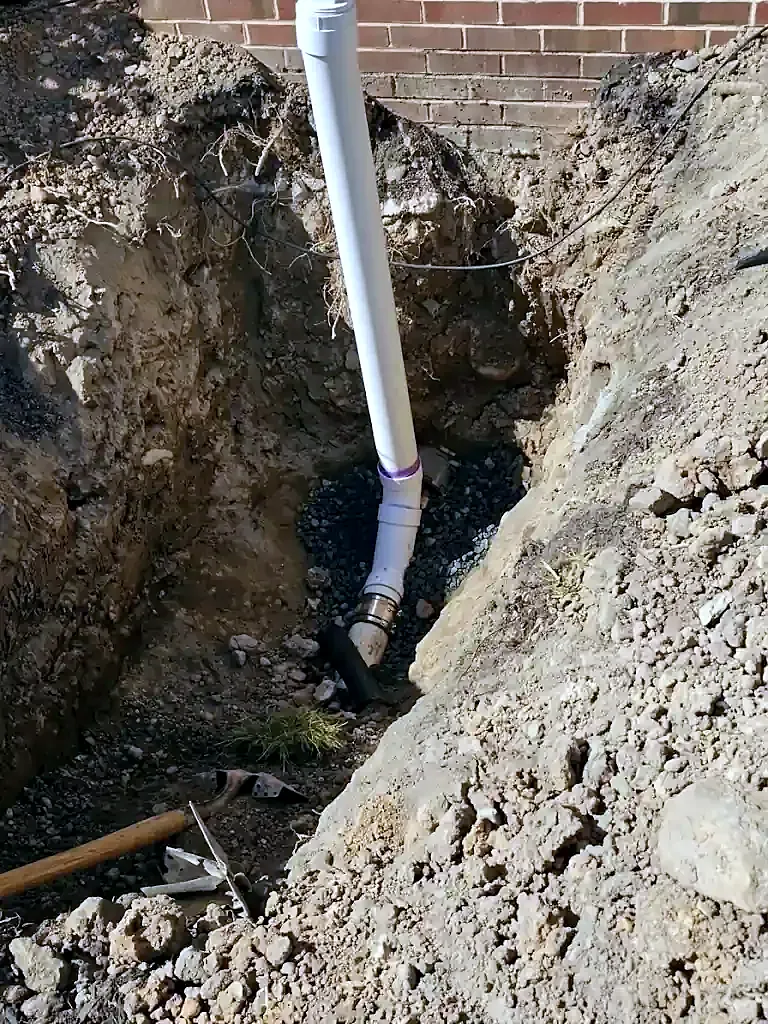
- Repair the defective section where the pipe is otherwise sound. One camera inspection located a cracked line about 3 feet beyond the clean-out, outside the foundation wall, at roughly 5 feet deep. We excavated to that section, replaced the cracked portion, backfilled and re-seated the ground, and pulled and processed the permit.
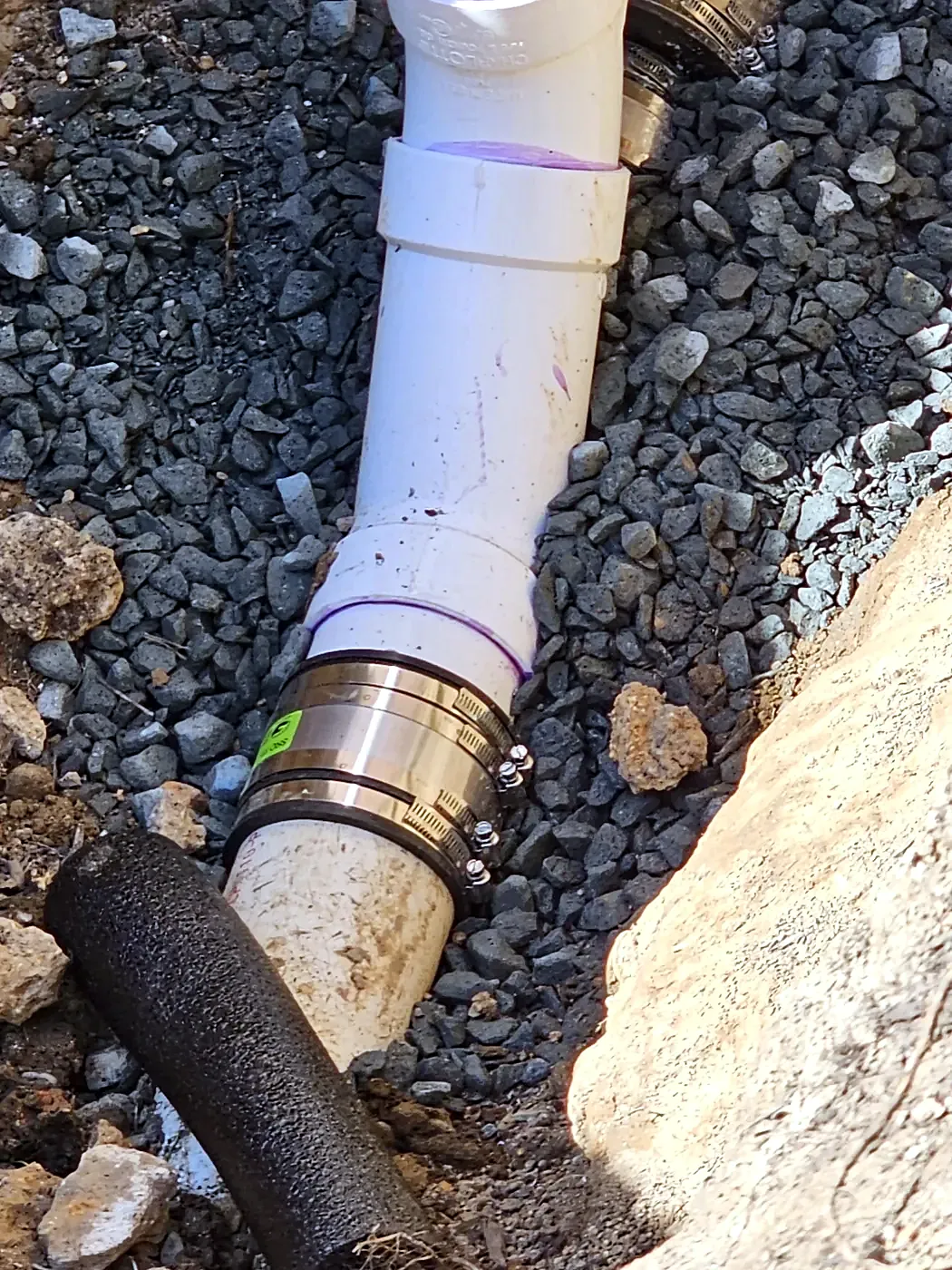
- Transition failing material where the pipe type is the problem. On one job we cut the pipe, transitioned from cast iron over to PVC and installed a clean-out at the same time.
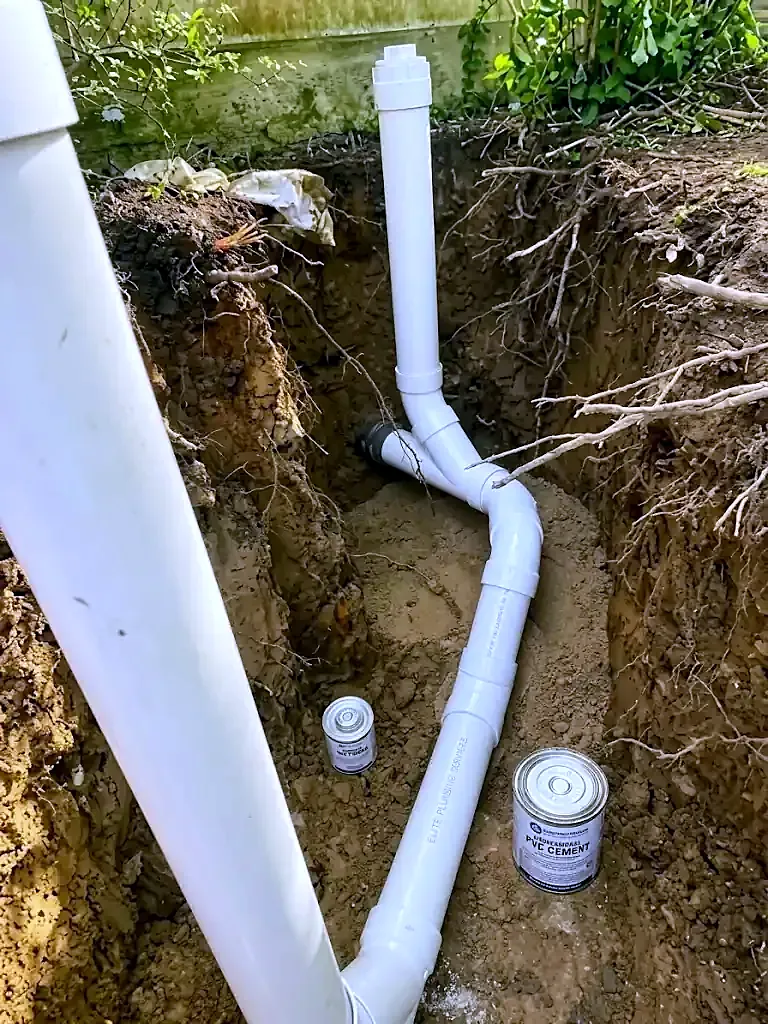
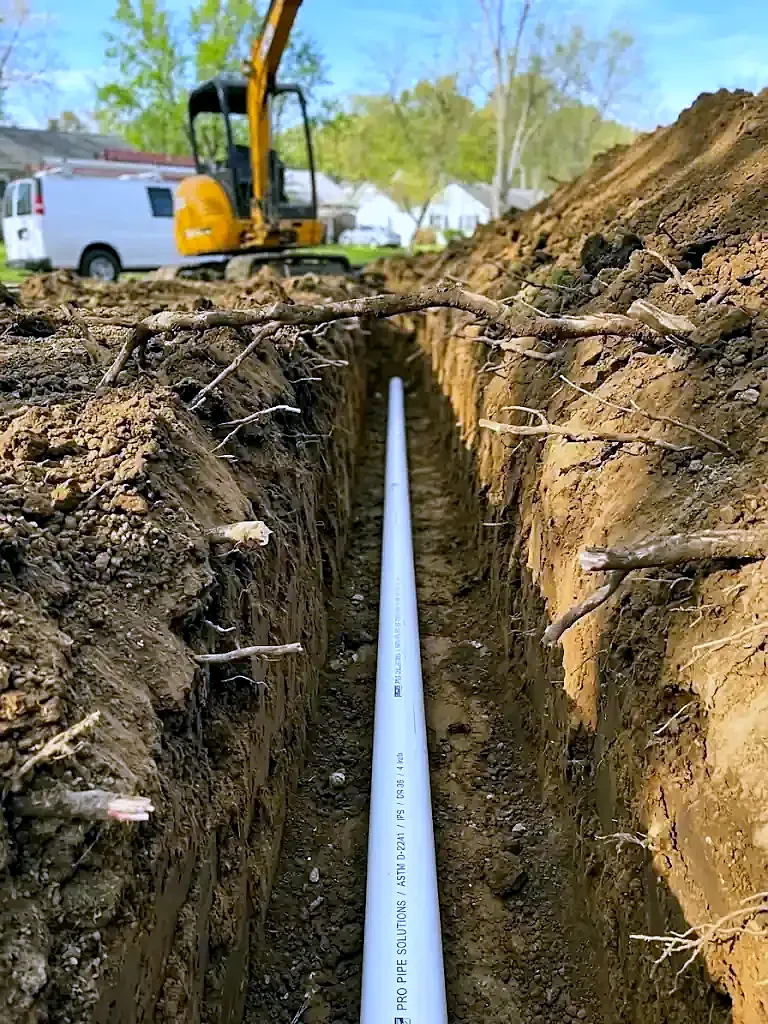
- Replace the run only when repeat problems and the camera together justify it. One property with a history of sewer problems was cameraed after snaking and several bad spots were identified along the run from the toilet out to the road, so the line was replaced — roughly 12 feet inside the house and the remainder outside, stopping about 5 feet short of the sidewalk.
A replacement inside the house is not a gentle job. That one required breaking up a bathroom floor and tile, lifting hardwood and carpet in the next room and breaking the concrete underneath. We say that plainly at estimate stage rather than after the tile is up.
Where a sewer line breaks, and how deep it runs
The lateral runs from the house, under the yard, out toward the road. Defects cluster in a few predictable places:
- Just beyond the clean-out, outside the foundation wall. The transition from inside to outside is a stress point — the crack we found 3 feet past a clean-out is a typical location.
- Where the material changes. Cast iron to clay, cast iron to PVC, or a previous repair joined badly. A PVC plug fitted onto cast iron by another contractor is the kind of thing we find on the stack.
- The stack itself. One basement sewage backup came from a main line stack cracked all the way down to the floor, with the underground drain running out to the exterior floor drain needing to be opened up and replaced.
- Under a slab. Water coming up through floor tile several feet from a fixture means a break in the ground beneath the concrete.
- Wherever something else was laid on top of it. While excavating to expose a cracked sewer line, one crew found the water service line running directly on top of it. That blocks access and is not an acceptable arrangement, so the water line had to be rerouted before the sewer repair could even start — see water service line replacement.
Depth drives method and safety. A defect at around 5 feet requires trench shoring, and shoring requirements are part of the job, not an optional extra. On another property the plan was written to keep the excavation under roughly three and a half feet where possible for exactly that reason.
Sewer line cleanouts and why a property needs one
A clean-out is a capped access point into the line. With one, a blockage is reached in minutes. Without one, the only ways in are through a lifted toilet or through excavation.
On one property the basement floor drain would not clear, and cabling from inside kept pulling back balls of paper towels. After repeated attempts the line appeared broken or separated and could not be cleared from inside at all. The lateral had to be located by excavating outside — a full day of locating where it entered the side of the house — before the line could be cut and an outside clean-out installed to give direct access.
That access changes every future call on the property. Where a house already has one we check it first: a customer with a stopped-up line had an exterior clean-out and a second in the basement, so nothing had to be lifted. Clean-outs are also added when we open a line for other reasons — cutting out a failed slop sink trap, or transitioning cast iron to PVC.
Sewer backups in a basement: check valves and ejector pumps
A basement is where a main line failure shows up first, and two pieces of equipment decide how bad it gets.
- A backwater check valve on the interior floor drain. On a property where sewage had been backing up into the basement, we broke up the basement floor out to the exterior floor drain, replaced the underground pipe running over to the stack, installed a new floor drain between the stack and the slop sink area, and fitted an interior floor drain with a check valve so a future blockage cannot come back up through it.
- A sewage ejector pump, where the basement plumbing sits below the sewer. One homeowner reported a ceiling leak and a basement flooded with sewage; the cause was a failed ejector pump. It was replaced along with partial 2 inch PVC and the 2 inch check valve, the pit lid was cracked open and resealed properly, and a permit was pulled.
- A pit lid that is actually sealed. We found one ejector pit lid sitting half on and half off because somebody had cut it to build cabinetry around the pump. That open lid was the source of a persistent basement odor.
If your basement relies on pumped drainage, see also sump pump repair and installation. If sewage is coming up right now, stop using water in the house and call — see emergency plumber.
Sewer line permits, inspections and putting the ground back
Sewer work is permitted work. We pull and process the permit, the work is performed to the Virginia building code, and a final plumbing inspection follows completion. On the job where a basement floor had to be broken out to replace underground drain pipe, the concrete was re-laid only after the county inspection had passed — which is the correct order and the one that protects you if anything is questioned later.
Putting the property back is part of the work, not an afterthought. Excavations are backfilled and re-seated. Where flooring, drywall or concrete has been opened or damaged to reach a line, it is restored — we have replaced laminate flooring and shoe molding over a new vapor barrier, patched wall areas and re-poured concrete around a drain after sewer line work.
What sewer line repair and cleaning costs
We do not quote sewer work by phone. The same call — a line that will not drain — covers cabling from an existing clean-out, a day spent locating a buried lateral, jetting with multiple passes and a confirming camera, a single cracked section replaced at depth with shoring, and a full replacement run out toward the road. Nobody can price that from a description.
An estimator comes to the property, and on this work the camera usually comes first, because the recording is what a sensible price is built on. You get a written price before any work begins, and on permitted work the job is not closed out until the inspection passes.
Sam & Sons Services has worked on sewer lines across Northern Virginia since 1999, under Virginia DPOR license #2705070610.