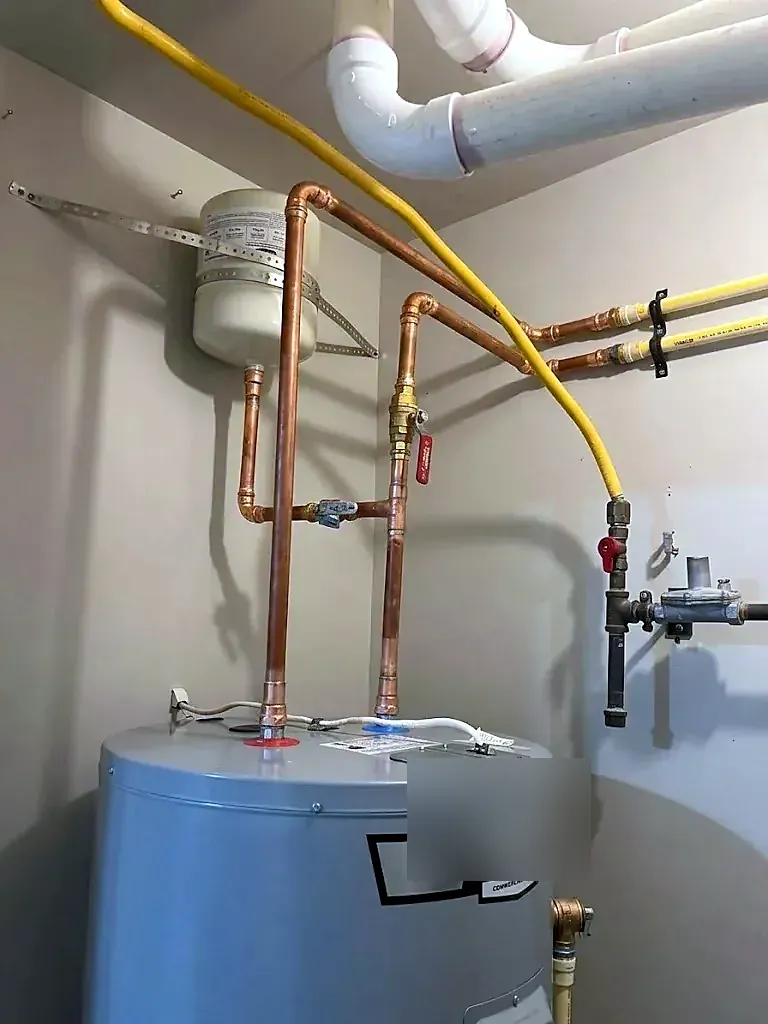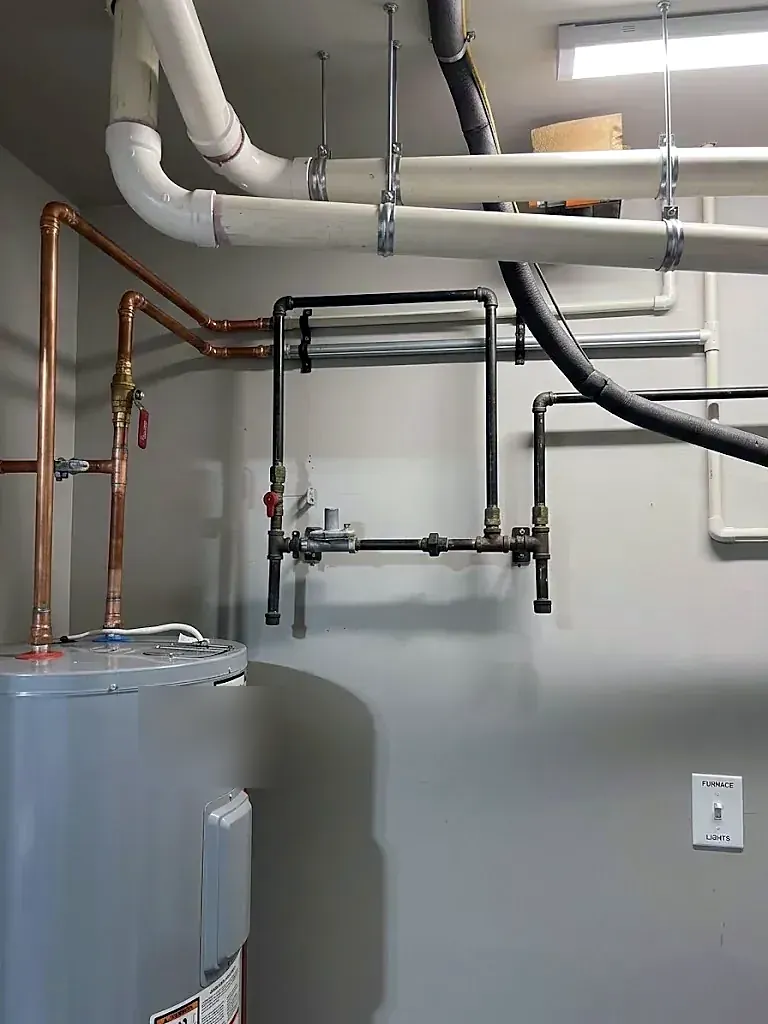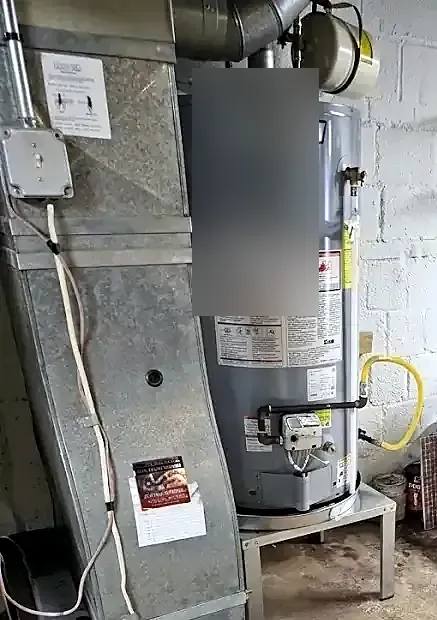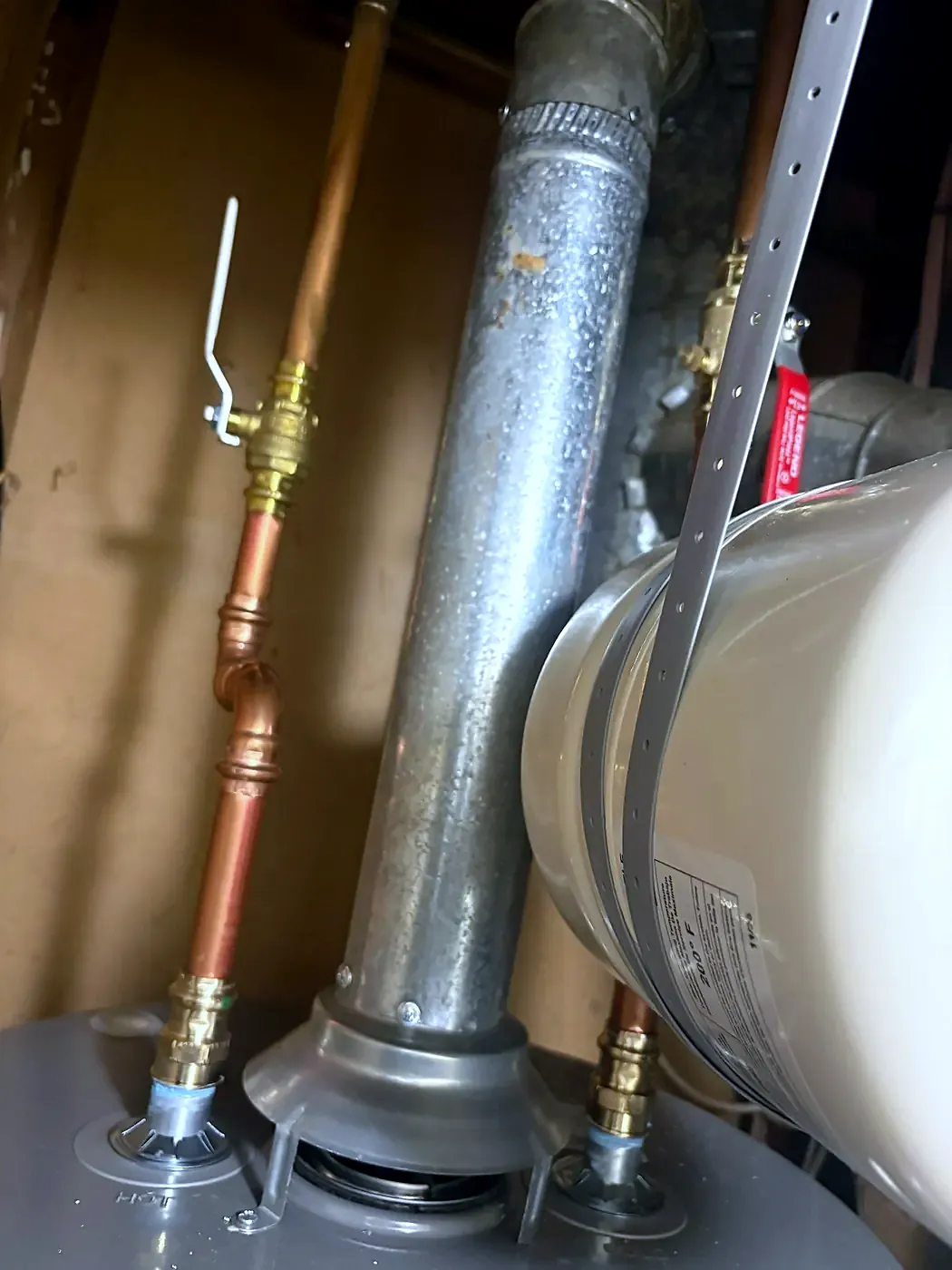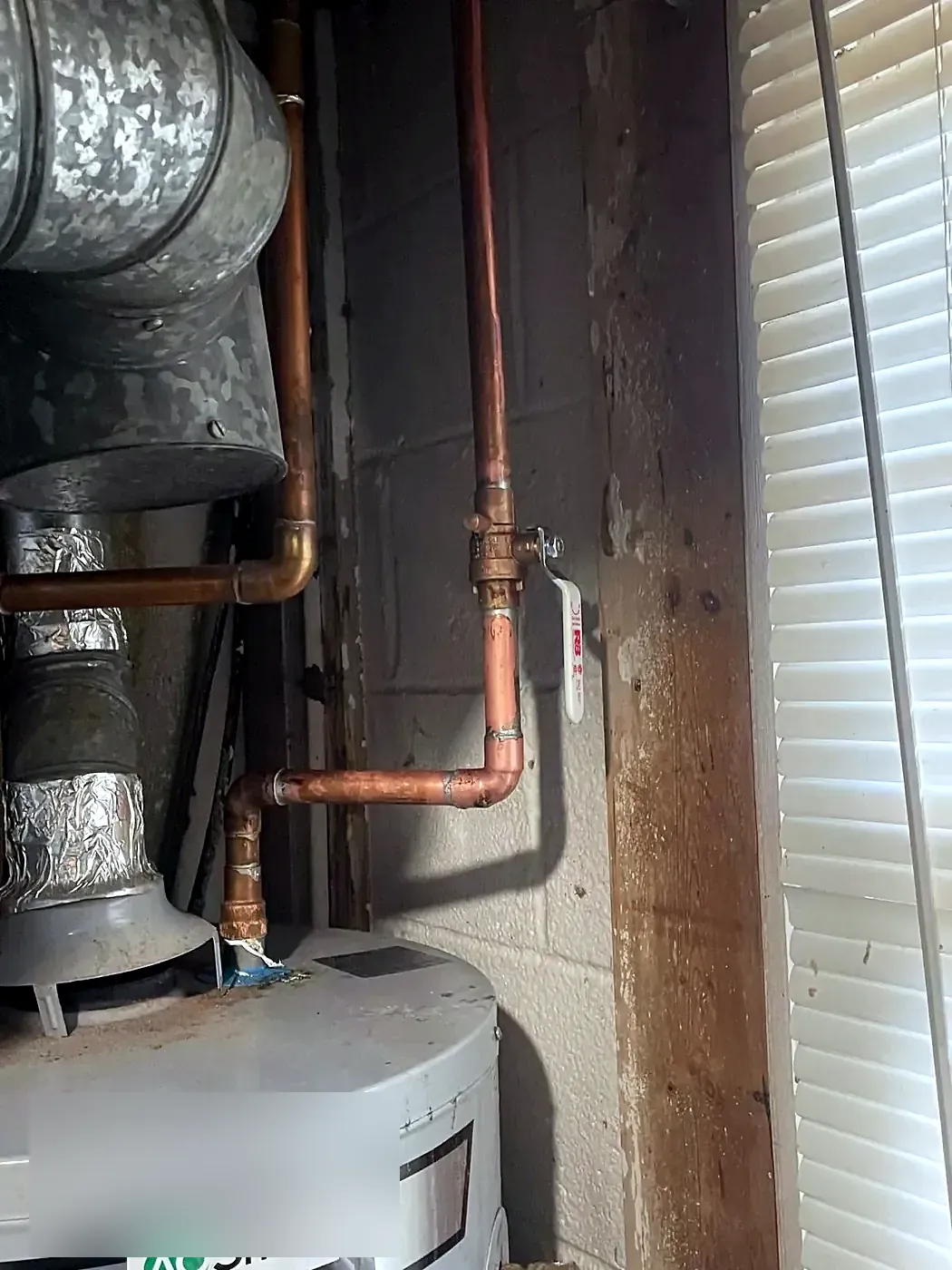
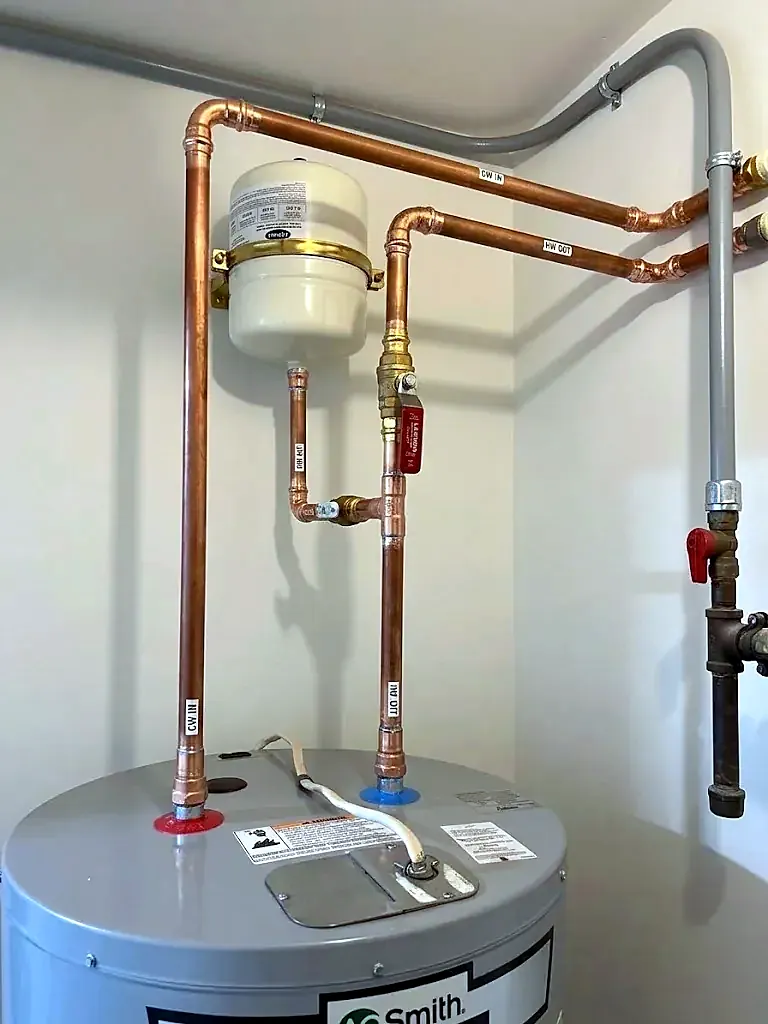
Replacing a water heater is permitted work in every Northern Virginia jurisdiction. A correct installation is not just a new tank: it includes a strapped thermal expansion tank with its own shut-off valve, a listed drain pan with a drain line, isolation valves on the cold and hot sides, a T&P relief discharge line in approved material, a union so the heater can be pulled again later, a gas shut-off and flex connector on gas units, and bonding restored across any cut copper. The old unit is hauled away and a county inspector signs the work off.
When a water heater needs replacement instead of repair
Age alone does not condemn a heater. These are the findings in our job records that ended in a replacement rather than a repair:
- The tank has failed internally. Water from underneath the jacket, a heater found flooding, or rust at the base with a slow weep. The glass lining is gone and no part restores it.
- The nipple at the base will not seal. One homeowner asked us to try tightening the connection first. With the system drained we cut the line and tried; it could not be brought tight enough to stop the leak.
- A gas heater that will not relight. We open the union, bleed the air out of the gas line and attempt a relight, sometimes several times. When the burner assembly is dead and the tank is into its second decade, a gas control valve is spent on a heater that is finished.
- Parts cannot be sourced. One electric unit pushed out only warm water with the element indicator ticking. It came from a big-box store, the supply house had no parts, and the model number had rubbed off the label, so nothing could even be identified.
- Rust at the connectors with a weeping relief line on a heater past fifteen years — or a noisy fifteen-year-old tank a homeowner only wanted an expansion tank added to. Fitting new parts there is doing the work twice.
Before we write up a replacement we check the warranty with the supply house or the manufacturer, using the model and serial number. One six-year-old heater came back out of warranty; another that had been written off entirely turned out to be covered and was replaced under the manufacturer’s warranty. If the fault is repairable, see water heater repair instead.
What size water heater do you need — 40, 50 or 75 gallon?
Our contract record runs across 40, 50 and 75 gallon gas tanks and 40, 50 and 80 gallon electric tanks, plus tankless units. Three things usually decide which one goes back in:
- The space it has to fit
- We have replaced heaters that had to drop into an existing recessed alcove with an access panel. The alcove sets the diameter and the height before anything else is discussed. Say so when you call if yours sits in a closet or a tight crawl space.
- The existing vent
- An atmospheric gas heater vents into a flue; a power vent moves combustion air and exhaust with a blower. These are not interchangeable, and swapping one for the other without reworking the venting is one of the ways an installation fails inspection.
- What the old tank actually delivered
- One household was content with less capacity than it had, and a 65-gallon electric heater came out in favor of a 50-gallon. Another had never had enough hot water: the diagnosis was a missing expansion tank, a missing mixing valve and a tank thick with sediment, not an undersized heater.
Gas, electric, power vent and tankless water heater installation
| Type | What the installation involves | What catches people out |
|---|---|---|
| Atmospheric gas | New gas shut-off valve and flex connector, air bled from the line, union at the heater, flue pipe checked and partly replaced where corroded or out of alignment. | Older installs were sometimes hard-piped with no union, so the heater cannot be isolated or pulled without cutting. |
| Electric | No venting, but the same pan, expansion tank, valve and bonding work, and the tank has to sit so the access plates can be reached. | One previous installer had jammed a heater in at an angle against an obstruction. The copper had to be cut and the tank twisted just to reach the thermostat and elements. |
| Power vent | Replaced in kind, with the blower, the combustion air path and the vent run configured to match what was there. | A gas final inspection was failed on exactly this point: the existing setup was power vent and the new unit was not drawing combustion air back. |
| Tankless | Vent run out to the exterior, gas line sized and run from the meter, and annual flushing built into the ownership. | A tankless unit that is never flushed scales up. We opened the internal filter on one and green sludge came out. |
What a code-compliant water heater installation includes
This is the sequence on a standard tank replacement. Very little of it is optional, and most of it is what a previous installer left out:
- Drain the system down, then remove the old unit and haul it away rather than leaving it for you to deal with.
- Set the new heater and repipe in copper. Partial 3/4 inch copper at the connections is standard here, with a union so the next person can pull the heater without cutting, and isolation ball valves on the cold side, the hot side and the expansion tank.
- Install and strap a thermal expansion tank. The most repeated item in our water heater records. It gets its own cut-off valve and it gets anchored, because an unsecured tank is written up at inspection.
- Install a listed drain pan and run its drain line. We have routed pan lines to a floor drain, to a sump pump and into an existing condensate line off the furnace. Where there is nowhere to drain, the pan is installed and capped.
- Install a T&P relief discharge line in approved material. One house had no relief line at all; on another job PVC had been used for it, which is not permitted.
- Gas units: shut-off valve, new flex connector, drip leg, clearance from the jacket, flue corrected, and air cracked out of the line before lighting.
- Restore the ground and bonding wire across any copper that was cut — copper piping is part of the grounding path in a lot of these houses. We have found a ground clamp with no screws in it.
- Gauge the static water pressure and check the PRV before we leave, because pressure is what kills the next heater.
Where CPVC has failed at the heater we make proper CPVC-to-copper transitions rather than patching plastic, and where dissimilar metals meet at the hot-side connection the transition is made so galvanic corrosion — electrolysis — does not restart the day we leave.
Water heater installation permits and inspections in Virginia
A repair does not need a permit. A water heater replacement does, in every Northern Virginia jurisdiction we work in. We pull and process the permit ourselves, the work is performed to the Virginia building code, and the county inspector has the final word. On permitted work a portion of the payment is held back until the inspection passes.
It is worth knowing what gets written up. A municipal gas final inspection on a replaced heater in our record failed on four points:
- The existing setup was a power-vent heater and the installed unit was not drawing combustion air back.
- The thermal expansion tank was not properly secured and strapped.
- PVC had been used on the T&P relief pipe, which is not an approved material.
- The drain pan had no listing or label showing the minimum 0.036 in. thickness and flame spread index compliance.
All four were corrected and the re-inspection passed. On some gas replacements the county also wants a vent or chimney certification filed before final inspection.
Why a new water heater fails early in Northern Virginia
Almost every house on public water here has a pressure reducing valve at the service entry, which makes the plumbing a closed system. Heated water has nowhere to expand, so pressure spikes on every cycle. Our job records are full of what that does:
- A gauge on one house read over 90 psi because the PRV had failed. The pressure had taken out shut-off valves under the kitchen sink and in a hallway bath, and the kitchen faucet with them.
- Another heater was leaking at the hot-side connection from electrolysis and again where copper met CPVC. A check of that house turned up ten leaking cut-off valves.
- A whistling noise in the plumbing was traced to a failed PRV; three more broken valves turned up while we checked.
- Saddle valves above a heater are a standing leak risk — we delete them and convert to quarter-turn valves — and one heater had never been flushed since the day it was installed.
That is why a pressure gauge goes on the house as part of a water heater installation, not as an add-on. See water pressure, PRVs and shut-off valves for that side of the work, and pipe repair and leak detection when the damage has already spread past the mechanical room.
Tankless water heater installation and relocation
Tankless changes the shape of the job, because the appliance no longer has to live where the tank did.
- One replacement removed a 60-gallon gas tank, capped off the existing vent and gas lines, and set a tankless unit rated at 11 gpm recovery. A ceiling and part of a wall were opened to run a new gas line from the meter and a new vent line out to the side of the house.
- Another moved the heater into the laundry room: 70 feet of water supply line, 25 feet of gas line and 25 feet of flue pipe run out to the exterior wall.
- A condo tankless unit that had stopped producing hot water needed no replacement at all — a power reset, a flow sensor test and black gasket debris cleared from the braided supply line inlet told most of the story, and the manufacturer’s technical line identified the control module.
Tankless units are not maintenance-optional. One manufacturer confirmed to us that the unit must be flushed annually, and that only the heat exchanger was still under warranty. Gas sizing is the other thing people underestimate — see gas line installation and repair.
How long does a water heater installation take?
A straightforward tank-for-tank replacement is normally a single visit: drain down, old unit out, new unit set, repiped, valved, panned and vented, with the county inspection scheduled separately. Water is off for part of the day, not all of it.
What adds time is almost always something found rather than something planned:
- No floor drain, so the pan has nowhere to go. On one job the drain was there but had been covered over with duct tape — we removed it so the heater could be drained and the pan line had somewhere to discharge.
- A main shut-off that will not hold, or one buried inside a wall. We have opened the back of a wall to reach a 3/4 inch cut-off valve and replaced it with a ball valve with a bleeder.
- A washing machine or dryer that has to be pulled out and reset for access, or copper badly routed under the PRV that has to be rerouted and protected before the new work ties in.
If the heater is actively leaking right now, we answer the phone around the clock — see emergency plumber. Shut the cold supply valve on top of the tank, turn the gas control off or switch off the breaker, and call.
What water heater replacement costs, and how the price is set
We do not quote water heater prices over the phone and we do not publish them. Two installations that look identical from the doorway differ by a vent certification, an alcove that dictates the unit, a gas line that has to be extended, a missing relief discharge line, or eight other valves in the house that will not hold once the water goes back on.
An estimator comes to the property, looks at the actual installation, and puts a written price in your hand before anything starts. Sam & Sons Services has been doing this in Northern Virginia since 1999, under Virginia DPOR license #2705070610.