Most “no hot water” calls come down to one of four things: a failed gas control valve or pilot assembly on a gas heater, a burnt-out element or thermostat on an electric one, a tripped safety or control fault on a tankless unit, or a tank that has failed internally and is leaking. The first three are usually repairable. A tank leaking from the bottom is not — that heater has to be replaced. A licensed technician can tell which it is on site, usually in one visit.
Common water heater problems and what they mean
Water heaters rarely fail without warning. These are the calls we take, in roughly the order we take them:
- No hot water at all
- On a gas heater this normally means the burner is not lighting — a pilot assembly, thermocouple or gas control valve problem, or air in the gas line after a supply interruption. On an electric heater it usually means an element or the upper thermostat has failed, or the high-limit reset has tripped.
- Only warm water, or hot water that runs out fast
- One of the two elements on an electric heater is dead, so the tank only half-heats. On a gas heater the same symptom points to sediment insulating the burner from the water, a failing dip tube, or a tank that is simply undersized for what the household now uses.
- Water pooling around the base
- This is the call that decides the day. A fitting, nipple or flex connector leaking at the top of the tank is a repair. Water coming from underneath the jacket is the tank itself, and no repair fixes that.
- Banging, pinging or knocking
- Usually sediment in the bottom of the tank flashing to steam, or thermal expansion with nowhere to go. We have also traced a persistent night-time pinging to a tank that was already leaking internally and still inside its manufacturer warranty.
- Rusty or smelly hot water
- Rust-colored hot water — and only hot water — means the anode rod is spent and the tank lining is next. Sulfur smell is usually a reaction between the anode and the water supply.
- A tankless unit throwing a fault code
- Tankless failures are more often sensors, debris or a control board than the heat exchanger. They are worth diagnosing properly before anyone suggests replacement.
Why a water heater leaks — what we check first
The diagnosis is rarely just the heater. Across the water-heater calls in our job files, the same underlying conditions come up again and again — and they are usually the reason the heater failed early:
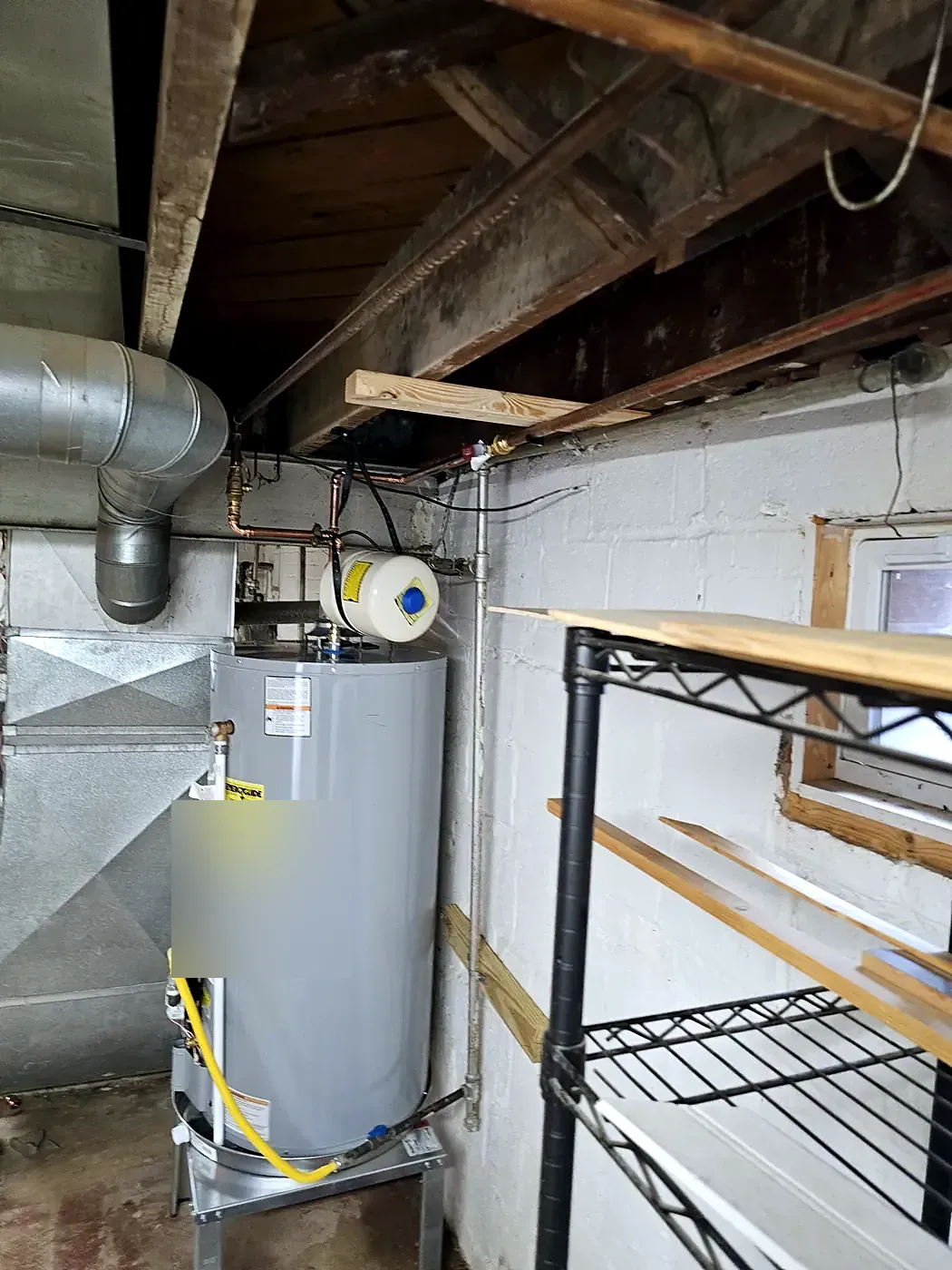
- No thermal expansion tank. Northern Virginia water systems are closed by a pressure reducing valve at the house. Heated water has nowhere to expand, so pressure spikes on every heating cycle and works the tank, the fittings and every valve in the house. A missing or waterlogged expansion tank is the single most common thing we correct on a water heater call.
- A failed or failing PRV. We have opened houses where the pressure reducing valve had rusted through, and found not only a leaking heater but eight or ten leaking shut-off valves and supply lines throughout the property. Fix the heater without fixing the pressure and the next failure is already scheduled.
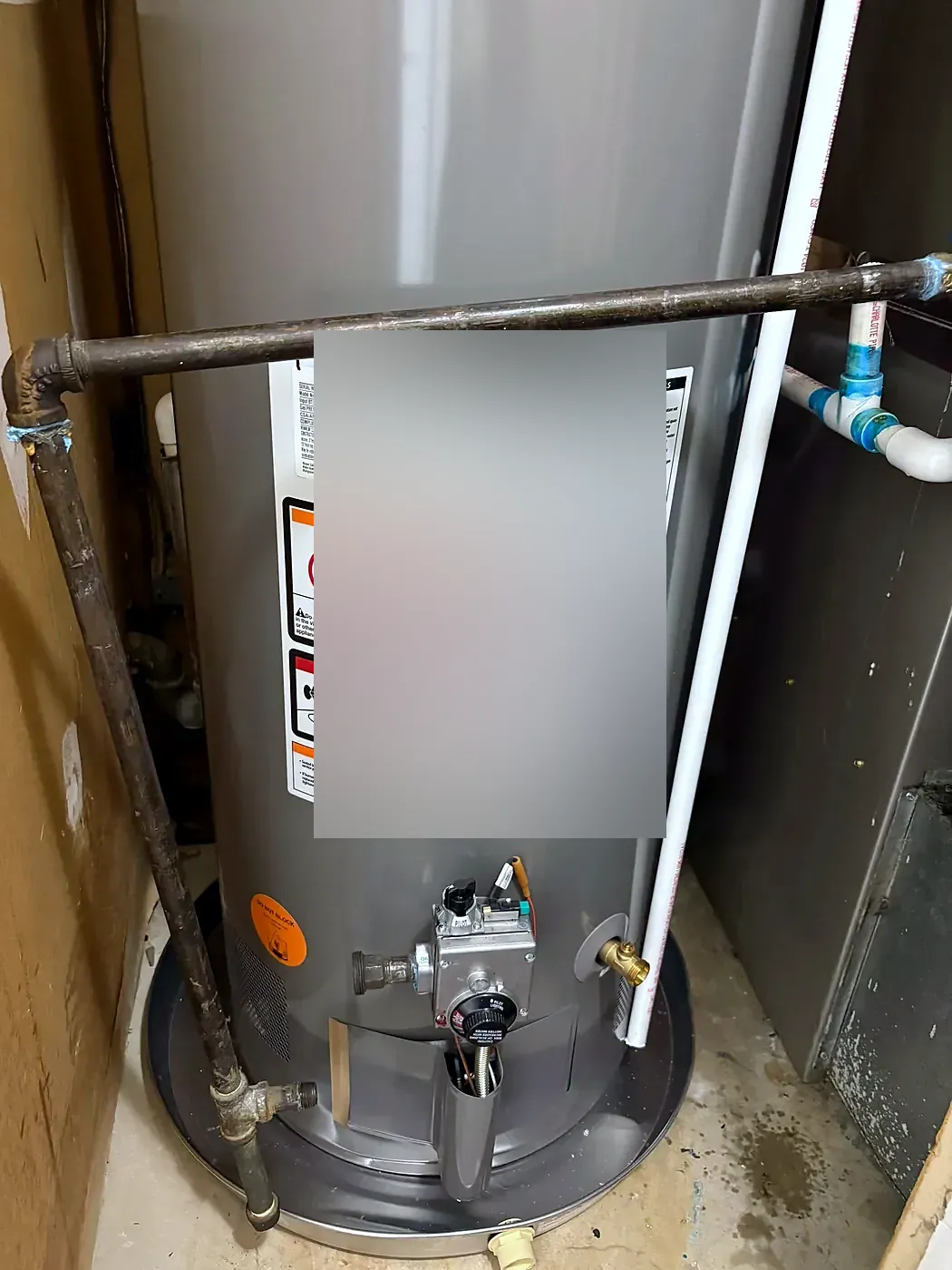
- Electrolysis — galvanic corrosion — at the connections. Where copper meets steel at the hot-side nipple with no dielectric separation, the two dissimilar metals form a small electrical cell and the less noble one eats away. Plumbers call it electrolysis; the engineering term is galvanic corrosion. Either way it shows up as a green or white crust at the joint, then as a weep above the fitting.
- No drain pan, or a pan with nowhere to drain. We have found basement floor drains taped over. A heater in a finished basement with no pan and no drain line turns a small failure into a flooring claim.
- No union at the heater. Older installs were sometimes hard-piped straight in, which means the heater cannot be isolated or pulled without cutting.
- Gas piping with no clearance. On more than one call the original installer ran the nipple so far across that the gas line rested against the heater jacket and the drip leg sat too high. That is mechanical stress on a live gas connection, and it gets corrected.
- Bonding that was never restored. Copper water piping is part of the grounding path in a lot of these houses. After anyone cuts into it — including us — the piping has to be re-bonded across the gap. We have found panel grounds landed on the heater pipe instead of the main line.
None of this is exotic. It is what a quarter-century of opening up Northern Virginia mechanical rooms looks like.
Water heater repair or replacement: how to decide
We would rather repair a heater. A repair is faster, cheaper for you, and does not involve a permit. But there are four conditions where a repair is the wrong answer, and we will say so:
- The tank is leaking internally. Water from the bottom of the jacket, or a slow weep that does not stop when every fitting is tight, means the glass lining has failed. No part fixes that.
- The nipple or fitting cannot be sealed. We drain the system and try. If the connection will not hold after that, the thread in the tank itself has gone.
- Parts cannot be sourced. Big-box heaters are a recurring problem: we have had units where the model number had rubbed off the label entirely and no supply house could identify the part. A heater we cannot get parts for is not repairable at any price.
- The unit is old enough that the repair will not pay for itself. Past roughly twelve years on a tank heater, a gas control valve or a full element-and-thermostat set is money spent on a tank that is near the end anyway.
Before we recommend replacing anything, we check the warranty. We call the supply house or the manufacturer with the model and serial number, because a tank still inside its warranty period is a very different conversation — we have replaced heaters under manufacturer warranty that the homeowner had already written off. When a repair is viable but marginal, we will tell you that too, and where we cannot warranty a repair on a unit in poor condition, we say so before you decide.
If replacement is the answer, see water heater installation and replacement for how that job runs.
What a water heater repair service call includes
- Confirm the symptom. We run the fixtures and check the actual delivered temperature rather than taking the thermostat dial at face value.
- Test the incoming water pressure with a gauge. This is standard on our plumbing calls, not an upsell. High static pressure explains an enormous share of the failures we are called out for.
- Inspect the installation, not just the appliance. Expansion tank, drain pan and pan drain, shut-off and isolation valves, dielectric separation at the connections, flex connector condition, venting, clearance and bonding.
- Diagnose the fault. On gas: attempt a relight, bleed the gas line, and test the pilot assembly and gas control valve. On electric: pull the upper and lower access plates and test both elements and both thermostats. On tankless: reset power, read the fault code, check the flow sensor, and check the inlet screen and braided supply lines for gasket debris — which we will show you when we find it.
- Show you what we found and what your options are. Including the option to do nothing yet, when that is reasonable.
- Do the work, and drain the system down properly first where the repair calls for it.
If the heater has never been flushed — and a surprising number have not been since the day they were installed — we will tell you, because sediment is quietly costing you capacity and efficiency.
Gas, electric, power vent and tankless — what's different
| Type | What usually fails | What the repair involves |
|---|---|---|
| Atmospheric gas | Pilot assembly, thermocouple, gas control valve; sediment | Relight and gas-line bleed first; control valve or pilot assembly replacement. Venting and draft get checked as part of the call. |
| Electric | Upper or lower element, thermostat, high-limit reset | Both access plates come off and all four components get tested. Elements and thermostats are usually replaceable as a set. |
| Power vent | Blower assembly, pressure switch, control board, as well as everything above | Same diagnosis as atmospheric gas plus the vent motor and its safety switch. Replacements are usually made in kind — a power vent alcove will not take a conventional unit. |
| Tankless | Flow sensor, inlet screen fouling, control module, scale in the exchanger | Power reset, fault code read, flow sensor and inlet checked, manufacturer technical support consulted where the code is ambiguous. Descaling where the exchanger is scaled. |
| Boiler / indirect | Controls, circulator, zone valves | Handled as a boiler repair rather than a tank heater call. |
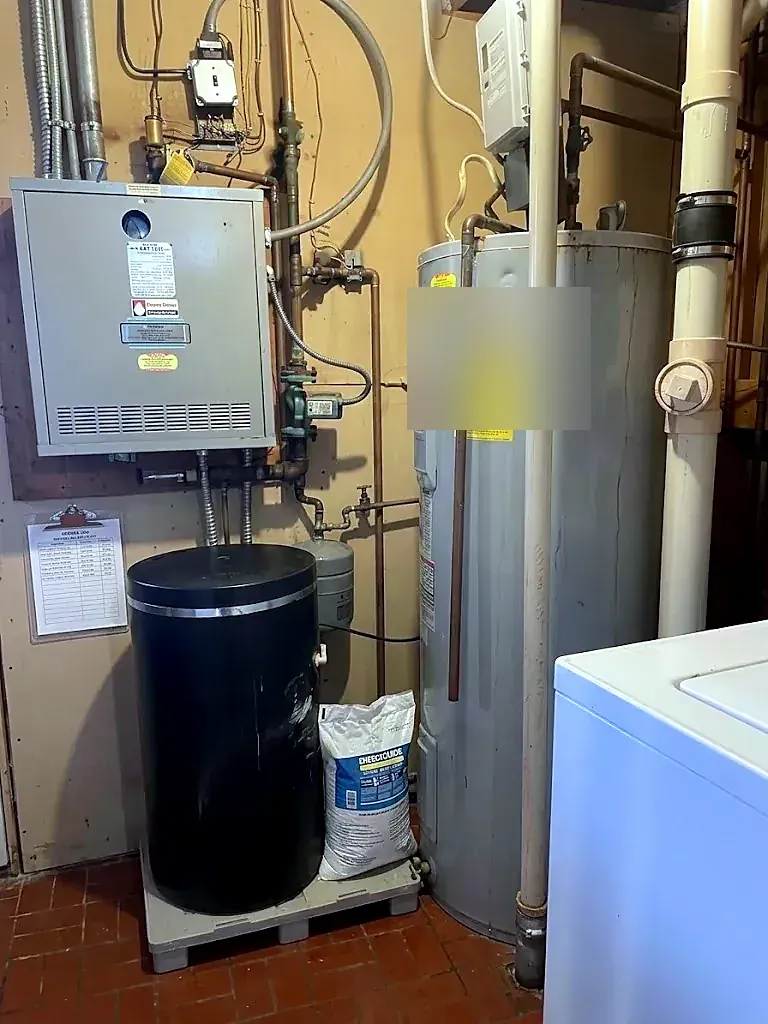
Space matters more than people expect. We have replaced heaters that had to fit an existing recessed alcove, which ruled out a power vent unit and dictated the tank size before anything else was decided. If your heater sits in a closet, an alcove or a tight crawl space, mention it when you call.
Do you need a permit to replace a water heater in Virginia?
A straightforward repair — an element, a thermostat, a gas control valve, a flex connector — does not require a permit. Replacing a water heater does, in every Northern Virginia jurisdiction we work in.
When a permit is required we pull and process it ourselves and the work is performed to the Virginia building code, with a final inspection before the job closes out. On gas replacements, some counties also require a vent or chimney certification filed before final inspection. Permit and processing fees are written into the contract, and on permitted work we hold back the final portion of payment until the inspection passes — which is how it should be, and how we have always done it.
Code also drives parts you may not have asked for. A drain pan and pan drain line, a thermal expansion tank, proper isolation valves, a sediment trap and drip leg on the gas connection, correct vent pitch and clearance, and restored bonding across any cut copper are not optional extras. If a previous installer skipped them, they get put right.
How long does a water heater last in Northern Virginia?
Three local conditions do most of the damage:
- Closed systems with no expansion control. Nearly every house on public water in this area has a pressure reducing valve at the service entry, which makes the plumbing a closed system. Without a working expansion tank, every heating cycle spikes the pressure.
- High or unregulated street pressure. When a PRV fails, the house sees full street pressure. The heater is usually not the first thing to leak, but it is often the most expensive.
- Hard water and sediment. Mineral load settles in the bottom of the tank, insulates the burner, and causes the banging most people ignore for a year before they call.
The practical consequence: a water heater repair done properly includes checking the pressure and the expansion control. See water pressure, PRVs and shut-off valves for that side of the work.
Water heater emergency: what to do before we arrive
We answer the phone 24 hours a day. If a heater is actively leaking:
- Shut off the cold water supply at the valve on top of the heater. If that valve will not turn, shut the main.
- On a gas heater, turn the gas control to OFF. On an electric heater, switch off its breaker — an electric element that fires in an empty tank destroys itself in minutes.
- If there is a hose bib on the tank and somewhere for the water to go, open it and let the tank drain down.
- Call us. Tell us gas or electric, roughly how old, and where in the house it sits.
See emergency plumber for after-hours response.
What water heater repair costs, and how we price it
We do not quote water heater prices over the phone or publish them online, because access, venting, the existing piping, permit requirements and missing code items can each change the scope once the unit is in front of us. Two heaters that look identical can differ by a vent certification, an alcove that dictates the unit, a gas line that needs relocating, missing code items from the last install, or a floor drain that no longer exists. A number given sight-unseen is either padded to cover the unknowns or it is going to change.
An estimator comes to the property, looks at the actual installation, and gives you a written price for the work in front of him — before anything starts.