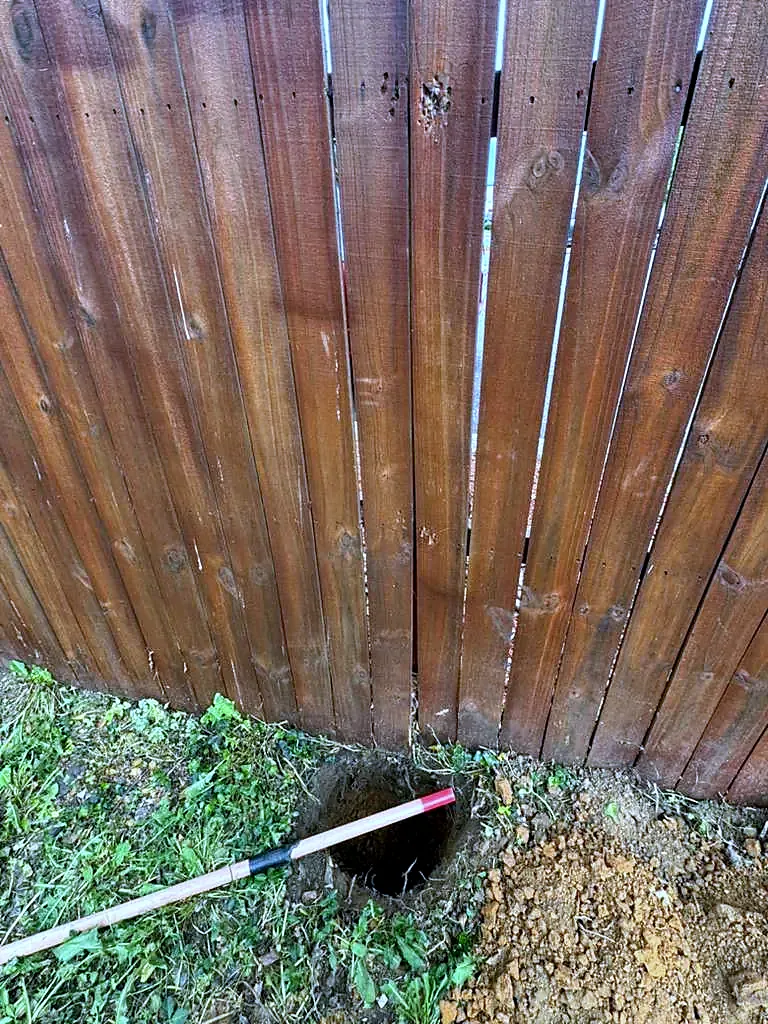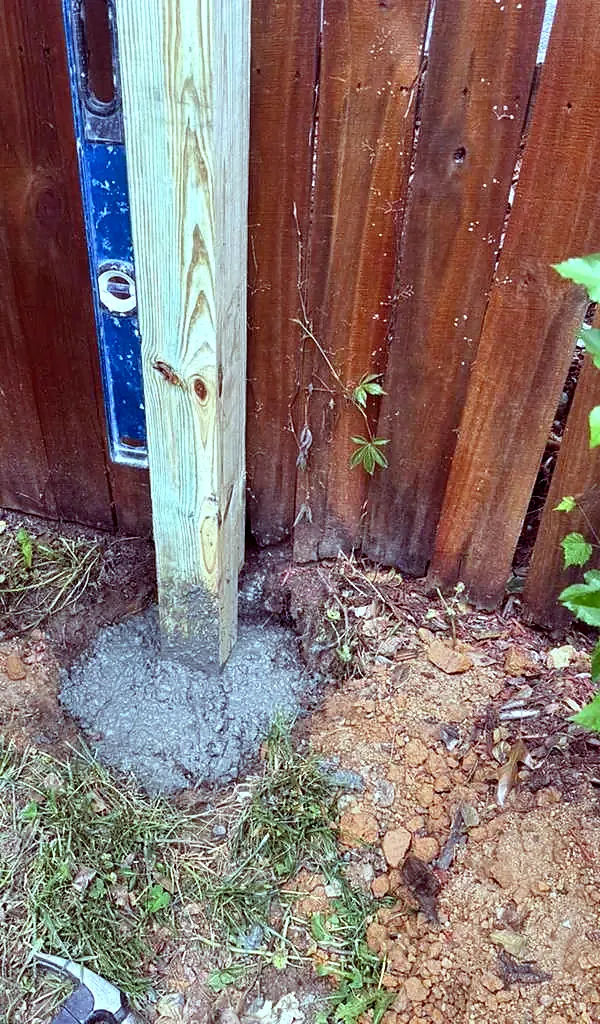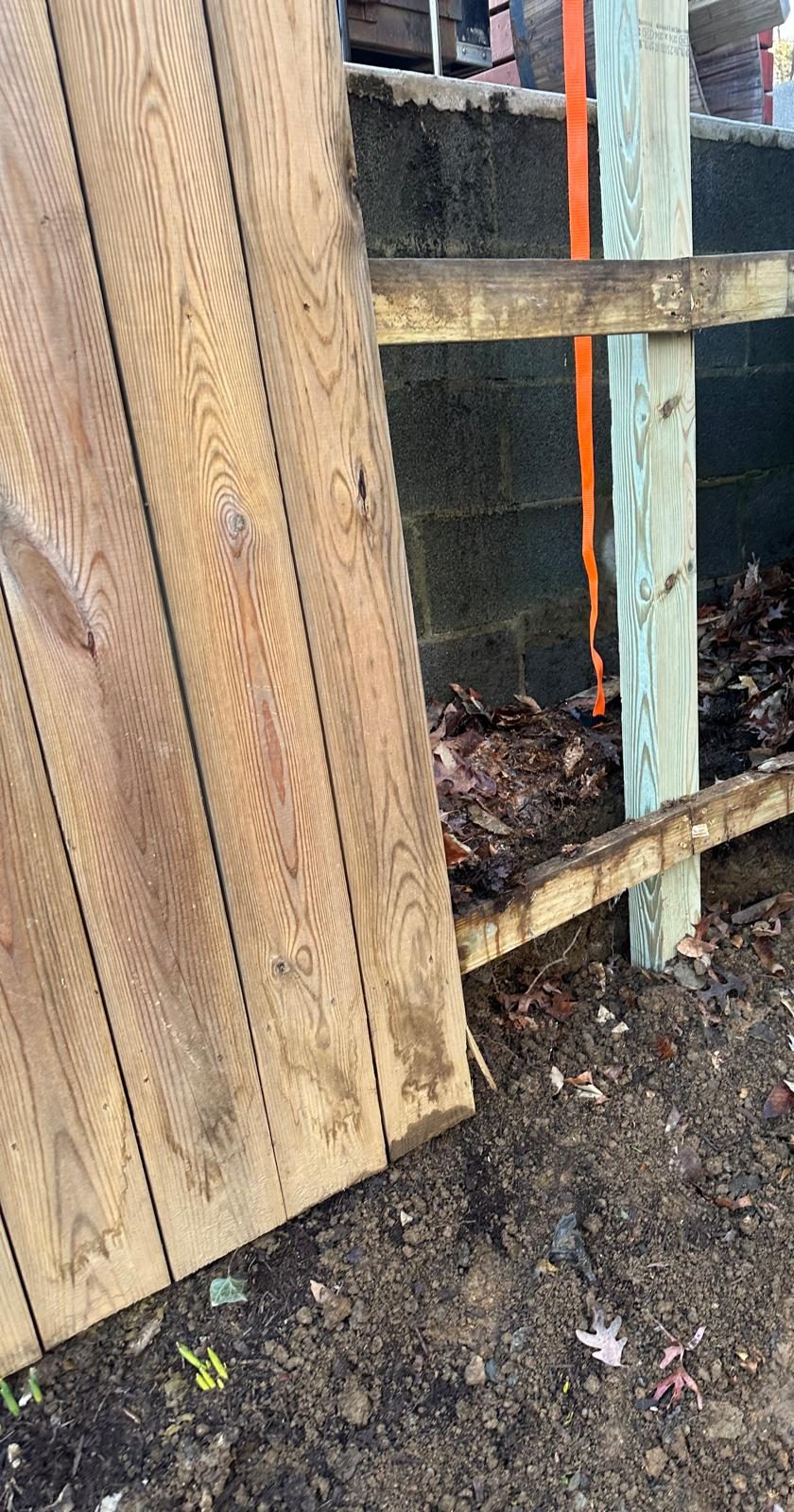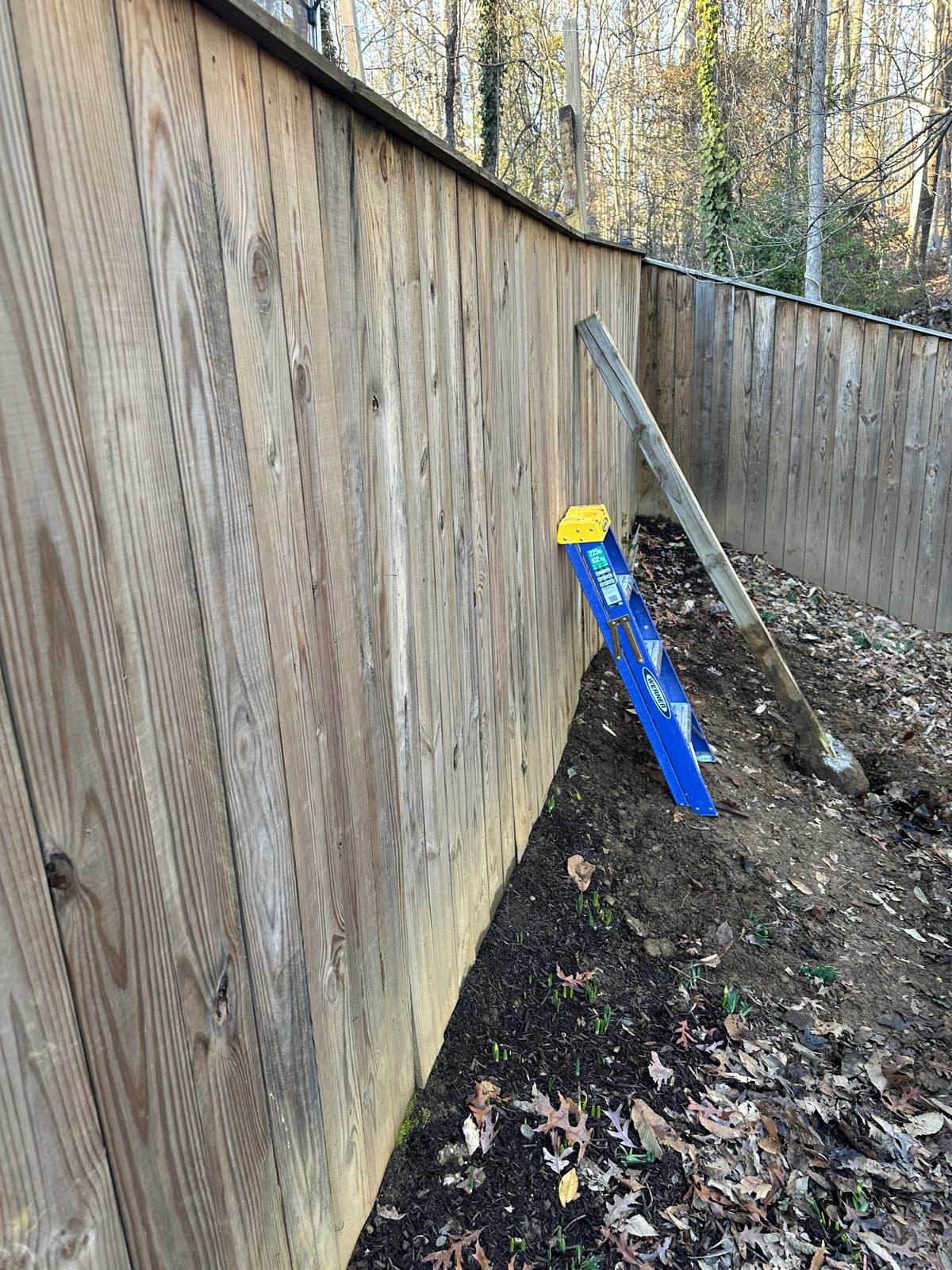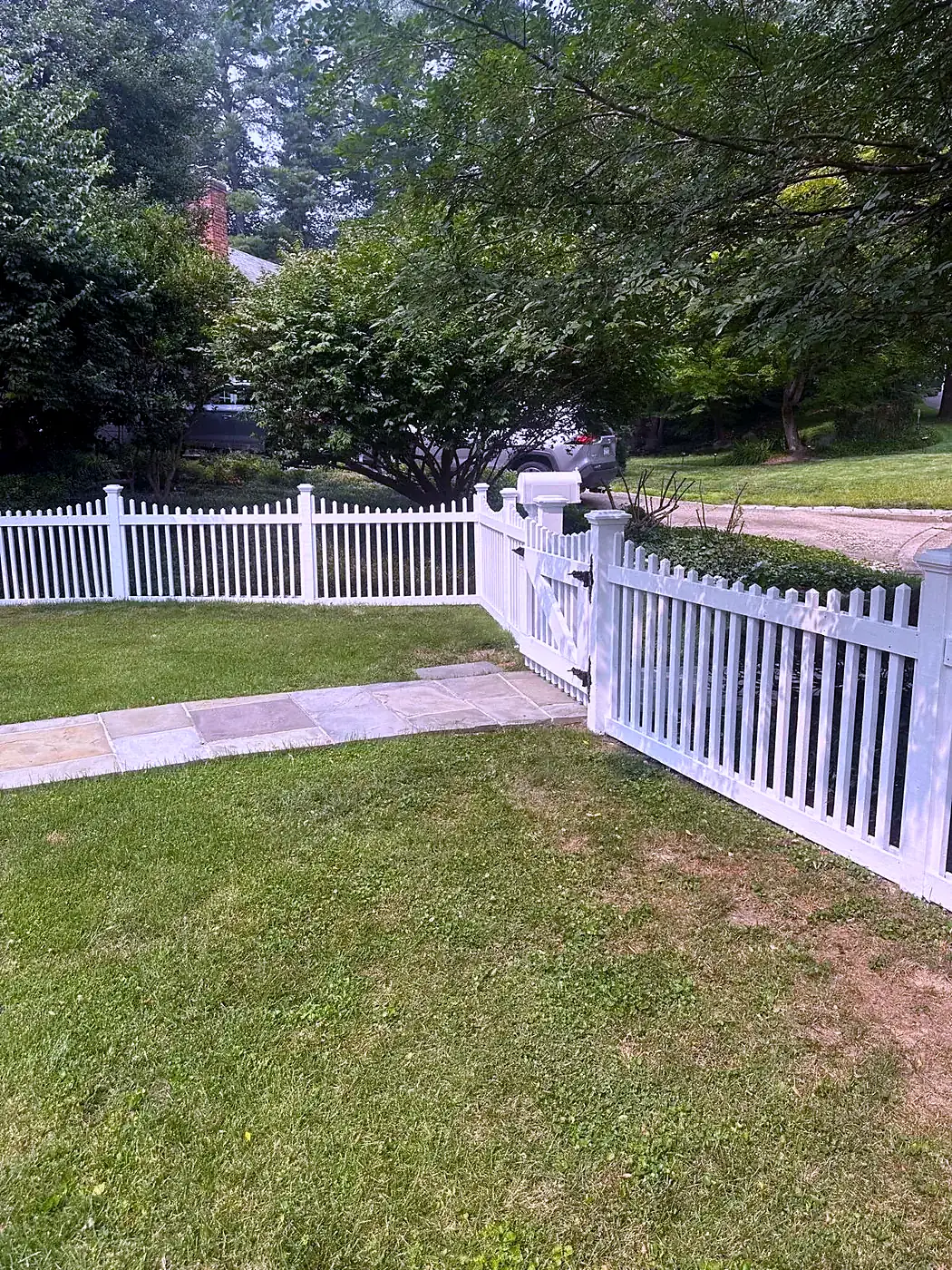
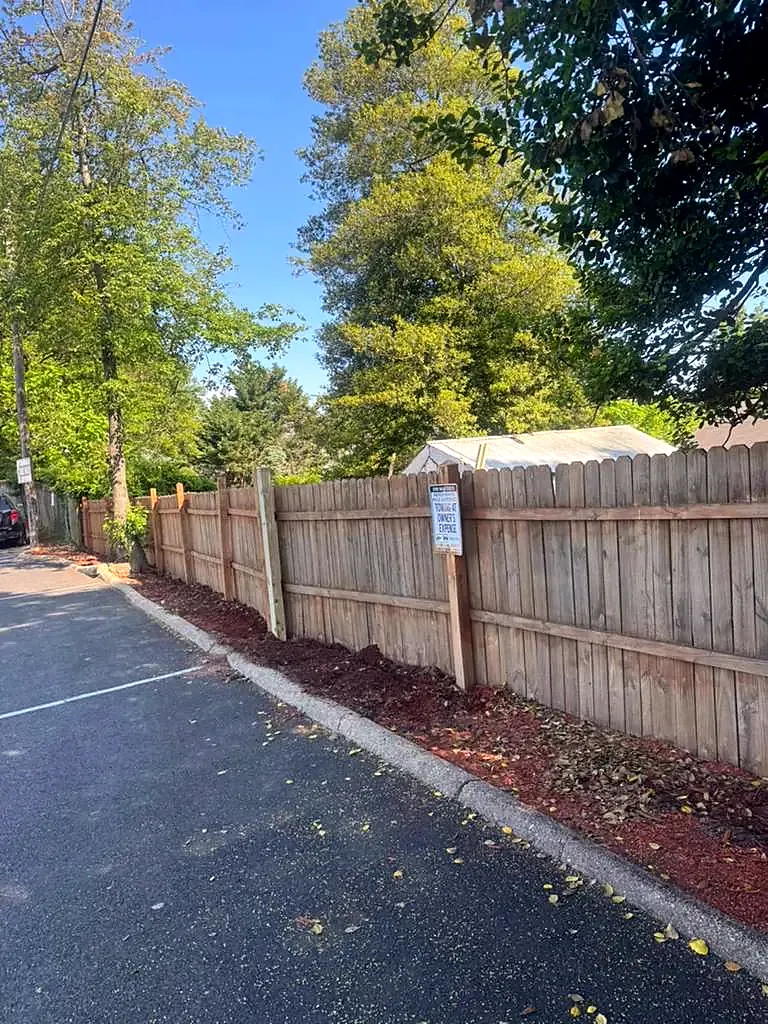
Nearly every fence failure starts underground. A post rots at grade or its concrete footing breaks up, the post leans, and the sections and gate hanging off it go out of square. That is why a sagging gate is usually a post repair rather than a hinge repair. The work is to excavate around the failed post, remove it and its old footing together, pour a new footing in minimum 3500 PSI concrete, set a new pressure-treated post, and reconnect the sections with metal brackets and galvanized fasteners.
Why a fence post leans, rots or fails
A fence post has the hardest job on the property: it holds a wind load, it sits half in soil and half in weather, and nothing above it works if it moves. These are the failures we are called out for:
- The post has rotted at ground level. The line where wood meets soil stays damp, and that is where a post goes first. The top can look perfectly sound while the base has gone.
- The concrete footing has broken up or was never big enough. We have pulled posts where the footing came out in pieces with the post still attached to it.
- The footing under a gate post has cracked. A gate post carries a swinging load every day. When the concrete beside it breaks, the post is left unsupported and out of level, and the gate stops closing.
- The post is leaning but still sound. Sometimes the ground has simply given way on one side. A leaning post that has not rotted can often be braced and re-secured rather than dug out.
- A corner post has failed. Corner posts take pull from two directions at once. When one goes, the sections on both sides and often a gate all have to be disconnected to get at it — on one job that meant taking the fence sections off one side and the gate off the other before the post could come out.
The reason we start at the posts rather than at the visible damage is simple: replacing panels on a leaning post buys you one season.
How a failed fence post and footing is replaced
There is no shortcut version of this. Setting a new post into the old broken footing, or packing dirt around a post and calling it done, is what produces the next failure.
- Disconnect the fence sections and any gate hanging on the post so nothing is torqued while the post comes out.
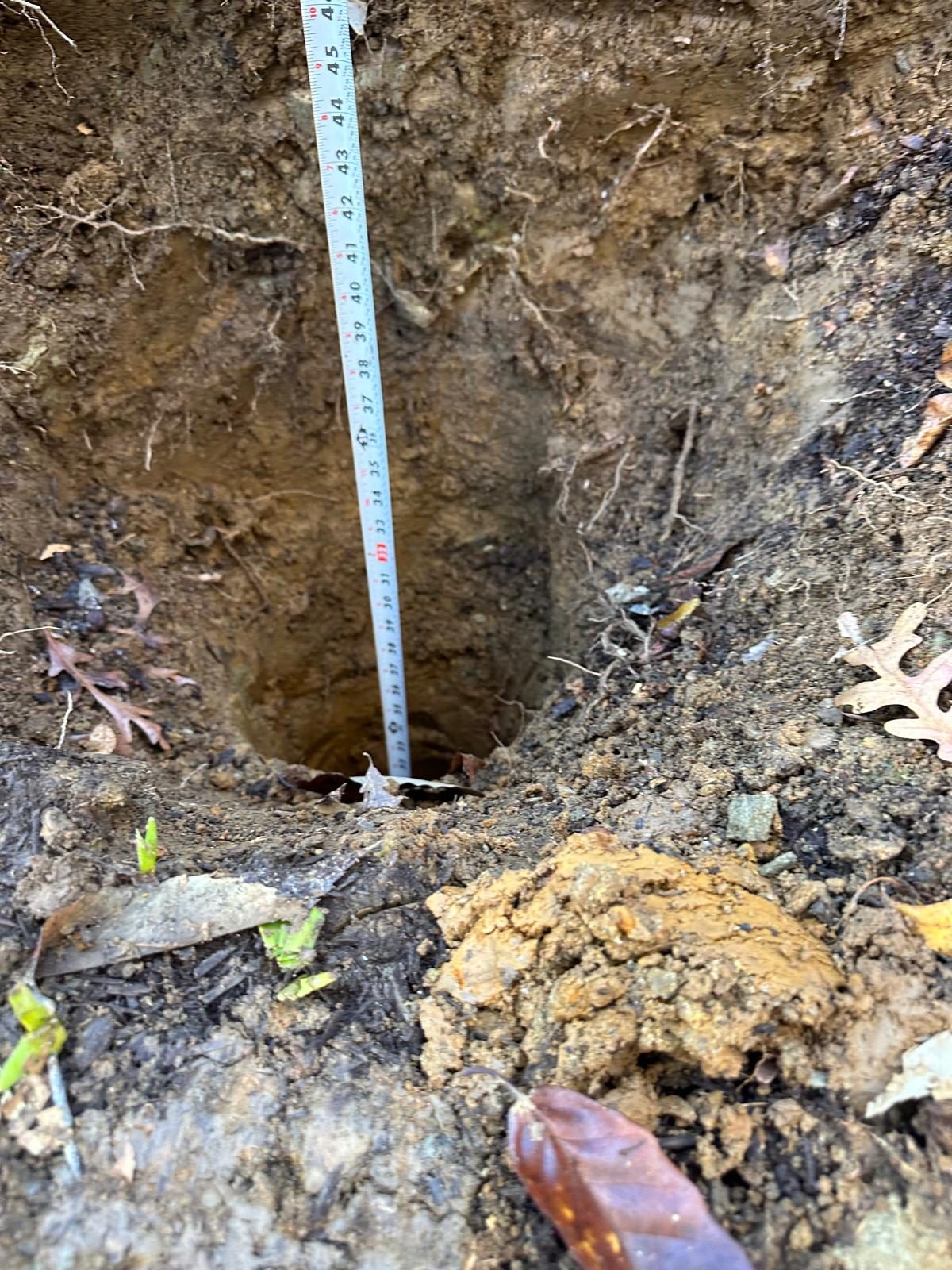
- Excavate the soil around the post and its footing, then remove the post and the old concrete together and haul both away. The old footing does not stay in the ground.
- Pour a new concrete footing in a minimum 3500 PSI mix — a 12 by 24 inch footing is typical for a fence line post, larger where a gate or corner load calls for it.
- Set the new pressure-treated post. We use pressure-treated pine, 4x4 on standard runs and 6x6 where a post carries a gate, a corner or a longer span.
- Backfill and grade the ground to fall away from the post, so water is not being delivered straight back to the thing that just rotted.
- Reconnect the sections and gate with metal brackets and galvanized nails or screws rather than whatever was there before.
Where a post is leaning but sound, the lighter repair is to brace it — 2x4 pressure-treated bracing set against the lean, with the section re-secured to it. That is a legitimate repair, not a patch, and we will tell you when a post qualifies for it.
Fence gate repair: why a gate stops closing
A gate is the moving part, so it is the part that tells you first that something has shifted. Homeowners describe it as a gate problem. It usually is not.
- The gate drags or will not latch
- Check the post before the gate. If the gate post is out of plumb, no amount of hinge adjustment will square the gate up. We level and secure the post first, then re-hang the gate to it.
- The concrete beside the gate post has broken
- This is a repair in its own right. On one job we chiseled two grooves six to eight inches long into the broken concrete, set half-inch rebar into the grooves to brace the broken piece back to the sound concrete, packed the grooves with mortar mix finished to match the existing surface as closely as possible, then leveled and secured the gate post so the gate operated again.
- The gate has come off its hinges
- Worn hinge hardware and latches are replaced rather than re-shimmed. A gate that has dropped once on tired hardware will do it again.
- Two gates on the same fence have both stopped working
- That normally points back to a failed post they share or to a corner post between them, not to two coincidental hardware failures.
Loose fence panels, rails, boards and mesh
Once the posts are right, the sections are straightforward work — and this is the part of a fence repair that makes the most visible difference.
- Missing rails are replaced and re-secured into the posts. On one job five rails were missing outright along with a failed post.
- Loose or split boards are re-fastened or replaced with 1x6 pressure-treated boards where the old ones cannot be saved.
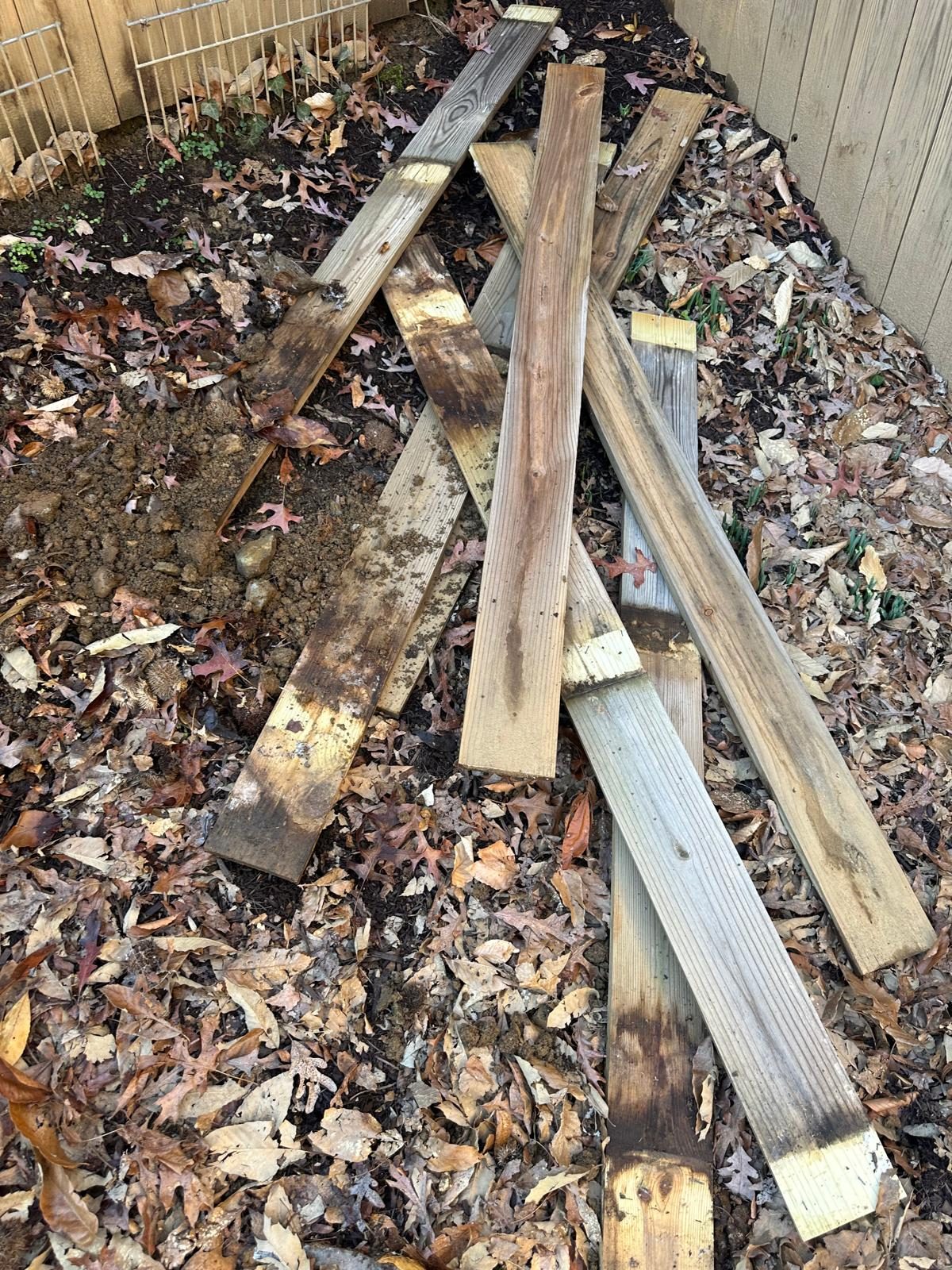
- Whole sections that have pulled away are removed, rebuilt where needed and reinstalled, tied to the posts with metal brackets and galvanized nails. On one fence six sections came off and went back with new boards where they were needed.
- Loose wire mesh is re-secured to the frame rather than left to sag, which is what lets a fence fail as a barrier even when it looks intact.
- Sections that have to come off for other work — excavation along the line, drainage correction, access for a machine — are disconnected carefully and reinstalled when the work is finished, not replaced.
Rot in the boards and rails is the same problem as rot anywhere else on the exterior of a house, and it is often found alongside it. See rotted wood and trim repair, and interior and exterior painting where the fence is to be finished afterwards.
Fence installation: what a new fence run involves
When a fence is past repairing, replacing it is a better use of money than chasing posts one at a time — and the decision usually turns on how many posts are failing rather than on how the fence looks.
A new fence run follows the same discipline as a post repair, applied along the whole line: old sections, gates and posts removed and hauled away with their footings, new footings poured in minimum 3500 PSI concrete, new pressure-treated posts set and secured, and new pressure-treated sections built and connected with metal brackets and galvanized fasteners. Gates are hung last, onto posts that are already plumb and set.
Fence installation is regularly part of a wider exterior job rather than a standalone one. We have replaced fence sections and a gate as part of a project that also took out an old shed and replaced worn decking and walkway around a pool with poured concrete — see concrete, walkway and step repair for that side of the work, and deck, porch and railing repair where a deck adjoins the fence line.
Fences, neighbors and property lines before installation
This is the part of fence work that has nothing to do with carpentry, and it is where jobs go wrong when it is skipped.
A fence sits on or beside a property line, so the line has to be settled before a post hole is dug. That is a conversation between you and your neighbor, and where a community association is involved, with them as well. A contractor cannot decide where your line is, and we will not set posts on an assumption about it.
What happens on the other side of the line matters too, because it does not stay on the other side. On one call about water entering a house at a rear corner, what we found was that the neighboring yard sat higher than the back garden and a retaining wall built on that side was steering water toward the house. Correcting it meant disconnecting a section of fence, removing part of a brick patio along the line and taking out about eight feet of that retaining wall before the ground could be regraded — then putting the fence section back. Anything on a shared line is worth discussing with your neighbor before it becomes a repair.
Fence repair where drainage and grading are the real problem
Posts rot from water, and water arrives for a reason. When we are pulling several failed posts out of the same stretch of fence, the question is what is keeping that ground wet.
The usual answers are grade that does not fall away, downspouts discharging into the fence line, and surface water from an adjoining property running along it. The code minimum we work to on regrading is a five percent drop away from the house, and downspouts get extended well clear of the foundation rather than dumped at the base of a wall or a post. If the same corner of your garden is soft every spring, that is worth fixing at the same time — see gutter repair, cleaning and downspouts and foundation, grading and crawl space repair.
Backfilling and grading to fall away from each new post is part of every post replacement we do, for exactly this reason.
Do you need a permit for fence installation in Virginia?
Straightforward fence repair — replacing a post and footing, rebuilding sections, re-hanging a gate — does not require a permit. A new fence can, depending on the jurisdiction, the height and where the line runs, and a community association may have its own approval process that is separate from anything the county requires.
Our practice is the same either way: where a permit applies we pull and process it, permit and permit processing fees are included in the price, and the work is performed according to the Virginia building code. You should never be the one finding out afterwards that something needed filing.
What fence repair and installation costs, and how we price it
We do not quote fence work by phone and we do not publish prices. One leaning post that can be braced and one corner post that has to come out with its footing, its sections and a gate are different jobs, and nobody can tell which yours is from a description.
An estimator comes to the property, walks the fence line, checks the posts at ground level and the footings under the gates, and gives you a written price for the work before anything starts. Sam & Sons Services has worked across Northern Virginia since 1999 under Virginia DPOR license #2705070610, and you can reach us at (703) 256-8080.