A hidden water leak is found by elimination, not by guesswork. We test the toilets, the shut-off valves and every faucet, photograph the water meter and re-read it after a hold period to see whether water is still moving with the house shut down, and rule the underground service line in or out. Only then does anything get cut, and in the smallest opening that reaches the pipe. Most interior leaks turn out to be a copper pinhole, a failed material transition, or a fixture quietly running.
Signs of a hidden water leak in your house
Nobody calls us and says “I have a pinhole in a three-quarter-inch copper riser.” They call about one of these:
- A water bill that jumped with nothing about the household changed. The source is usually several small losses at once, not one dramatic one.
- A stain that dries out and comes back. Water travels along joists and pipe runs, so the stain marks where it fell through, not where it came from.
- Water seeping up through a basement floor. On one evening call that was the waste pipe under a vanity, separated at a corroding metal slip nut.
- Damp that only appears when something runs. A ceiling that wets when the upstairs shower is used points at a fixture or a drain, not a pressurized line.
- A green or white crust on copper. Hard water and dissimilar metals both leave a visible deposit before they leave a hole.
- A musty smell with nothing visible. We have opened ceilings and found a boxed-in dead space holding water quietly.
- Something intermittent you cannot catch. One homeowner had put a paper towel under the kitchen sink because the drip only happened sometimes. That towel was the best evidence on the job.
How leak detection works — finding the leak before opening a wall
Leak detection is elimination run in a fixed order, so nothing is cut open on a hunch:
- Read the water meter, then read it again. We photograph it and re-read after a hold period with the house shut down. A reading that has not advanced rules out a continuous leak, including the buried service line.
- Test every toilet. A silently running fill valve or a bowl siphoning through the overflow tube loses more water than most visible drips.
- Test every shut-off valve and supply line — angle stops under sinks, toilet stops, laundry, refrigerator and dishwasher valves. On high-bill calls we routinely find several failing at once.
- Test every faucet, inside and out, including hose bibs, which can drip behind the wall rather than out of the spout.
- Check the water heater connections for the crust of electrolysis where dissimilar metals meet, and for weeping above a fitting.
- Gauge the water pressure. A failed pressure reducing valve is the most common reason a house has several leaks at the same time.
- Only then open drywall, at the lowest point the water has reached, and work back — photographing what is behind the opening before it closes.
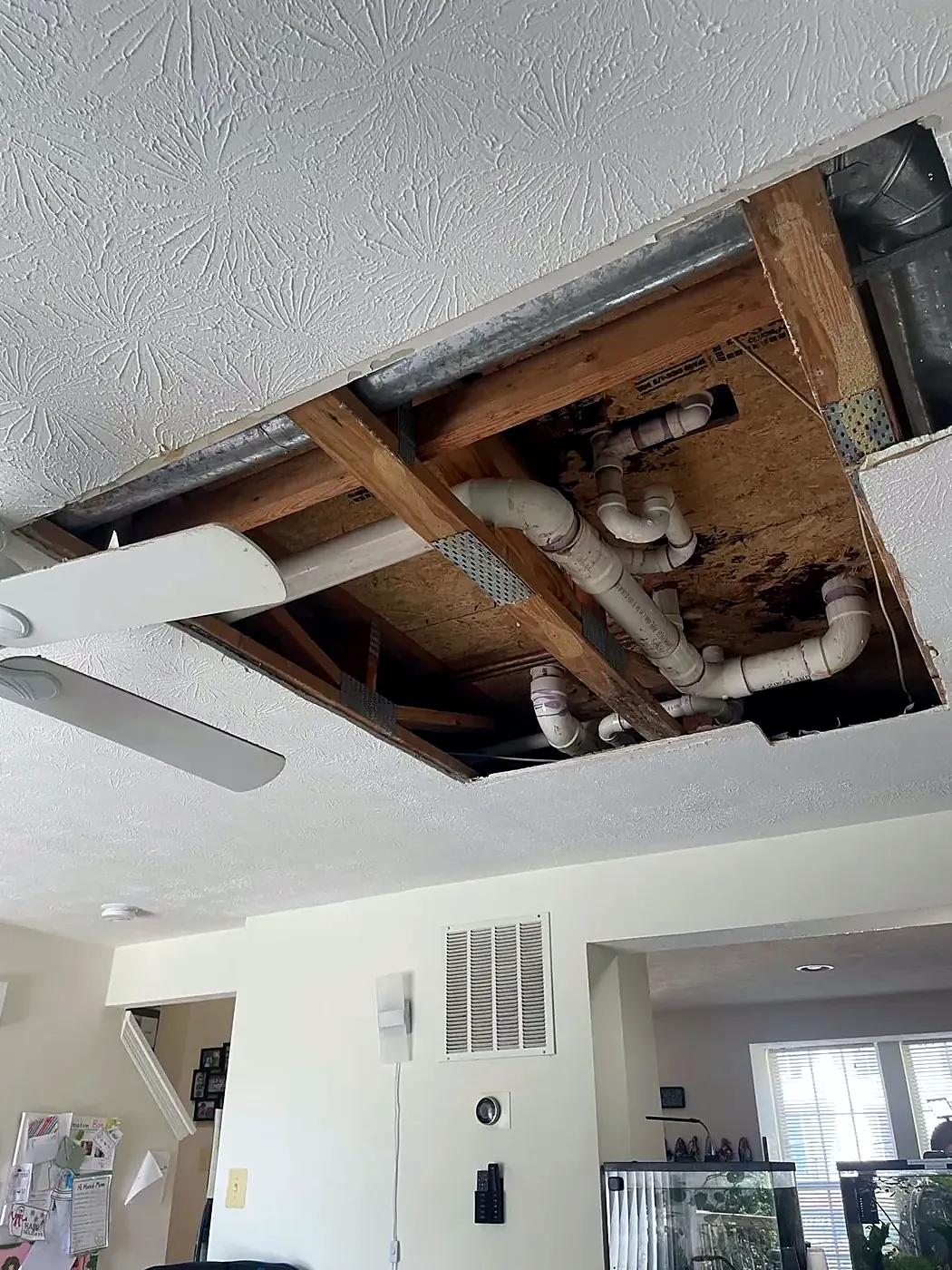
On one call the ceiling was opened, the upstairs faucet run, and water appeared down the back of the tub: the tub and shower faucet was the source, and the supply piping was never the problem. On another, there was no water line in that ceiling bay at all — the leak was at the bowl bolts of the toilet above.
Why a copper pipe leaks
- Water pressure
- When the pressure reducing valve at the service entry fails, the house sees street pressure. On one leak search a three-quarter-inch line had failed in three separate places, along with several shut-off valves and both angle stops at two sinks — all from one failed valve. See water pressure, PRVs and shut-off valves.
- Electrolysis at dissimilar metals
- Where copper meets a steel or brass fitting with no dielectric separation, galvanic corrosion works the joint from inside — a crust at the connection, then a weep above it.
- Hard water
- We have found green corrosion developing along a three-quarter-inch main line purely from the mineral load in the supply.
- Material transitions
- Copper to CPVC, PVC to brass to copper. Transitions fail more often than straight runs, and one made without the correct fitting fails sooner.
- Saddle valves
- The clamp-on taps used for humidifiers and ice makers are a standing leak risk, and we replace them with quarter-turn valves whenever we find them.
- Unsupported pipe
- Lines never strapped move, rub and work their joints. Where we open a ceiling, hot and cold lines get strapped as code requires before it closes.
- Freezing
- A freeze split looks nothing like a pinhole — see burst and frozen pipe repair.
Is it a supply leak or a drain leak?
A supply leak runs all the time, because the line is under pressure whether anyone is home or not. A braided supply line that let go in an upstairs bathroom flooded a house and took down the kitchen ceiling before anyone reached the main.
A drain or waste leak only runs when something is used — after a shower, a wash cycle, a flush. Behind that symptom we have found separated waste piping, a closet flange sitting below the finished floor so the wax ring never sealed, a cracked main stack, and shower pans whose membrane had failed and was wetting the framing below. In one case dining room ceiling damage was coming through the shower floor, and patching the ceiling alone would have achieved nothing.
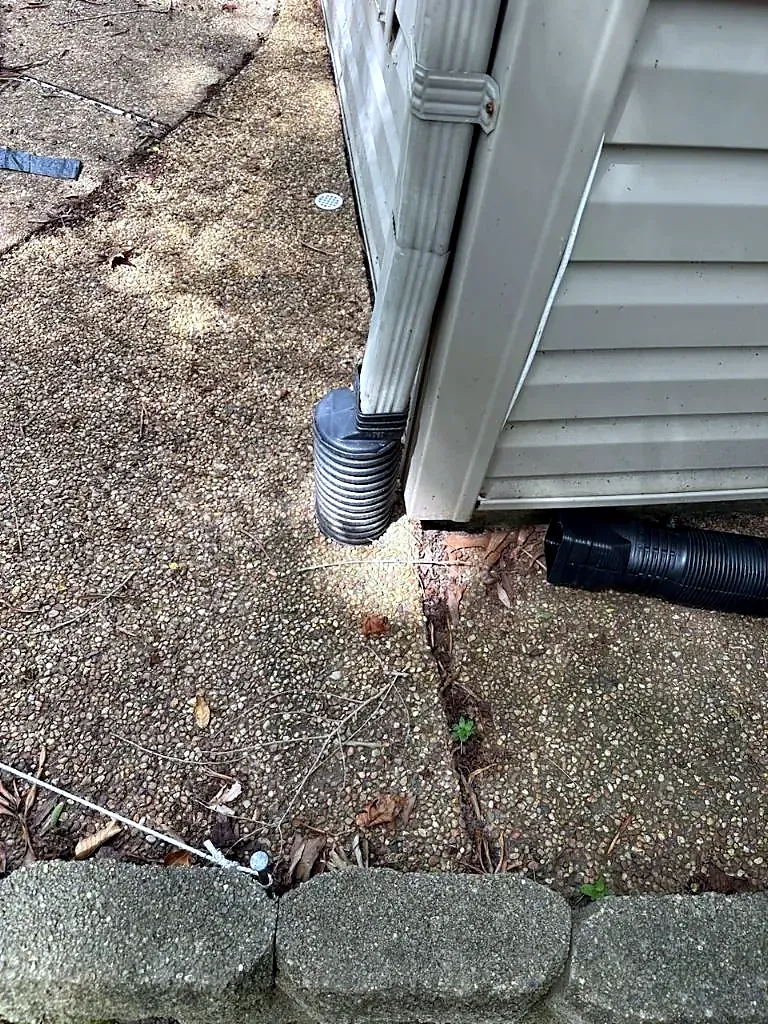
And some water is not plumbing at all. We have traced interior damage to failed chimney flashing, deteriorated plumbing vent boots, missing flashing above a sliding door, an unflashed door threshold, grading that ran toward the house, and condensation on a heating line inside a wall.
What a pipe repair actually involves
- Isolate and drain the system down. Almost no copper work happens on a live line, and if the main shut-off will not hold — a lot do not — that valve is dealt with first.
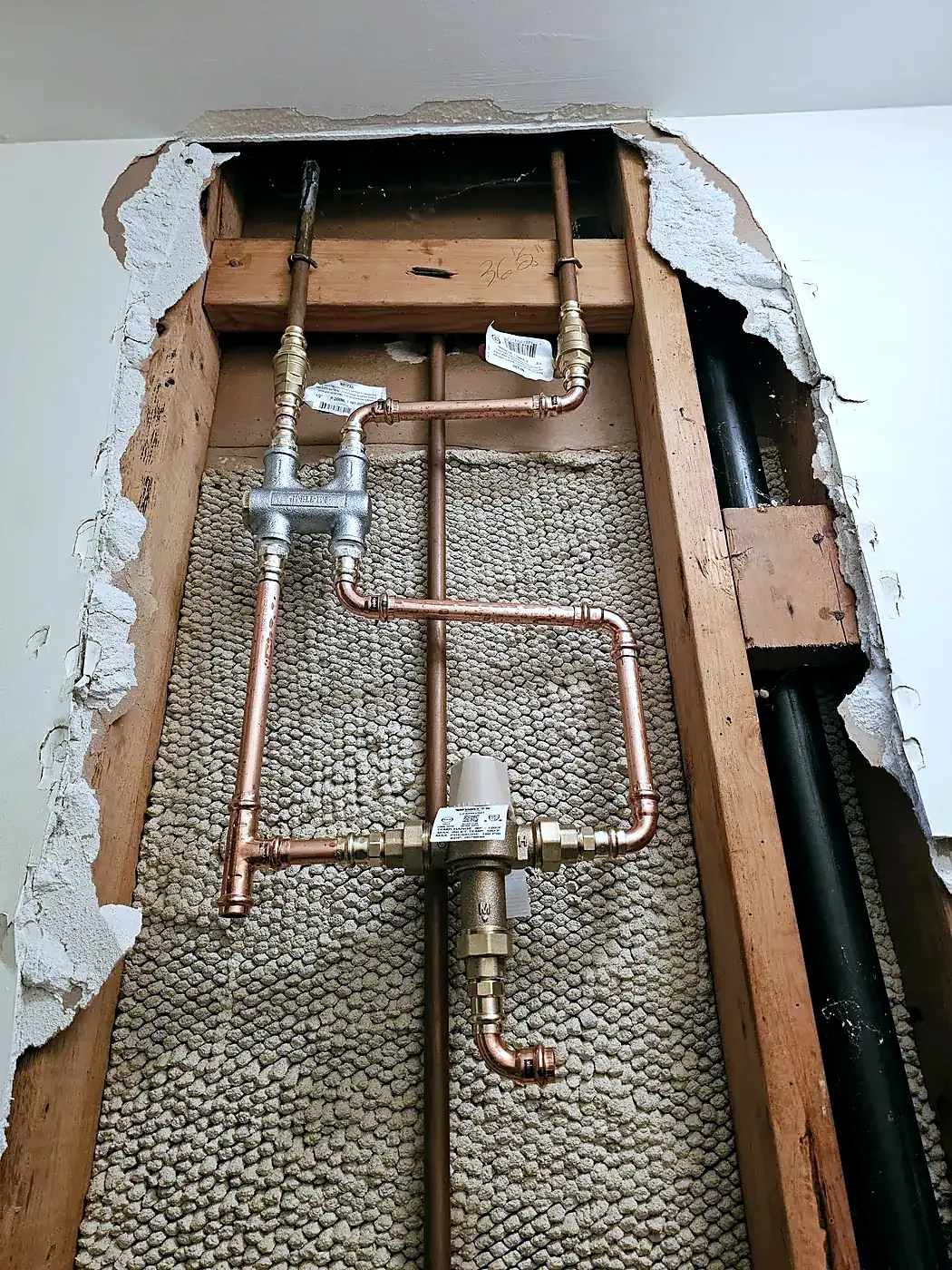
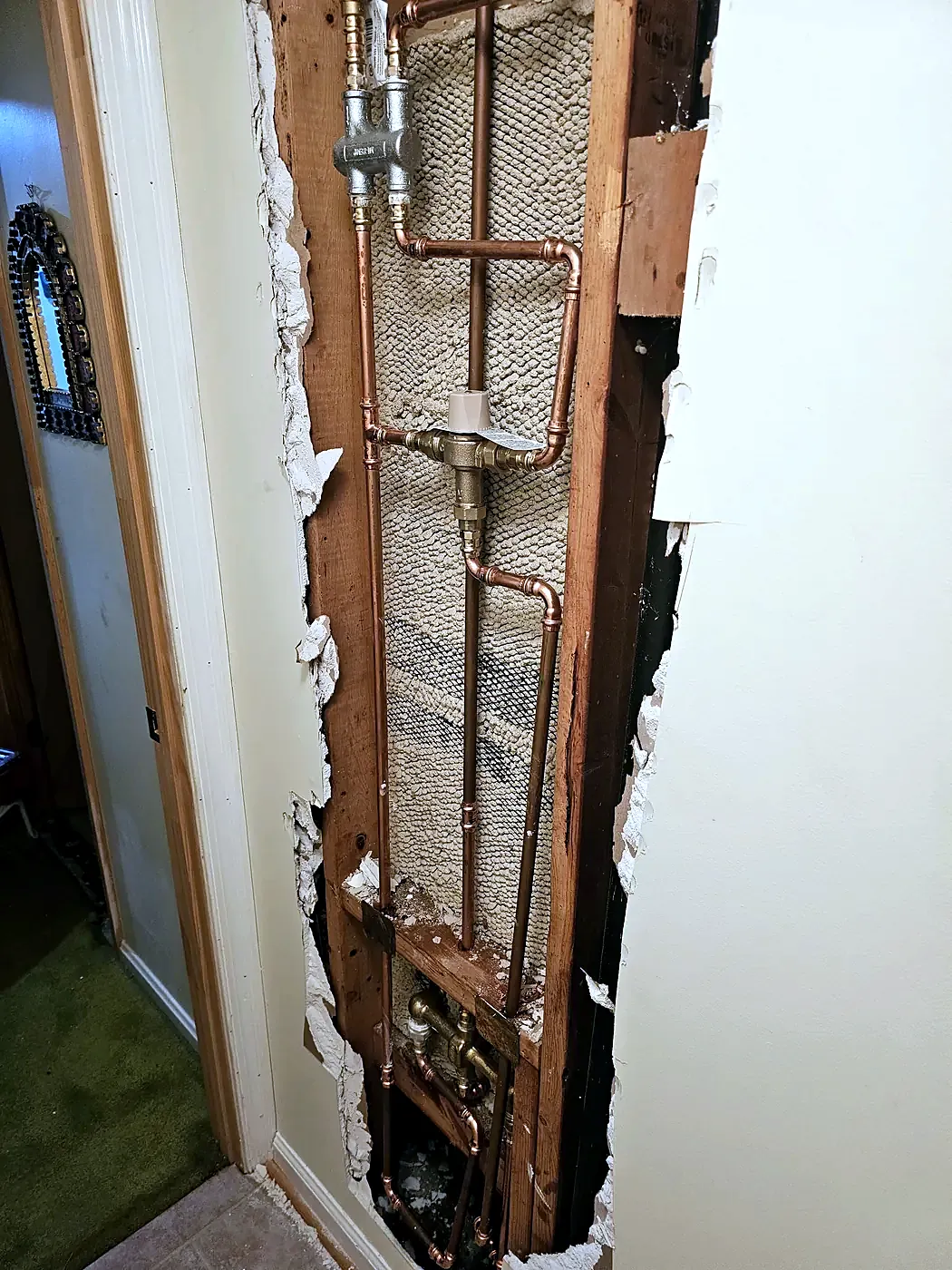
- Open the smallest access that reaches the pipe: sometimes a hole in a basement ceiling corner, sometimes four to five feet of wall because the split runs.
- Cut out the failed section and replace it in copper, sized to the existing run rather than reduced.
- Add what should have been there — isolation valves with bleeders ahead of a finished ceiling, pipe strapping, a sleeve where a line passes through framing, insulation where the run sits against a cold exterior wall.
- Refill and test the whole system, not just the repair. More than once refilling has revealed a second failure elsewhere.
- Show you the failed section before it goes in the truck.
Pipe repair behind walls and ceilings: what gets put back
The plumbing is often the smaller half of the job. Restoring the room is the other half, and it is where a lot of contractors hand you a hole and a phone number.
- Dust tents go up and furniture, flooring and electronics are covered before anything is cut.
- Damaged drywall is removed and hauled away, and the open cavity inspected for mold and further damage.
- Concrobium Mold Control is applied, and exposed joists and studs sealed with stain-killer primer so old water tannins do not bleed through new paint later.
- Lost insulation is replaced, and cavities against unconditioned space are insulated rather than left as found.
- New half-inch drywall goes in glued and screwed, then taped, blocked, skimmed and sanded ready for paint.
Rotted subfloor under a failed pan or fixture is cut out and replaced before anything new goes down. See drywall and ceiling repair and shower leak repair.
What causes a high water bill when you can't see a leak?
In our contract record a high bill with nothing visible is rarely one big leak. It is an accumulation.
- Toilets. A worn flapper, a fill valve held open by debris, or a bowl siphoning through the overflow. On one call the debris was the disintegrating washer from the toilet’s own shut-off valve.
- Failing shut-off valves and supply lines weeping behind cabinets nobody looks at.
- Washing machine valves and hoses, left closed where no machine is connected.
- Outside hose bibs, including one where the hose had simply been left connected over the winter.
- Saddle valves on humidifier and ice-maker lines.
- A buried service line — the one that has to be ruled in or out properly. On one high-bill job the meter re-read cleared the underground line; on another, outside testing indicated the house may still have had an underground leak, which is a different job: water service line replacement.
Do you need a permit for pipe repair in Virginia?
More often than homeowners expect. We pull and process plumbing permits for pipe repairs routinely — partial copper replacements, valve replacements, re-routes — and the work is performed to the Virginia building code with a county inspection after completion. On permitted work we hold back the final portion of payment until that inspection passes.
One code item genuinely surprises people. In a lot of Northern Virginia houses the metal water piping forms part of the building’s grounding path, so when it is cut for any reason continuity has to be restored across the gap with a bonding jumper or clamp. We have found a panel ground landed on a water heater pipe instead of the main line, which does not do the job it was installed to do.
What pipe repair and leak detection cost
We do not quote pipe repair by phone and we do not publish numbers, because the same symptom can be two entirely different jobs. A ceiling stain can be a supply-line swap under a sink or eight feet of copper behind a finished wall with drywall, insulation and paint to follow.
An estimator comes to the property, runs the diagnosis, shows you what was found and gives you a written price before any work starts. For water coming in now rather than later, see emergency plumber.